Complete J1772 charger guide. Compatible vehicles, real charging speeds, adapter compatibility with NACS, home installation tips, and troubleshooting.
The SAE J1772 is the five-pin round connector on every non-Tesla home EV charger sold in North America since 2010. If you have plugged your EV in at a hotel, a workplace parking lot, or a friend’s house, you almost certainly used a J1772 plug. It does not get the headlines that NACS or CCS do, but it does the unglamorous daily work of charging the majority of American EVs at a slow, steady pace.
This guide covers what J1772 can and cannot do, why the standard still matters during the NACS transition, real charging speeds you should expect at home, and how to keep your J1772 home charger useful long after you upgrade your car.
Already know J1772 is your plug? Skip to our top charger picks.
We tested the best J1772 Level 2 chargers for Ford, Chevy, Nissan, Hyundai, Kia, BMW owners and more J1772 supported EVs. See which one fits your lifestyle, budget, vehicle onboard charger, and amp service before you read the full guide.
See Best J1772 Chargers →SAE J1772 (Type 1) Physical and Electrical Specifications
- Connector Standard: SAE J1772 (Type 1)
- Primary Region: North America and Japan
- Physical Port Strategy: AC-only connector that requires CCS1 expansion pins for DC fast charging
- Max AC Delivery: Up to 19.2 kW (single-phase AC)
- Max DC Delivery: Not supported
- Communication Protocol: PWM analogue signalling
What J1772 Is and Where It Came From
The plug is named after the SAE J1772 standard published by the Society of Automotive Engineers, which is why every documentation source insists on the full SAE J1772 name, even though nobody ever uses the SAE prefix in conversation. The current revision of the standard dates back to 2010, with minor updates since. then
Internationally, this same connector is called Type 1, which can be confusing when reading European documentation. Type 1 and J1772 are the same plug. In the United States, Canada, and Japan, we call it J1772. In Europe and Australia, the equivalent specification is called Type 2 and uses a different physical layout, which is why this is called Type 1.
The standard was created to solve a simple problem. Before J1772, every electric vehicle manufacturer used its own proprietary plug, which meant your Nissan Leaf could not charge at a Ford charging station, and vice versa. SAE J1772 forced interoperability, any J1772 plug works with any J1772 inlet, period.
What J1772 Does and Does Not Do
This is the most important section in this guide and the one most other articles get wrong. J1772 is an AC-only standard. It cannot perform DC fast charging. It was never designed to. If you need DC fast charging, you need either CCS Combo 1, which extends J1772 by adding DC pins underneath, or NACS, which replaces J1772 entirely.
On the AC side, J1772 is genuinely capable. The standard supports up to 80 amps at 240 volts, for a total of 19.2 kilowatts of charging power. Almost no real-world station delivers that much, partly because almost no car can accept it, but the standard has the headroom.
In typical home use, you will see one of three power levels. Level 1 charging uses a standard 120-volt outlet and delivers about 1.4 kilowatts, adding 3 to 5 miles of range per hour. Level 2 charging at 32 amps on a 240-volt circuit delivers 7.7 kilowatts, adding 25 to 30 miles of range per hour. Level 2 charging at 48 amps on a 240-volt circuit delivers 11.5 kilowatts, adding 35 to 40 miles of range per hour.
Most modern EVs cap out at 48 amp AC charging because the onboard converter cannot handle more. The exceptions are a few luxury models and commercial vehicles. If your car maxes out at 32 amps, paying for a 48-amp charger is wasted money. Check your owner’s manual before you upgrade.
SAE J1772 Connector
The SAE J1772 connector features a distinct physical design and pin configuration, facilitating safe and efficient charging. Contrary to common misconceptions, J1772 chargers can deliver impressive charging speeds at residential and public charging stations.
The SAE J1772 connector, also known as the J plug or Type 1 connector, is a standard for electric vehicle connectors in North America, supporting AC Level 1 and AC Level 2 charging.
Level 1 chargers are slower, typically plugged into standard household outlets, and provide 1.3 kW to 2.4 kW of power, taking up to 24 hours for a full charge. They come with electric vehicles and offer up to 140 miles of range for 20 hours of charging. Level 1 chargers are easily accessible in residential areas and incur no additional costs.
Level 2 chargers, on the other hand, offer faster charging rates ranging from 3 kW to 19 kW, providing 18-28 miles of range per hour and fully charging a battery in 8 hours or less, charging 3 to 7 times faster than Level 1 chargers. These chargers are often found at public charging stations but can also be installed in homes for faster charging.
| Feature | Level 1 Charger | Level 2 Charger |
|---|---|---|
| Voltage | 120 VAC | 208-240 VAC |
| Max Current | 16 A (1.9 kW) | 80 A (19.2 kW) |
| Power Output | Slow | Faster |
| Typical Use | Home | Public stations, home (optional) |
| Charging Time (for 250-mile range) | Up to 24 hours | 8-10 hours |
| *Cost (charger) | Included with EV | Separate purchase |
What Does a J1772 Connector Look Like?
The J1772 connector, also known as the J-Plug or Type 1 connector, is circular, with a diameter of approximately 60 mm (2.36 inches) and five pins.
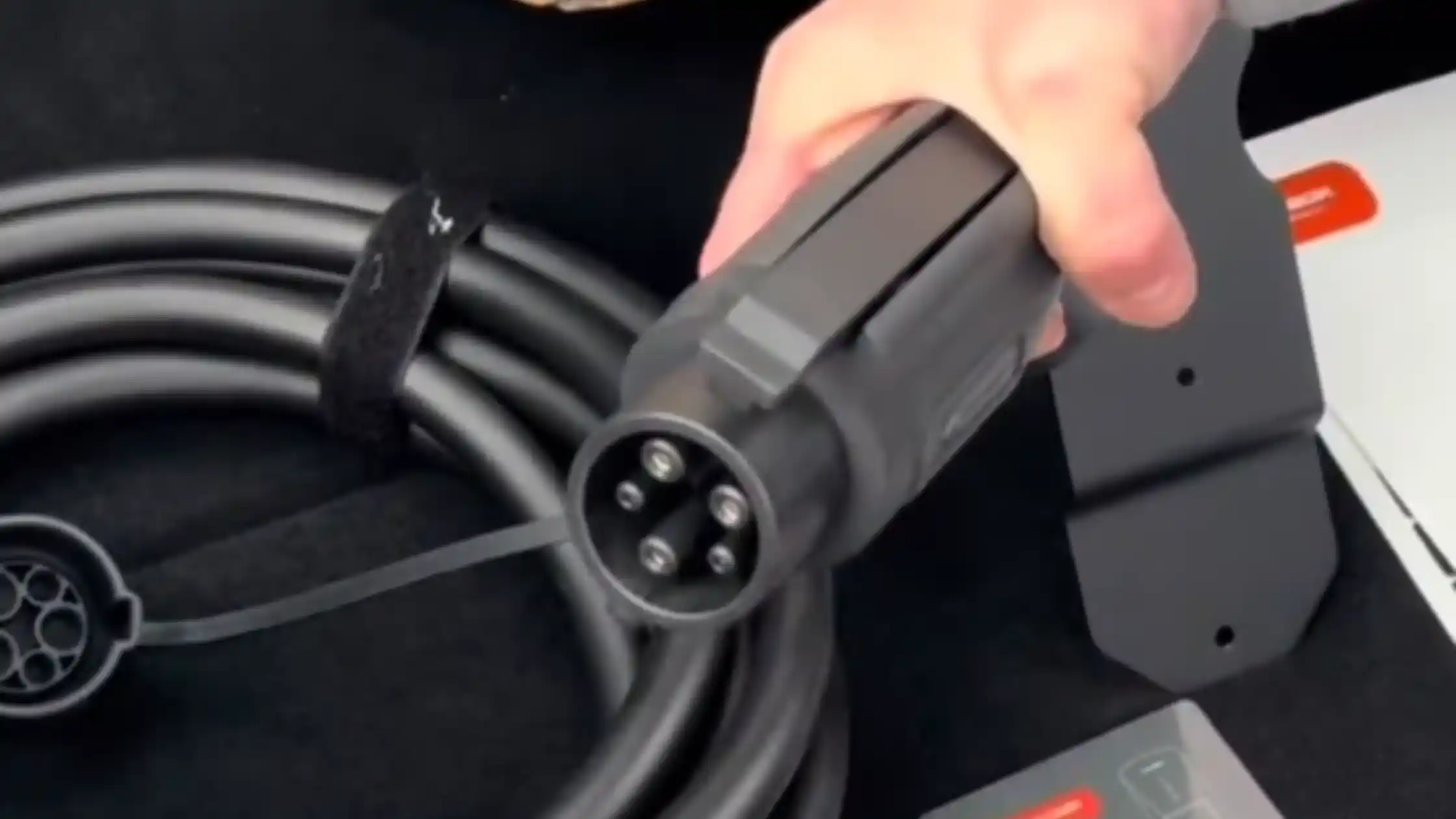
The housing is thermoplastic, while the pins are copper alloy with silver plating. It has a voltage rating of 120V-250V AC, a current rating of up to 80A, and a power rating of up to 19.2kW. The connector operates over a temperature range of -30 °C to +50 °C (-22 °F to +122 °F) and can withstand up to 10,000 mating cycles. It includes a manual locking mechanism with a thumb release button for safety.

What Is the Purpose of the J1772 Connector Pins?
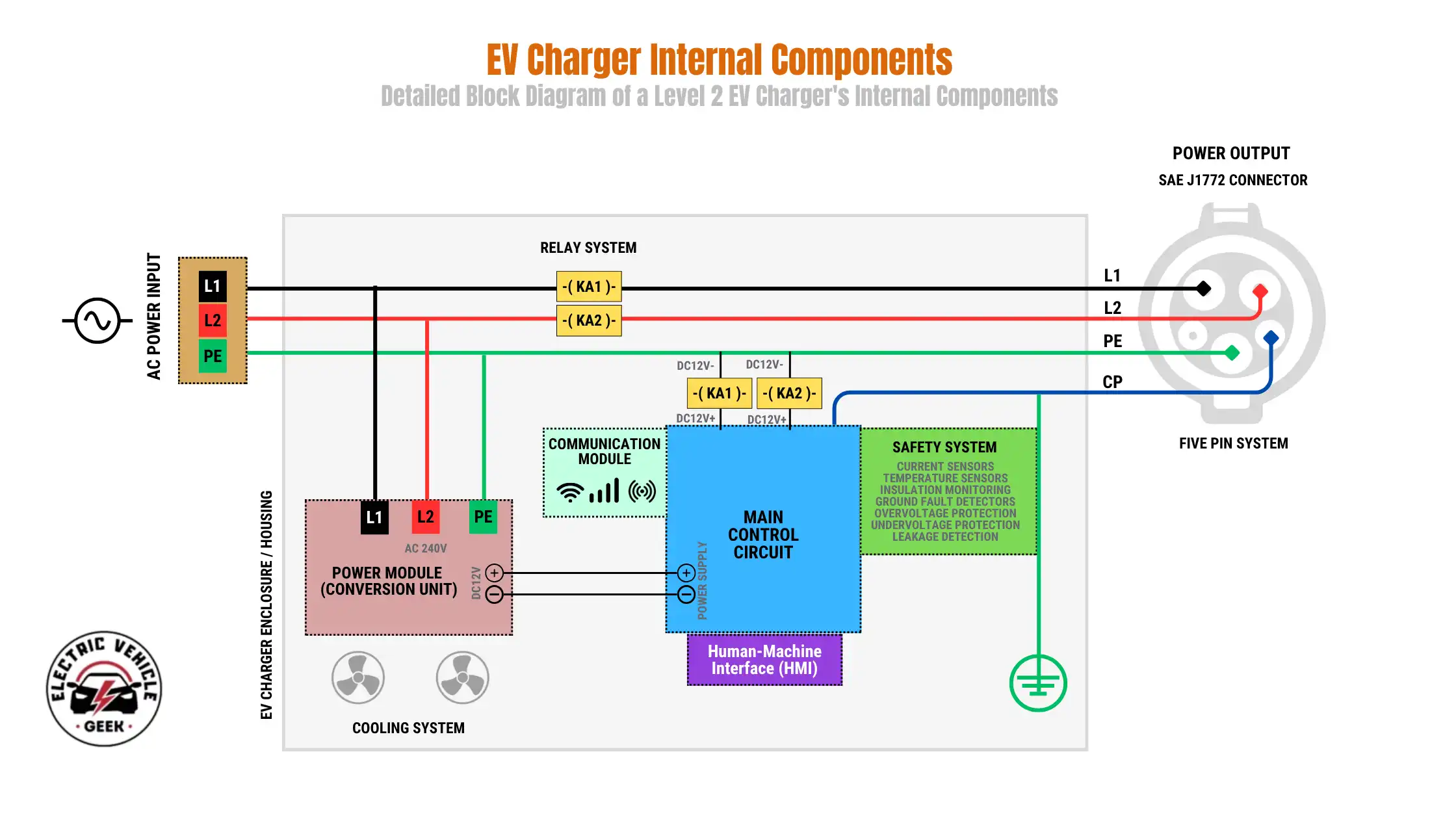
SAE J1772 Connector charger features five pins: 3 large power pins (L1, Neutral, PE) and two smaller signal pins (PP, CP). The purpose of the J1772 connector pins is to enable safe, efficient AC charging for electric vehicles. Here’s a breakdown of their functions:
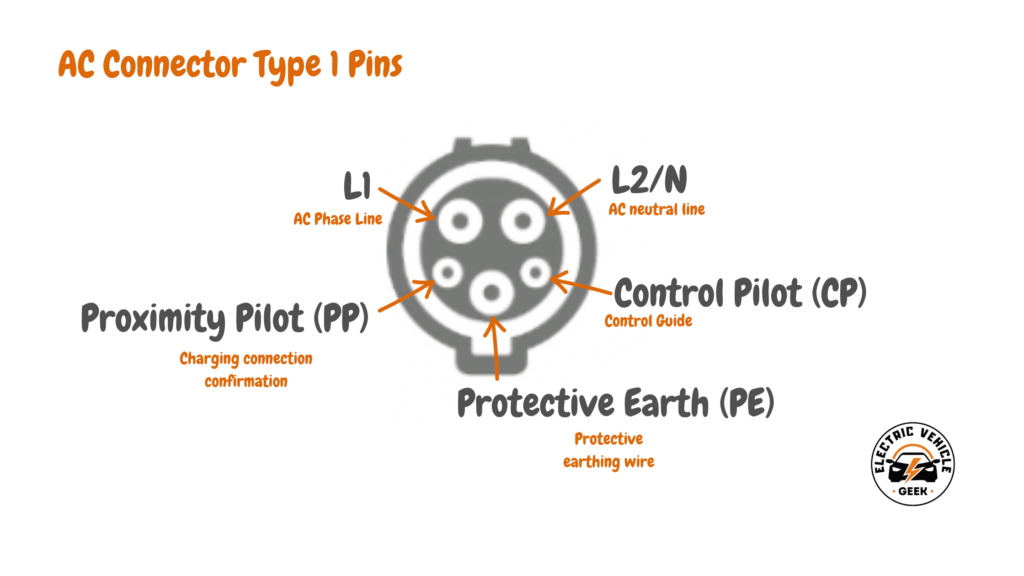
Large J1772 Connector Power Pins:
- L1 (AC Line 1): With a diameter of 9.5mm, it delivers AC power from the charging station to the vehicle.
- Neutral (N): Also 9.5mm in diameter, it provides a return path for the AC.
- PE (Protective Earth/Ground): An 8.0mm diameter ensures electrical safety by grounding the connection and preventing shock hazards.
Small J1772 Connector Signal Pins:
- PP (Proximity Pilot): 3.0mm in diameter, it detects the presence of the connector and enables communication between the EV and the charging station.
- CP (Control Pilot): Also 3.0mm in diameter, it facilitates communication between the EV and the charging station to manage charging parameters like current and voltage.
Which Vehicles Use J1772
Before the 2025 NACS transition, almost every non-Tesla EV sold in North America came with a J1772 port for AC charging.
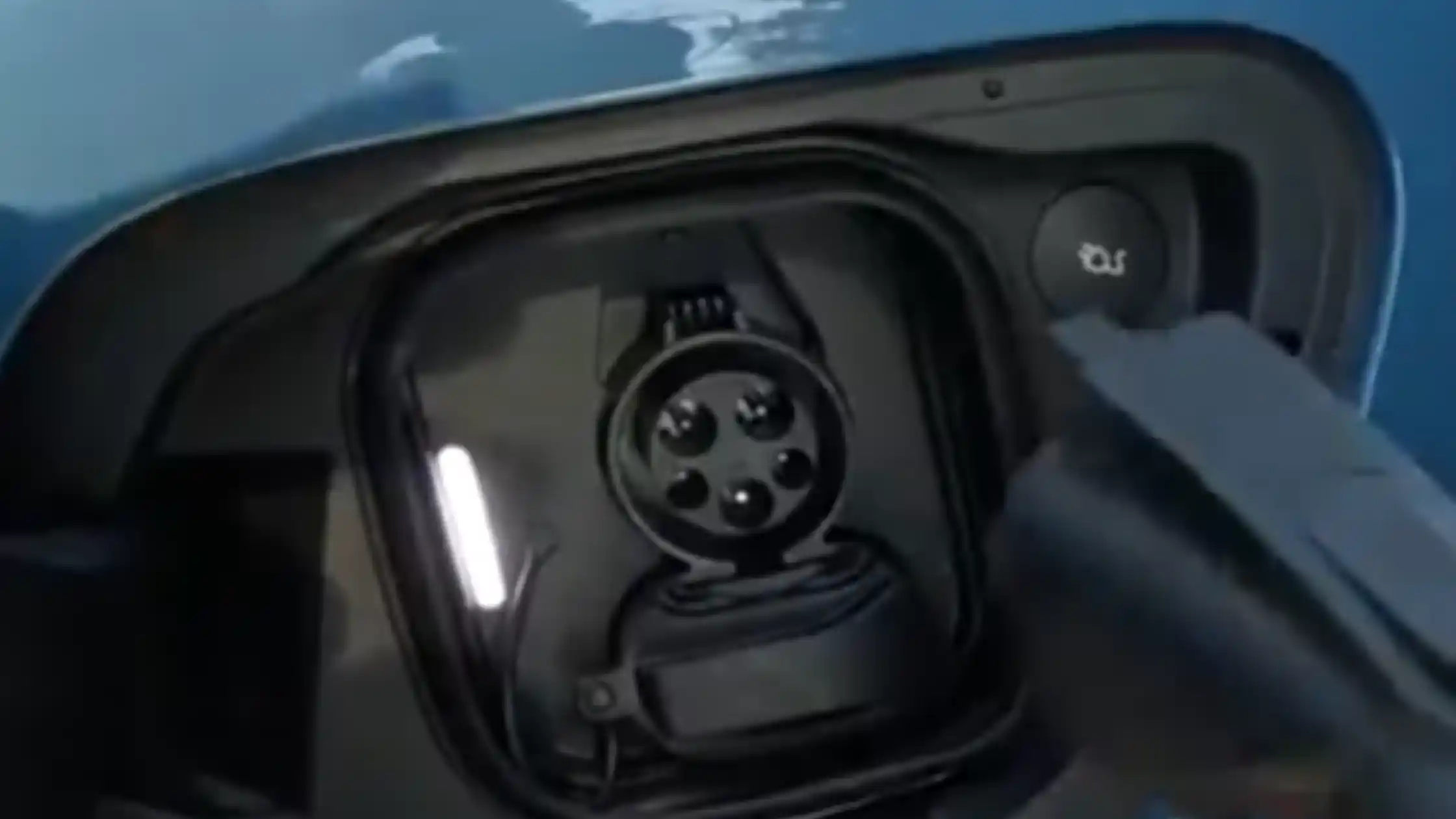
Vehicles with CCS1 also use J1772 since the CCS1 plug includes a J1772 portion at the top. Here is the comprehensive list.
| Brand | Models With J1772 Inlet | Notes |
| Ford | Mustang Mach-E, F-150 Lightning, Focus Electric (2012 to 2024) | Switched to NACS in 2025 |
| GM | Chevy Bolt, Volt, Spark EV, Cadillac ELR (2012 to 2024) | Switched to NACS in 2025 |
| Nissan | Leaf (2010 to 2024), Ariya (2022 to 2024) | Switched to NACS in 2025 |
| Volkswagen | e-Golf, ID.4 (all years through 2026) | Still J1772/CCS1 |
| BMW | i3, i4, iX, X5 PHEV (2014 to 2025) | Switching to NACS in 2026 |
| Hyundai | Ioniq Electric, Ioniq 5, Kona EV (2017 to 2024) | Switched to NACS in 2025 |
| Kia | Soul EV, Niro EV, EV6 (2015 to 2024) | Switched to NACS in 2025 |
| Honda | Clarity Electric, Prologue (2017 to 2024) | Switched to NACS in 2025 |
| Toyota | RAV4 EV, bZ4X (2012 to 2024) | Switching to NACS in 2025+ |
| Audi | e-tron, Q4 e-tron (all years) | Still J1772/CCS1 |
| Mercedes | B-Class Electric, EQ lineup (2014 to 2024) | Switching to NACS in 2025+ |
| Volvo | XC40 Recharge, C40 Recharge (2021 to 2024) | Switched to NACS in 2025 |
| Tesla | Model S, 3, X, Y (with J1772 adapter) | NACS native, ships with an adapter |
The Main Challenges Facing SAE J1772 Charger Adoption.
Outlined below are some of the challenges facing SAE J1772 charger adoption today:
Incompatibility of Devices
While the widespread adoption of the J1772 standard is undeniable, the Tesla Supercharger network poses a significant obstacle. Tesla’s exclusive charging infrastructure, incompatible with J1772, creates interoperability challenges for non-Tesla electric vehicles. Despite Tesla’s plans to open certain segments of its network to other EVs via CCS chargers, concerns persist regarding network fragmentation and the seamless integration of alternative charging systems.
International Compatibility
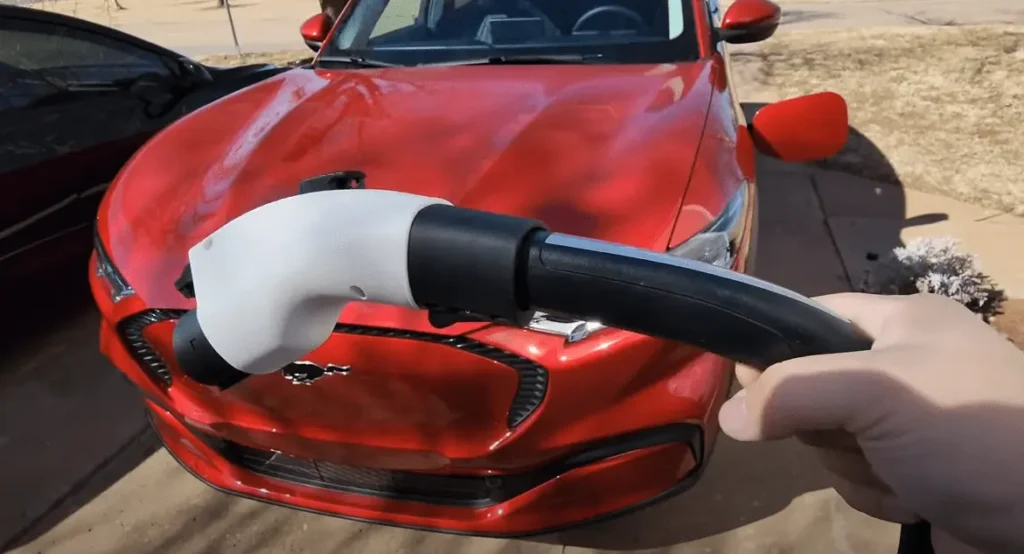
J1772’s incompatibility with European (Type 2) and Asian (GB/T) standards complicates international travel for EV owners. Adapters or specialised chargers are necessary for cross-border journeys, adding complexity and inconvenience. Efforts to harmonise charging standards globally could alleviate this challenge and promote smoother EV adoption worldwide.
Limited Implementation of Safety Features
Some J1772 chargers lack essential safety features, such as diode checks and the “Vent Required” state, which monitor grounding integrity and detect overheating in EVs. This deficiency compromises safety during charging sessions, potentially exposing users to electrical hazards. Rigorous enforcement of safety regulations and standards is imperative to ensure uniform compliance and bolster consumer confidence in J1772 infrastructure.
Quality and Reliability Issues
Substandard J1772 chargers pose reliability and safety risks, including malfunctions and overheating. Quality assurance measures, including stringent testing and robust quality control protocols, are essential to weed out inferior products and uphold the integrity of the charging ecosystem.
Overheating Issues
J1772 chargers overheating, even at currents below their rated current, underscores concerns about thermal management and component quality. Addressing these issues necessitates enhanced design standards, improved materials, and rigorous performance testing to mitigate the risk of overheating-related incidents.
Deployment Cost
The high cost of installing J1772 charging infrastructure presents a barrier to widespread adoption, particularly compared to more superficial Level 1 charging solutions or proprietary networks. Lowering installation costs through technological innovation, streamlined permitting processes, and targeted incentives could facilitate the expansion of J1772 charging networks and make EV ownership more accessible.
Cost of Ownership
The upfront cost of J1772 chargers may deter individuals and businesses from investing in home or public charging solutions. Lowering the barrier to entry through subsidies, tax incentives, and innovative financing mechanisms could incentivise greater adoption of J1772-compatible charging infrastructure, driving the proliferation of EVs and supporting sustainable transportation initiatives.
Bypassing Regulations
The proliferation of devices that circumvent J1772 and National Electrical Code (NEC) regulations poses significant safety risks and undermines the integrity of the standard. Robust enforcement mechanisms, including stringent certification processes and penalties for non-compliance, are necessary to deter the use of non-compliant equipment and safeguard consumers against potential hazards.
Safety Certifications That Matter
Any J1772 home charger sold in the US should carry UL 2594 certification for the station as a whole and UL 2251 for the connector itself. The control box should also list compliance with NEC Article 625, which governs electric vehicle charging equipment.
For outdoor installation, look for an IP54 rating or better on the station housing and an IP44 rating or better on the connector. IP54 means dust-protected and splash-resistant from any direction, which is the minimum you want for a garage that occasionally sees rain blowing in.
ENERGY STAR certification is a nice bonus. It means the unit has been tested for low standby power draw, which matters if you have multiple chargers or your unit sits idle 90% of the time.
Integration with smart grids and renewable energy sources:
Future iterations of J1772 infrastructure may incorporate advanced features to facilitate seamless integration with smart grids and renewable energy sources. Bidirectional charging capabilities and dynamic pricing mechanisms could enable EVs to serve as grid resources, enhancing grid stability and promoting the utilisation of renewable energy.
How J1772 Locks and Why Theft Anxiety Is Overblown
The J1772 plug has a mechanical latch on top of the handle that engages a small ledge on the carport. The driver presses a button on the handle to release the latch when unplugging.
Here is the catch. Nothing is stopping a stranger from walking up and pressing that button. At home, this rarely matters. At a public station, it is a real annoyance because someone can unplug your car and plug in their own.
The fix is a small plastic ring lock that you can buy for under twenty dollars. It slides over the latch button while the plug is connected, preventing the button from being pressed without a key. Multiple brands sell them. They are worth the money if you ever charge in shared parking lots.
Some newer J1772 ports also include a vehicle-side electronic lock that engages during the session. Check your owner’s manual to see if your car has this feature.
J1772 to NACS Adapters and the Path Forward
If you own a J1772 home charger and just bought a NACS vehicle, you need a J1772-to-NACS adapter. Most NACS vehicles ship with one in the trunk from the factory. Ford, GM, Rivian, Hyundai, Kia, and Tesla all include the adapter as standard equipment.
If your vehicle did not include one, the manufacturer sells them separately for $50 to $100. UL-listed third-party options exist from Lectron and A2Z EV. Avoid the unbranded Amazon adapters priced under $30. They sometimes work but offer no safety guarantees and no warranty if they damage your car.
The adapter is purely mechanical. It does not change anything electrically. The J1772 plug physically reshapes into the NACS port shape, and the signalling pins on each side line up correctly. Your charging speed remains the same as it would on a native NACS connection.
Common J1772 Problems and Solutions
Latch Trigger Stuck or Broken
The thumb latch is the single most failure-prone part of the J1772 design. After thousands of insertions or a single bad drop onto concrete, the plastic latch can crack or stick. If yours is stuck closed, gentle pressure with a small flathead screwdriver usually frees it. If it is broken, the cable is essentially done. Replacement plug heads are available, but they are rarely worth the labour cost on a consumer unit.
Charging Stops Randomly
Almost always a loose connection at the wall, not the plug itself. Check that the NEMA 14-50 plug is fully seated in the outlet. Check that the outlet is rated for continuous EV charging. Many older RV outlets are not. If the outlet itself feels warm, stop using it immediately and have an electrician inspect it.
Slow Charging Despite a Higher Amp Charger
Your car is the bottleneck. Check the maximum AC charging rate in your owner’s manual. A 32-amp car will only ever pull 32 amps, even if the charger and circuit support 50. This is by design and not a fault.
Should You Buy a J1772 Home Charger?
It depends on your car and your timeline. If you drive a 2024 or earlier non-Tesla EV, yes, get a J1772 charger and use it for the life of the vehicle. When you upgrade to a NACS car later, buy a fifty-dollar adapter and keep using the same wall unit.
If you drive a 2025 or later NACS vehicle, buy a native NACS charger instead. The slight price difference is worth not having to deal with an adapter every day.
If you are not sure which car you will own in three years, J1772 is the safer hedge. The adapter going from J1772 to NACS is small, cheap, and reliable. An adapter going from NACS to J1772 is also fine, but you may find yourself charging more often at older J1772-only public stations.
Whichever you pick, target 40 amps on a NEMA 14-50 outlet for the best balance of speed and electrical work. Going to 48 amps requires a 60-amp circuit, which often means panel upgrades. 32 amps is enough for most daily drivers, but gives you no future headroom.
J1772 Home Charger ReviewsHow J1772 Compares to Other EV Charger Plugs and Connectors
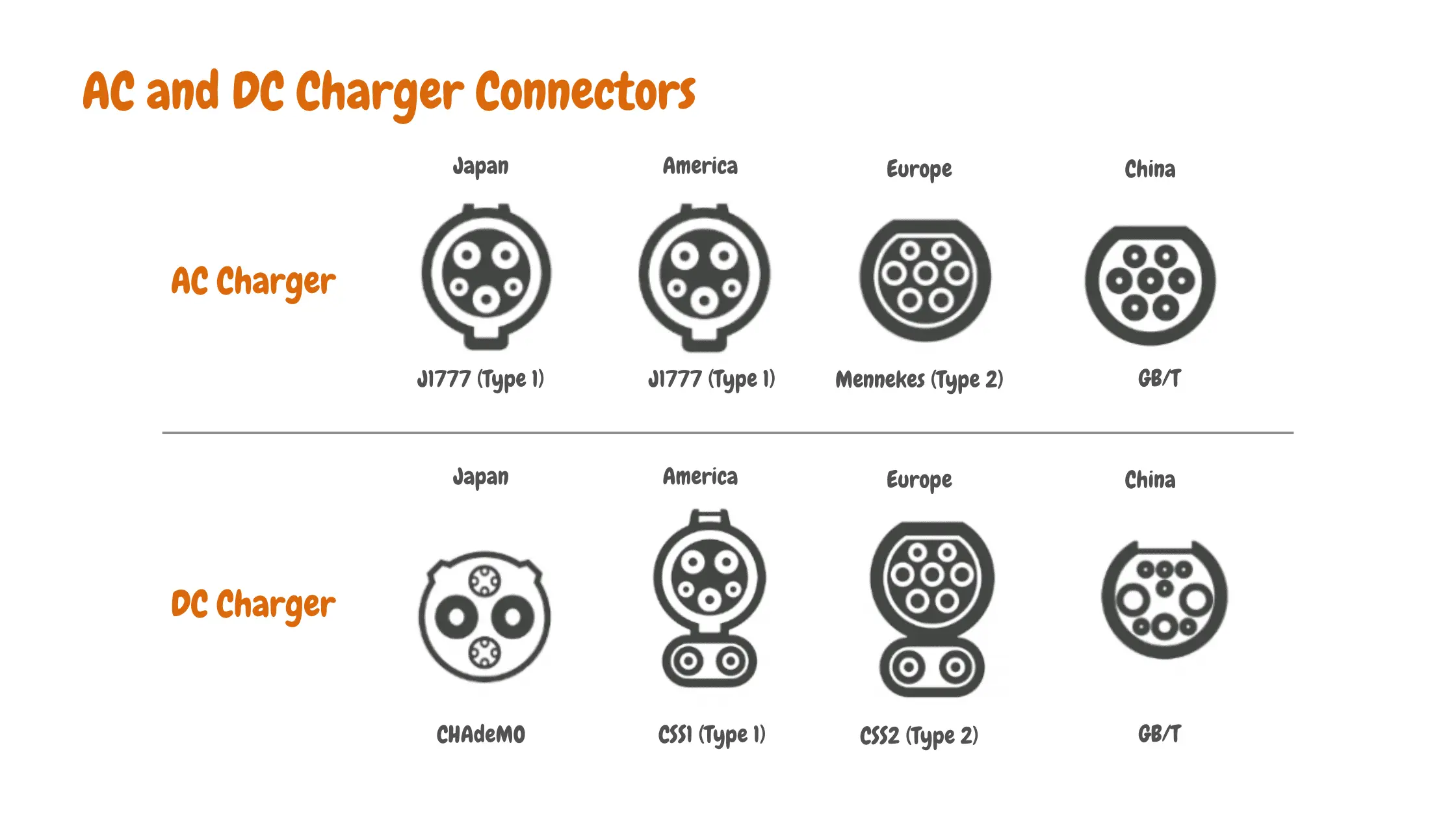
Here is how every major EV connector stacks up in terms of power, region, and use case. Use this table to see at a glance where this standard fits in the wider charging world.
| Connector | Region | Max AC Power | Max DC Power | Pin Count |
| NACS (J3400) | North America | 19.2 kW | 1,000 kW (theoretical) | 5 |
| CCS Combo 1 | North America | 19.2 kW | 360 kW | 7 |
| J1772 (Type 1) | North America, Japan | 19.2 kW | Not supported | 5 |
| Type 2 / CCS2 | Europe, Oceania | 43 kW (3 phase) | 360+ kW | 9 |
| CHAdeMO | Japan, legacy global | Not supported | 400 kW | 10 |
| GB/T | China | 27.7 kW | 237.5 kW (900 kW ChaoJi) | Dual port |
Conclusion
J1772 is the quiet workhorse of American EV charging. It does not support fast charging, it does not make headlines, and NACS is slowly catching up. But it still represents the vast majority of installed home and workplace chargers in the country, and it will keep doing so for the next 10 years easily.
If you have one, keep it. If you need one, buy a high-quality UL-listed J1772 EV charger that meets your electric vehicle’s onboard charger limits. And budget twenty dollars for a lock ring if you charge anywhere outside your own garage.
Frequently Asked Questions
What is a J1772 charger?
The SAE J1772 (also known as a J-plug) is the North American standard electrical connector for electric vehicles. It allows EVs to connect to Level 1 (120V) and Level 2 (240V) alternating current (AC) charging stations.
Is J1772 Level 1 or Level 2?
It supports both. The J1772 connector design is identical for both Level 1 and Level 2 charging; the difference lies in the voltage and power delivery of the charging station it is plugged into.
Can a Tesla use a J1772 charger?
Yes. While Tesla uses its own proprietary North American Charging Standard (NACS) port, every Tesla vehicle comes with a compact J1772-to-NACS adapter that allows it to utilize any standard J1772 charging station.
What is the difference between J1772 and CCS?
J1772 is strictly for AC charging (Level 1 and Level 2). CCS (Combined Charging System) Type 1 takes the standard J1772 plug and adds two large bottom pins to allow for high-speed DC Fast Charging.
Do all electric cars use the J1772 plug?
Virtually all non-Tesla electric and plug-in hybrid vehicles in North America built over the last decade use the J1772 plug for AC charging. However, major automakers are currently transitioning new models to the NACS port.
How fast does a J1772 charger charge an EV?
Charging speed depends on the station’s amperage and the car’s onboard charger. Typically, a Level 2 J1772 charger adds about 12 to 30 miles of range per hour, whereas a Level 1 outlet adds roughly 3 to 5 miles of range per hour.
What is the max amperage for an SAE J1772 plug?
Under the official SAE guidelines, the standard J1772 connector is rated to handle a maximum continuous current of 80 amps at 240 volts AC, delivering up to 19.2 kW of power.
Do I need an adapter to use a J1772 charging station?
If you drive a standard non-Tesla EV in North America, you do not need an adapter; the plug connects directly to your car. Only Tesla drivers require the standard adapter to use these stations.
What voltage does a J1772 charger use?
It operates at 120 volts AC for Level 1 charging (typical household outlets) and 208 to 240 volts AC for Level 2 charging (typical for commercial stations and residential heavy-appliance circuits).
Is NACS replacing the J1772 connector?
Yes, the industry is transitioning. The North American Charging Standard (NACS) is becoming the dominant port built directly into new vehicles, but millions of J1772 stations and vehicles remain in active use, making adapters a standard tool for the foreseeable future.

James Ndungu is a certified EV charger installer with over five years of experience in EVSE selection, permitting, and installation. He holds advanced credentials, including certification from the Electric Vehicle Infrastructure Training Program (EVITP) and specialized training in EV charging equipment and installation, as well as diplomas in EV Technology and Engineering Fundamentals of EVs. Since 2021, James has tested dozens of EV chargers and accessories, sharing expert insights into the latest EV charging technologies.