When most people think about off-grid EV charging, they imagine adding a few extra panels to their roof and plugging in their car. The reality is dramatically different. True off-grid EV charging isn’t a DIY solar project; it’s the engineering of a complete microgrid that functions as a standalone power plant.
Without the utility grid acting as an infinite buffer, your system must handle sustained and continuous high-amperage EV charging loads, manage multi-day autonomy, and coordinate intelligent power distribution across generation, storage, and consumption.
This is professional power systems engineering, and understanding the distinction is critical to success.
Looking for a smart, secure EV charger with ecosystem integration optimized for off-grid solar systems? Check out our expert Off-Grid EV Charger Reviews for detailed analysis and top recommendations.
View Our Off-Grid EV Charger ReviewsTable of Contents
- Off-Grid Home EV Charging with AC-Coupled Microgrids
- Off-Grid EV Charging with DC-Coupled Microgrids
- Hybrid AC and DC Microgrids for Off-Grid EV Charging
- The Five Core Subsystems
- The Efficiency Principle: Why DC-Coupling Matters
- Real-World Performance Expectations
- The Cost Reality
- Grid-Tied vs Off-Grid EV Charging
- Expert Tip: Overbuild, Don’t Underbuild Your off-grid EV charging System
- The Bottom Line
Off-Grid Home EV Charging with AC-Coupled Microgrids
Off-grid home EV charging with AC-coupled microgrid is the most common method used in off-grid home solar EV charging. In this system, all the electricity needs for your home and your AC off-grid EV charger connect to one main AC power line called the AC bus.
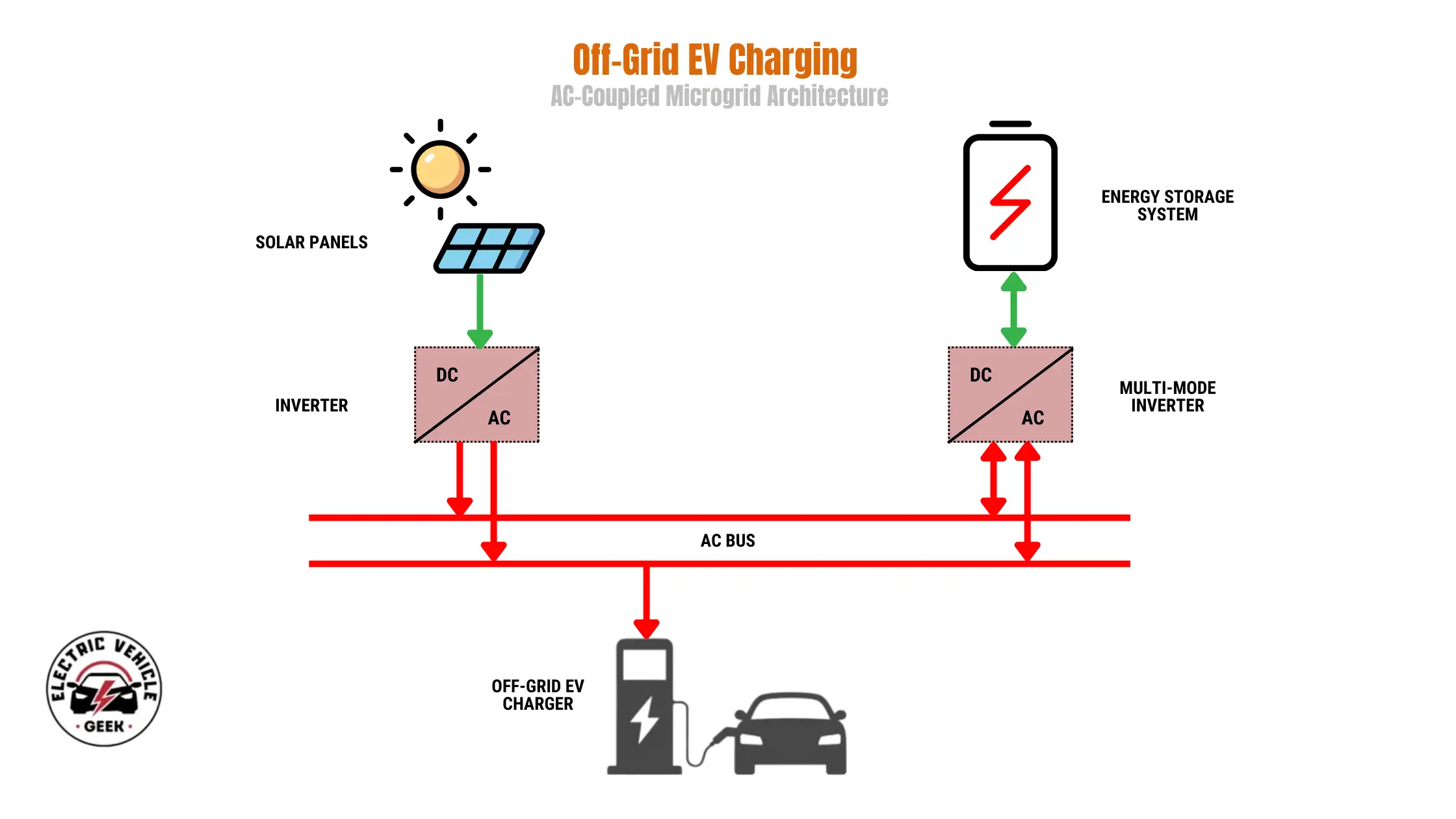
The battery system connects to this AC bus using a device that can change electricity back and forth between AC and DC power. This lets you size the solar panels, battery, and other parts separately to fit your home’s needs.
This setup is flexible because all loads connect to the AC bus, which helps manage when the battery charges and discharges, so you use energy better and avoid high power demand times.
AC-coupled microgrids with solar power are more efficient because they lose less energy when converting power. But to keep everything running smoothly, the system needs to carefully measure the power at the main connection point.
This kind of system makes off-grid EV charging easier and more reliable, letting you charge your car with clean energy right at home. The main advantage of off-grid EV charging systems based on AC microgrids is that they work well with most home devices and home EV chargers since almost all use AC power.
Off-Grid EV Charging with DC-Coupled Microgrids
In a DC-coupled microgrid, all sources and loads connect to a common DC bus (DCB). Solar panels, batteries, and electric vehicle charging stations (EVCS) operate in parallel on this DC network. The solar power plant (SPP) connects to the DCB using a maximum power point tracking (MPPT) system to optimize energy harvest from the sun.
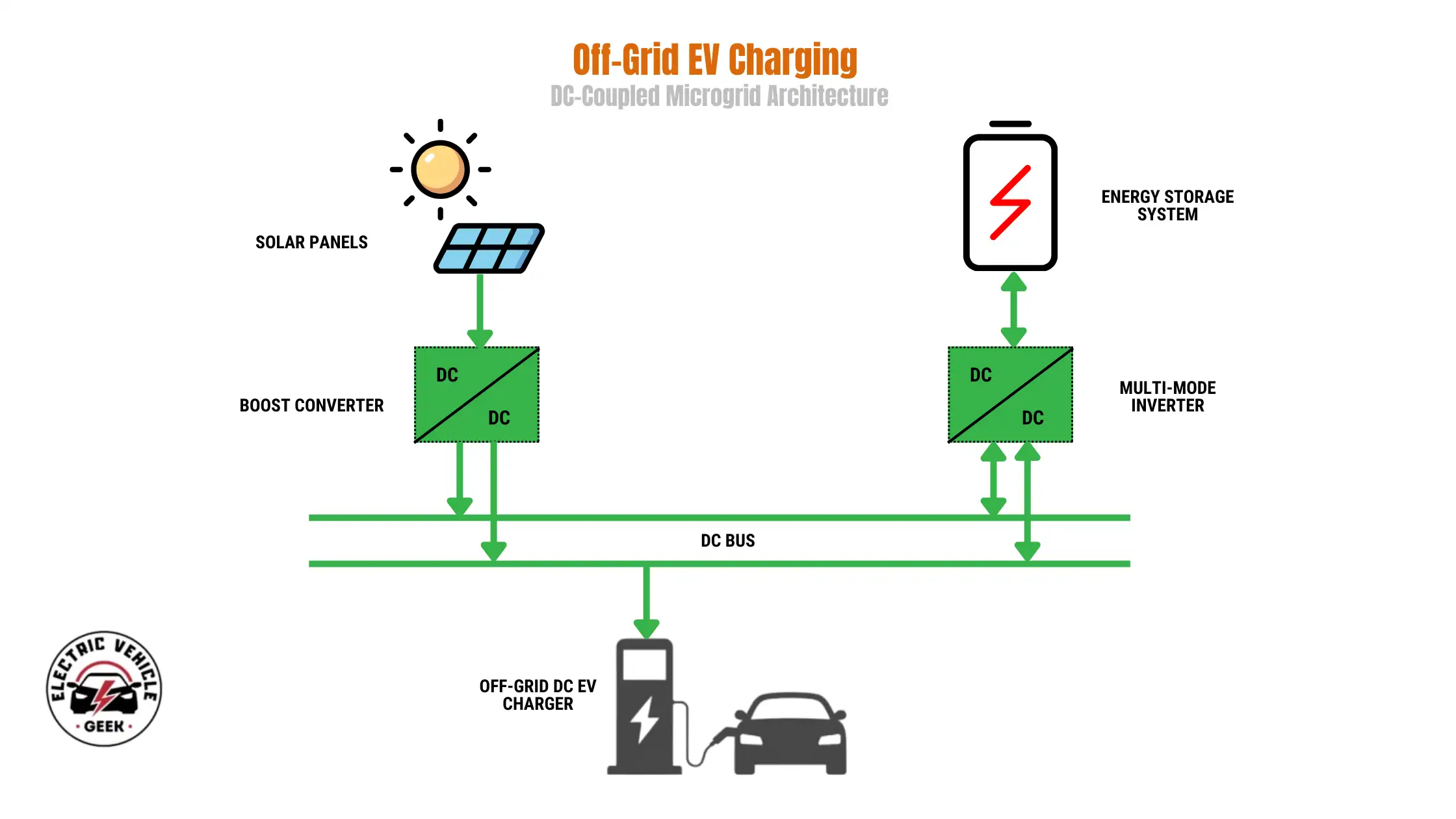
DC microgrids use advanced control strategies to keep the voltage stable on the DC bus and prevent issues like circulating currents. This control can include techniques like hierarchical or fuzzy control to manage power flow and balance energy between solar generation, battery storage, and loads.
This architecture is common in off-grid public EV charging stations with DC fast chargers, where efficient high-power DC charging is essential. However, DC-coupled setups are less common in typical off-grid home systems because most household loads and EV chargers run on AC power, making AC-coupled microgrids a better fit for residential use.
Hybrid AC and DC Microgrids for Off-Grid EV Charging
A hybrid AC/DC-coupled microgrid combines the advantages of both AC and DC power systems in a single, efficient setup. Solar panels feed power into a central DC bus through a DC-DC boost converter, while an energy storage system connects via a bidirectional DC-DC multi-mode inverter that manages both charging and discharging.
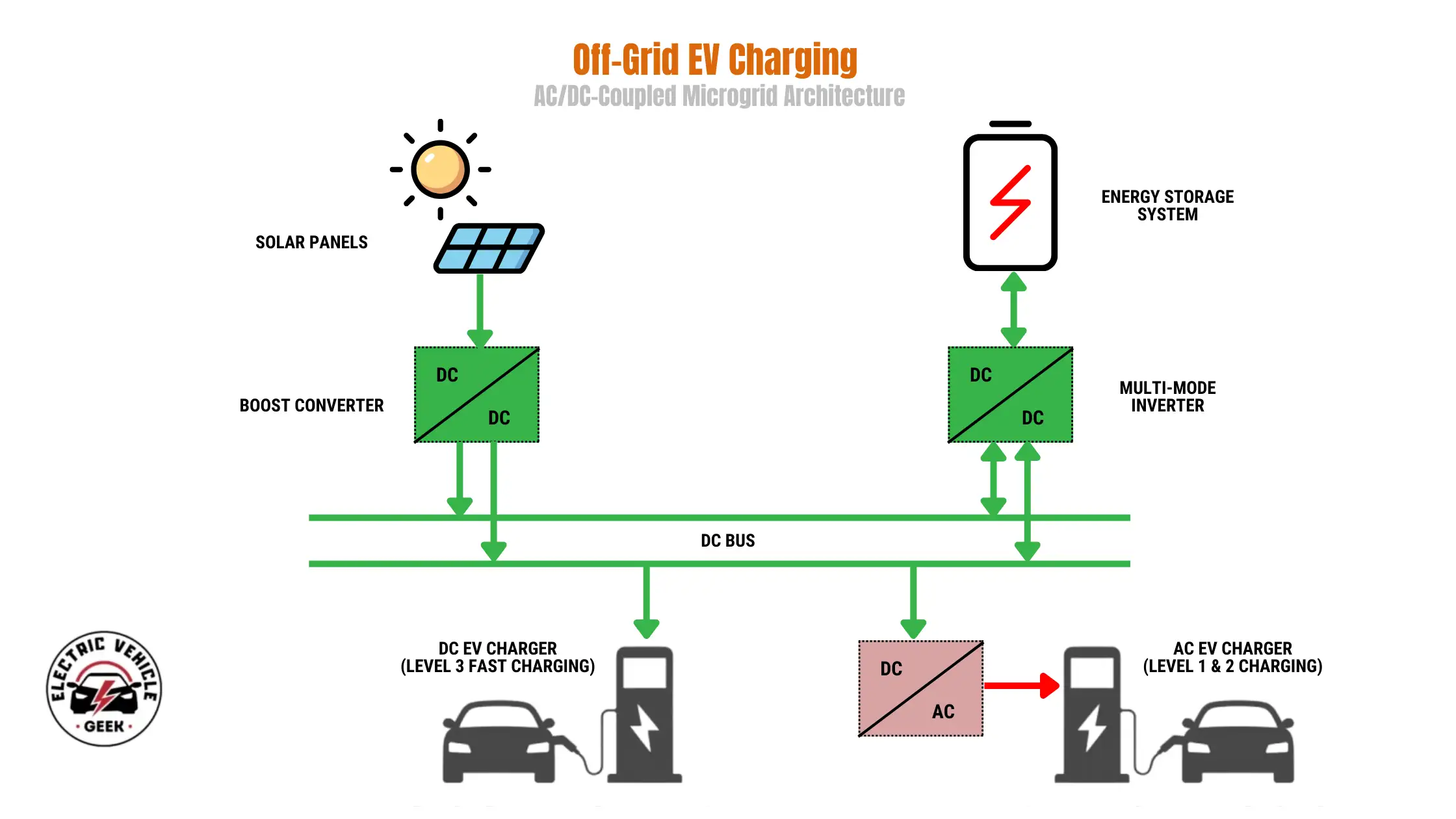
The system powers AC & DC EV chargers: a fast Level 3 DC charger connected directly to the DC bus for high-speed charging, and Level 1 and Level 2 AC chargers that receive power through a dedicated DC/AC inverter.
The AC side maintains standard voltages (120 V or 240 V) for Level 1 and Level 2 AC EV charging and other AC loads. The DC bus supplies the higher voltage needed for Level 3 fast charging.
By mixing AC and DC power, hybrid microgrids minimize energy conversion losses and helps regulate voltage and frequency, stabilize the microgrid, making them ideal for off-grid public EV charging stations that require flexible, efficient energy management.
Advanced control systems optimize charging by balancing solar generation and electricity demand, reducing peak loads, and improving energy distribution efficiency.
The Five Core Subsystems
A professional off-grid EV charging system consists of five integrated subsystems, each requiring specialized components and careful engineering:
1. High-Efficiency Solar Generation
At this scale, panel efficiency directly impacts system viability. Modern N-Type TOPCon or Interdigitated Back Contact (IBC) panels rated at 450W or higher offer superior low-light performance and lower long-term degradation compared to standard panels. For a vehicle requiring 60 kWh per charge, you’re looking at a 12-15 kW solar array, which is approximately 30-35 high-efficiency panels.
The array must also include module-level rapid shutdown devices for safety compliance with NEC 2020/2023 requirements, and commercial-grade racking with wind ratings exceeding 140 mph. Ground-mount systems are often preferred over rooftop installations for better serviceability and improved cooling airflow.
2. Energy Storage
Lead-acid batteries are not viable for this application. The continuous discharge rate (C-rate) required to support EV charging (often 0.5C to 1C) will destroy lead-acid cells within months. Professional systems use Lithium Iron Phosphate (LiFePO4) battery banks, typically in rack-mounted or high-voltage stack configurations.
The critical factor is capacity. A general rule suggests that stationary storage should be two to three times the size of the vehicle battery for proper autonomy. For a 60 kWh EV, that means 80-100+ kWh of stationary storage. This prevents draining household power reserves just to charge the vehicle and provides the multi-day buffer needed for cloudy weather.
These battery systems must include a closed-loop Battery Management System (BMS) that communicates directly with the inverter via CAN bus or similar protocols. This enables real-time temperature monitoring, dynamic charge rate adjustments, automatic current limiting, and cell balancing, all critical for safety and longevity.
Vehicle-to-Home (V2H)
Vehicle-to-Home (V2H) technology allows a compatible EV to send power back into your home, effectively turning the vehicle into a large mobile battery.
Since most EVs store 60–100+ kWh (far more than typical 10–20 kWh home battery systems), V2H can significantly increase energy resilience in off-grid or hybrid setups.
For off-grid systems, V2H can reduce solar/generator runtime, support home loads during low solar production, and protect stationary batteries from deep discharge. However, it requires bidirectional chargers, proper transfer switching, and professional system design. Not all EVs support this feature.

V2H isn’t a replacement for proper solar or battery sizing, but it can be a powerful addition to a well-engineered off-grid energy system.
3. Industrial Power Electronics
EV onboard chargers present inductive loads that demand high surge capacity and rock-solid voltage stability. Undersized/ cheaper Modified Sine Wave (MSW) inverter inverters will experience thermal shutdowns or voltage collapse under sustained load due to sensitive EV charger onboard systems, heat, and efficiency, EV charger handshake safety checks.
For off-grid solar EV charging, we recommend an industrial-grade pure sine wave solar inverter such as the Victron Quattro or Schneider Conext XW Pro, often configured in parallel stacks to deliver 40-50 amps continuous with surge capacity well beyond that.
These are not consumer hybrid inverters. They are microgrid components designed for industrial duty cycles. The solar charge controllers must also be commercial-grade Maximum Power Point Tracking (MPPT) units capable of handling 150-450V DC input, allowing for longer string configurations that reduce conductor losses and copper costs.
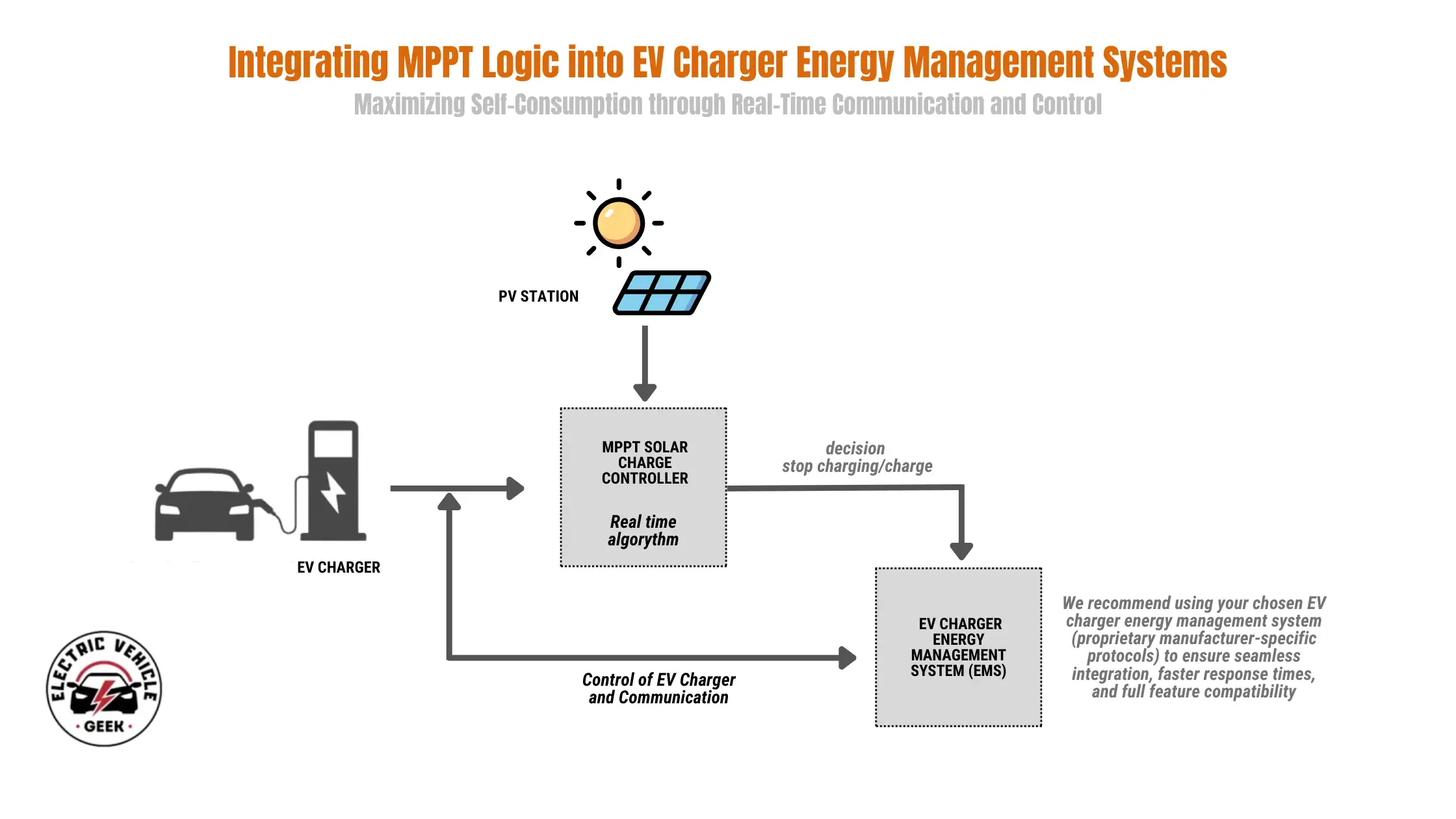
Beyond the raw power of industrial inverters, a dedicated Energy Management System (EMS) is integrated via communication protocols (such as Modbus or CAN bus). This system acts as the “brain,” performing Dynamic Load Balancing. It monitors real-time solar yield and battery State of Charge (SoC) to modulate the EV charger’s pilot signal. This ensures that the EV only draws “excess” solar energy or throttles down during high-demand industrial cycles to prevent inverter thermal stress or battery deep-discharge.
4. Intelligent Control Layer
The system requires a central controller (such as a Victron Cerbo GX or equivalent) that coordinates all components via CAN bus communication. This controller manages BMS communication, inverter control, MPPT optimization, and real-time State of Charge (SoC) tracking. Without this coordination layer, the system cannot prevent overcharge, overheating, or uncontrolled discharge.
Most importantly, the control layer must interface with the Electric Vehicle Supply Equipment (EVSE) for dynamic load management. When solar production drops due to cloud cover, the system can communicate with a smart EVSE to throttle charging from 40A down to 12A, preventing battery depletion. This intelligent handshake between stationary storage and vehicle charging is what separates a functioning system from one that fails when you need it most.
5. Critical Safety Systems
Professional installations include multiple layers of protection that are often overlooked in amateur designs. This includes Class T fuses for lithium battery protection (these are extremely fast-acting to prevent arc flash events), Type 1 and Type 2 surge protection devices on both DC and AC sides, 500A+ rated copper busbars for high-current DC connections, and 4/0 AWG cabling between batteries and inverters.
Thermal management is equally critical. When pushing 10 kW continuously for 5-6 hours, inverters and battery systems generate significant heat. Active ventilation or climate control for the equipment room is not optional; it’s essential for both performance and component longevity.
The Efficiency Principle: Why DC-Coupling Matters
One of the most important design decisions in off-grid systems is minimizing energy conversion losses. Every time electricity changes form, from DC to AC or AC to DC, approximately 10-15% of the energy is lost as heat.
In a DC-coupled system, solar panels charge batteries directly through DC charge controllers, eliminating one conversion stage. The energy only converts from DC to AC once, when powering the home or vehicle. In contrast, AC-coupled systems convert DC solar to AC, then back to DC for battery storage, then to AC again for use, losing efficiency at each stage.
For an off-grid EV charging system where every watt counts, DC-coupling isn’t just about efficiency; it also reduces thermal stress on components and extends system lifespan. Over-specifying cooling capacity is as important as over-specifying panel wattage.
Real-World Performance Expectations
It’s important to have realistic expectations about what an off-grid system can deliver. In optimal conditions, summer, clear skies, proper panel orientation, and a well-designed system can fully charge an EV in a single day while maintaining house loads. During winter or extended cloudy periods, you may need 2-3 days between full charges, or you may need to reduce your driving distance to match available energy.
Because of these limits, charger selection matters.
For most off-grid homes, Level 1 or Level 2 EV chargers are the practical choice.
- Level 1 chargers draw the least power and are the easiest to support off-grid. They’re slow, but they place minimal stress on your batteries and inverter.
- Level 2 chargers offer a balanced solution. They can be configured for lower amperage settings, allowing you to match charging speed to your solar generation and battery capacity.
- Level 3 (DC fast) chargers, on the other hand, are extremely high-demand systems. They require massive power delivery, advanced cooling, and industrial-grade electrical infrastructure. Running a Level 3 charger off-grid would demand oversized inverters, large battery banks, and significant solar capacity, well beyond what most residential systems are designed to handle.
That’s why Level 3 charging is typically reserved for commercial or grid-connected installations.
Click the button below for solar-ready EV chargers (Level 1 & Level 2 Solar Chargers) that consistently perform well in off-grid EV charger installations.
Our Recommended Solar-Ready EV Chargers for Off-Grid & Grid-Tied Solar EV ChargingMany professional installations include a backup generator with an automatic transfer switch that activates when the battery’s state of charge drops below 20%. This isn’t admitting defeat, it’s designing for resilience. The generator might only run a few times per year during prolonged storms, but it provides peace of mind and prevents battery damage from deep discharge.
The system’s performance is also heavily dependent on vehicle efficiency. A Tesla Model 3 that requires 250 Wh per mile is far easier to support off-grid than a large SUV that requires 400+ Wh per mile. Your daily driving distance must be matched to your generation and storage capacity.
The Cost Reality
Professional off-grid EV charging systems are expensive. A complete installation with 12-15 kW solar, 80-100 kWh lithium storage, commercial inverters, proper safety systems, and professional installation typically ranges from $40,000 to $70,000 or more. This is significantly more expensive than a grid-tied solar system plus a simple Level 2 EV charger.
However, for remote properties where utility grid extension would cost $50,000-$100,000 per mile, or for those prioritizing true energy independence, the economics can make sense. The system also provides complete backup power for the home during grid outages, a capability that grid-tied solar alone cannot deliver.
It’s also worth noting that cutting corners on components almost always leads to system failure. Cheap inverters fail under sustained EV charging loads. Undersized batteries age rapidly. Inadequate cooling causes thermal shutdowns. The upfront cost difference between amateur and professional components is substantial, but the reliability difference is even greater.
Grid-Tied vs Off-Grid EV Charging
Grid-tied solar EV charging systems (check our grid-tied solar EV charging project) have a secret advantage that most homeowners never think about: the utility grid itself acts as an unlimited battery. When your panels produce excess energy, it flows to the grid. When you need more power than your panels generate, the grid supplies it instantly. The system never has to worry about running out of power or managing complex load balancing for EV charging.
Off-grid EV charging eliminates this safety net. Your system must generate, store, and deliver every watt of energy needed to charge a 60-75 kWh battery pack while simultaneously powering your home. This means managing:
- Sustained 40-50 amp continuous AC loads for 5-6 hours
- High inrush currents when the EV onboard charger starts
- Multi-day energy autonomy during cloudy weather
- Thermal stress from prolonged 10 kW power output
- Real-time communication between battery management systems and power electronics
This level of complexity requires industrial-grade components and careful system design. Consumer solar equipment simply isn’t built for this duty cycle.
Expert Tip: Overbuild, Don’t Underbuild Your off-grid EV charging System
There are many factors to consider when building an off-grid solar EV charging system. Accurately estimating your off-grid EV charging and other loads needs is critical for a reliable setup. It’s easy to overlook key details, leading to an undersized off-grid solar system. We recommend oversizing solar panels and battery capacity by 20–30% to accommodate future growth and maintain consistent, reliable performance – if higher upfront costs and additional expenses for extra panels, wiring, mounting materials, and labor are not a problem.
The Bottom Line
Off-grid EV charging is absolutely achievable, but it requires approaching the project as professional power systems engineering rather than a DIY solar installation. The difference between success and failure lies in understanding that you’re not just adding solar panels, you’re building a microgrid.
This means specifying industrial-grade components, oversizing generation and storage capacity, implementing comprehensive safety systems, and designing intelligent control logic that can manage variable loads and generation. It means accepting that the system will be expensive and that the weather will impose real constraints on charging frequency.
For those with the budget and commitment, a properly engineered off-grid EV charging system delivers true energy independence and resilience that grid-tied systems cannot match. But that independence comes with complexity and cost that must be honestly evaluated before beginning the project.
The key insight is this: treat it as what it actually is (a self-contained power plant), and you can build something remarkable.
Treat it as just another DIY project, and you’ll likely end up with an expensive system that doesn’t work when you need it most.

James Ndungu is a certified EV charger installer with over five years of experience in EVSE selection, permitting, and installation. He holds advanced credentials, including certification from the Electric Vehicle Infrastructure Training Program (EVITP) and specialized training in EV charging equipment and installation, as well as diplomas in EV Technology and Engineering Fundamentals of EVs. Since 2021, James has tested dozens of EV chargers and accessories, sharing expert insights into the latest EV charging technologies.