Supported by you via insider access, and when you purchase through links on our site, we may earn an affiliate commission. See our Affiliate Disclosure.

NEMA 6-20 EV Charger Reviews

We recommend NEMA 6-20 EV chargers (Level 2 charging, 240V, 20A) for their strong balance of speed and simplicity. Operating at 240V with a 20-amp circuit, they deliver moderate charging speeds, making them a practical option for plug-in hybrid vehicles (PHEVs) or slower overnight charging for battery electric vehicles (BEVs). While not as fast as higher-power Level 2 EV chargers, they offer a meaningful upgrade over standard 120V Level 1 charging without requiring a full high-capacity installation.

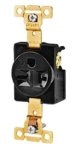
A NEMA 6-20 outlet is a 240V 20 amp outlet with two horizontal blades and a round ground hole. There is no neutral wire. EV chargers using this outlet draw up to 16 amps continuous and deliver 3.84 kW, the entry tier of true Level 2 charging.

The 6-20 outlet is used in homes with workshop circuits, window air conditioner installations, and certain older shop tool setups. It is the cheapest 240V outlet to install on an existing panel because the breaker is small and the wire is light gauge.

Every charger reviewed below was tested at a sustained 16 amp continuous draw on real 20A two-pole circuits. We verified clean operation, accurate ground-fault detection, and a reliable plug handshake at the entry Level 2 current level.

How We Tested This Amp Tier

We test NEMA 6-20 chargers on a dedicated 240V, 20A two-pole circuit with 12 AWG copper wiring. Continuous current is measured at 15.8 A for 6-hour stress windows. We verify the GFCI protection trips at 5 milliamps under live load. The plugs control pilot signal is monitored for stability at this lower amperage (some chargers handshake poorly at the bottom of their range). Thermal imaging checks the connector body and wall termination.

Our NEMA 6-20 EV Charger Reviews

Each charger below can deliver up to 20 amps via a standard NEMA 6-20 power plug, operating on a 240V circuit for Level 2 charging performance. We evaluate every unit on a 10-point scale across performance, build quality, durability, design, value, and brand reputation. Click any title to read the full hands-on review. While not as fast as higher-amperage Level 2 chargers, these units offer a strong balance of speed and efficiency, making them well-suited for plug-in hybrid vehicles (PHEVs), moderate daily driving, overnight home charging, and users looking for a practical upgrade from standard 120V charging.

Use the “Compare” button on each product to select multiple chargers, then click the ⚖️ scale icon to see a full side-by-side comparison.

Add to compare
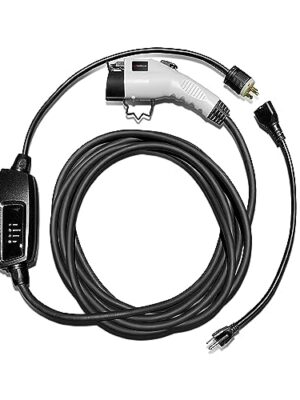
The Schumacher 16 Amp EV Charger is a reliable, 16A portable charger with a 28-ft cable, Level 1/2 support, 120V/240V compatibility, and efficient EV charging.
Charging Speed: 3.8 kW
Max Amperage: 16 Amps
Charging Level: Level 1, Level 2
Connector Type: J1772
Cable Length: 28 Feet
Connectivity: None
Installation Type: NEMA 5-15, NEMA 6-20
Smart Features: No
Enclosure Rating: IP54
Certifications: ETL, UL
More details +
The Schumacher Schumacher 16 Amp EV Charger is a reliable, portable EV charger that caters to both Level 1 and Level 2 charging needs. Its ergonomic design, durable construction, and flexible cable make it a practical choice for EV owners. However, those seeking advanced features like adjustable amperage or smart connectivity might need to explore other options.
Features
8
Real World Usage
8.5
Materials
8.5
Durability
9
Craftsmanship
8.5
Design
8.3
Monetary Value
8
Product Value
8.5
Brand Reputation
9
Expert Valuation
8.5
PROS:
  • Portable and lightweight, easy to carry or store
  • 28-foot cable offers excellent reach for most parking setups
  • Universal J1772 connector compatible with all major EVs
  • Supports both Level 1 (120V) and Level 2 (240V) charging
  • Durable construction with water-resistant features
  • LED indicators provide clear charging status
CONS:
  • Fixed 16-amp output; no adjustable amperage
  • Lacks smart features such as Wi-Fi, app control, or scheduling
  • Slightly bulky compared to small, plug-and-play Level 1 chargers
  • Slower charging on 120V adapter compared to full 240V output
Add to compare
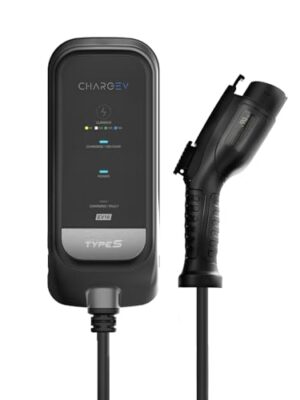
The Type S 16A Level 1 EV Charger supports 120V and 240V EV charging via NEMA 5-15, 6-20, and 10-30 outlets. Compact, weather-resistant, and adjustable, it's perfect for home, travel, or emergencies.
Charging Speed: 1.44 kW, 3.8 kW
Max Amperage: 16 Amps
Charging Level: Level 1, Level 2
Connector Type: J1772
Cable Length: 24 Feet
Connectivity: None
Installation Type: NEMA 6-20
Smart Features: No
Enclosure Rating: IP54
Certifications: FCC, UL
More details +
The Type S 16A Level 1 EV Charger is a premium-feeling, dependable Level 1 charger that does exactly what it promises: simple, safe, and reliable charging from any standard outlet. It’s not flashy, it’s not fast, but it’s highly practical and well built. If you’re okay with slower charging speeds and want a no-hassle EV charger for everyday or backup use, this is a solid choice.If you already have a Level 2 charger or want faster charging, consider stepping up to the Type S 40 Amp or other Level 2 options. Otherwise, give this a try—you won’t be disappointed.
Features
7.5
Real World Usage
8
Materials
8.5
Durability
9
Craftsmanship
8.5
Design
9
Monetary Value
8
Product Value
8.5
Brand Reputation
8.5
Expert Valuation
8.5
PROS:
  • Supports both 120V and 240V charging
  • Includes NEMA 5-15, 6-20, and 10-30 plug options
  • Adjustable amperage (6A–16A)
  • Weather-resistant (IP55 rated)
  • Lightweight and travel-friendly
  • Works with all J1772-compatible EVs
CONS:
  • No smart features or app connectivity
  • No LCD screen or detailed charge status display
Add to compare
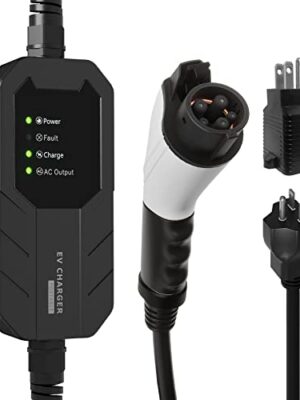
The Skysword Ⅱ is a versatile, portable EV charger. It offers both Level 1 and Level 2 charging, supporting 100-240V and 16A. With a 25-foot cable and included NEMA 6-20 and 5-15 plugs, it provides flexibility. It’s a safe, simple solution with LED indicators, ideal for home and travel.
Charging Speed: 1.92 kW, 3.8 kW
Max Amperage: 16 Amps
Charging Level: Level 1, Level 2
Connector Type: J1772
Cable Length: 25 Feet
Connectivity: None
Installation Type: NEMA 5-15, NEMA 6-20
Smart Features: No
Enclosure Rating: IP54
Certifications: ETL, FCC
More details +
The MEGEAR Skysword Ⅱ is a 25-foot portable charger, designed for convenience and practicality, making it ideal for everyday use whether at home, work, or while traveling.
Features
7.5
Real World Usage
8.5
Materials
8
Durability
7.5
Craftsmanship
8.5
Design
8
Monetary Value
8.5
Product Value
8
Brand Reputation
8.5
Expert Valuation
8
PROS:
  • Compatible with most electrical panels without requiring upgrades.
  • An affordable charging solution.
  • Built with a rigid structure for reliable portability.
  • Features straightforward error detection for easy troubleshooting.
  • boasts a smart-chip detection system that monitors charging issues
CONS:
  • 1-year limited warranty for manufucturing defects and technical queries
Add to compare
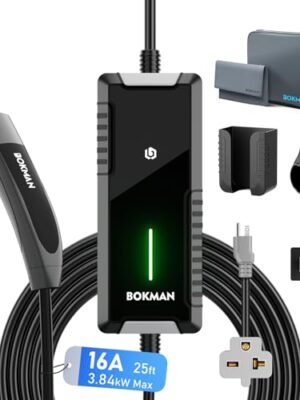
The Bokman Level 2 Mobile Charger delivers fast, efficient charging for Tesla vehicles, including Model 3/Y/X/S/Cybertruck. With a 16Amp power output and a 25ft cable, it features a NEMA 6-20 plug for Level 2 charging and NEMA 5-15 compatibility for Level 1, ensuring versatile, reliable performance at home or on the go.
Charging Speed: 3.8 kW
Max Amperage: 16 Amps
Charging Level: Level 1, Level 2
Connector Type: NACS
Cable Length: 25 Feet
Connectivity: None
Installation Type: NEMA 5-15, NEMA 6-20
Smart Features: No
Enclosure Rating: IP54
Certifications: CSA, Energy Star, ETL, FCC
More details +
Features
7.5
Real World Usage
8
Materials
7.5
Durability
8
Craftsmanship
8
Design
7.5
Monetary Value
8.5
Product Value
8.5
Brand Reputation
8
Expert Valuation
7.5
Show next

Important Key Specs Table Legend: Level 1 = Level 1 only (120V). Level 1/Level 2 = dual-voltage portable (120V or 240V).

How Fast Will an EV Charge on a NEMA 6-20 Charger?

A NEMA 6-20 charger delivers 3.84 kW of Level 2 power. That works out to 12 to 15 miles of range added per hour, roughly 3 times faster than a NEMA 5-15

Over an 8-hour overnight charge, you get 96 to 120 miles of range. That covers any normal daily driving in the U.S. with margin.

A 75 kWh Tesla Model Y refills in about 21.7 hours at NEMA 6-20 speeds. Two overnight cycles cover a full empty to full charge. For daily driving with 40 mile commutes drawing 12 kWh, a 6-20 outlet refills the commute in about 3.5 hours overnight.

How to Identify a NEMA 6-20 Outlet in Your Home

A NEMA 6-20 outlet is uncommon enough that many homeowners do not recognize it. It often gets confused with a NEMA 5-15 because both are 3-prong outlets of a similar size.

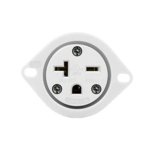
The giveaway is the slot orientation. A NEMA 6-20 has two horizontal slots side by side (rotated 90 degrees from a standard 5-15) plus a round ground hole. The left slot has a T-shape variation that allows NEMA 6-15 plugs to fit as well. There is no neutral wire connection because 6-20 is 240V across two hot conductors.

NEMA 6-20 20A 240V outlet

Where You Will Find It

Look in workshops, garages with welder or compressor installs, and rooms where window air conditioners were installed. Some older homes have a 6-20 outlet behind where a window unit used to be. If your panel shows a 20A two-pole breaker (a single breaker handle that spans two slots, rated 20A) feeding a single outlet, that is almost certainly a NEMA 6-20.

If you don’t already have a NEMA 6-20 outlet, or you’re looking to install a dedicated 240V circuit for faster, more efficient EV charging, here are the best NEMA 6-20 solutions we recommend for reliable Level 2 charging performance.

A standard NEMA 6-20 outlet from a home center costs 12 to 18 dollars. The construction is adequate for the load, and the EV charging duty cycle of 16 amps continuous is gentle enough that contractor-grade outlets last longer here than at higher amperages.

A commercial-grade NEMA 6-20 from Hubbell or Bryant runs $25 to $35. The premium is harder to justify here than at NEMA 14-50 because the thermal stress is lower. Still recommended if you want the same outlet to last 15 plus years.

The biggest reliability risk in a NEMA 6-20 installation is loose terminal screws in the outlet box. The two hot conductors carry 16 amps continuously, and any loose connection becomes a high-resistance hot spot. Confirm the electrician torques the terminals to spec, typically 12 inch-pounds for these outlets.

How to Test If It Is Wired Correctly

Use a multimeter to confirm the voltage across the two horizontal slots. You should read 240V (in the U.S., typically 228V to 252V depending on grid load). If you only read 120V, the outlet is either mislabeled as NEMA 5-20 or wired incorrectly. Have a licensed electrician verify before plugging in any EV charger.

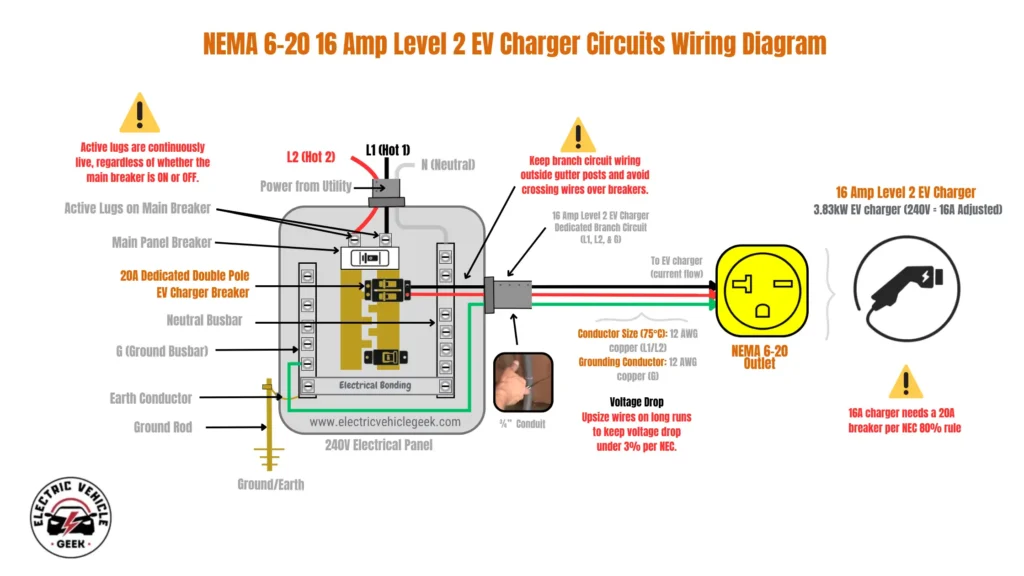
An informative wiring diagram titled "NEMA 6-20 16 Amp Level 2 EV Charger Circuits Wiring Diagram," created by Electric Vehicle Geek. The diagram illustrates the proper electrical connection for a 16-amp EV charger using a NEMA 6-20 outlet. It shows a 240V electrical panel with power coming from the utility. Inside the panel, a 20A dedicated double-pole breaker is installed. A black wire (L1) and a red wire (L2) connect to the breaker, and a green ground wire connects to the ground busbar. These three wires, specified as 12 AWG copper, run through a conduit to a NEMA 6-20 outlet. An EV charger with a compatible plug is shown connecting to this outlet. Note that this circuit does not use a neutral wire. Key information and warnings are highlighted throughout the diagram: "A 16A charger needs a 20A breaker per NEC 80% rule." "Active lugs are continuously live, regardless of whether the main breaker is ON or OFF." "Keep branch circuit wiring outside gutter posts and avoid crossing wires over breakers." "Upsize wires on long runs to keep voltage drop under 3% per NEC." The final charger is specified as a "16 Amp Level 2 EV Charger, 3.83kW."

NEMA 6-20 EV Charger Buyer's Guide

Choosing a NEMA 6-20 charger is about matching the 240V Level 2 voltage to your existing 20A two-pole circuit. The wiring is light, the cost to install a new 6-20 circuit is low, but the speed bump over Level 1 charger is real.

Why NEMA 6-20 Beats NEMA 5-20

Both outlets carry 16 amps continuous, but at different voltages. A NEMA 5-20 on 120V delivers 1.92 kW. A NEMA 6-20 on 240V delivers 3.84 kW. The voltage doubles the power output at the same amperage. If you can install a 240V circuit instead of a 120V circuit, do it.

The Cheapest 240V EV Charging Branch Circuit Install

A NEMA 6-20 install needs a 20A two-pole breaker, 12 AWG copper wire, and the outlet itself. Total parts cost is typically 40 to 80 dollars. Labor costs 200 to 400 dollars in most U.S. markets. Compared to NEMA 14-50 (which uses 6 AWG wire and a 50A breaker), this is the lowest-cost path to Level 2 home charging.

Hardwiring vs Plug-In at 16 Amps

At 16 amps, plug-in via NEMA 6-20 is fully permitted and reliable. Hardwiring is also an option, but it offers minimal benefit at this level, since the outlet and plug experience relatively low thermal stress. Most 6-20 chargers ship as plug-in units. If you want hardwired flexibility for code reasons in your jurisdiction, confirm the charger supports both options.

When to Upgrade From a NEMA 6-20 Charger

NEMA 6-20 charger (3.84 kW) delivers about 12-15 miles of range per hour. Over a typical overnight charge, that is 96 to 120 miles. Fine for daily driving for most U.S. owners. Not enough for daily drivers with 50-plus miles of commute or for BEVs that arrive home empty. Jump to NEMA 14-50 charger (32 amp 7.68 kW) when daily mileage exceeds 50 miles, or your panel can support a 50A breaker.

EVs That Work With a NEMA 6-20 Charger

NEMA 6-20 chargers fit any EV with an onboard charger rated 16 amps or higher, which is essentially every Level 2-capable EV sold in the U.S.

Best matches at NEMA 6-20 include the Chevy Bolt EV (overnight refill in about 19 hours), Nissan Leaf 40 kWh (12 hours), Mazda MX-30 (12 hours), Hyundai Kona Electric (19 hours, slightly over one cycle), Mini Cooper SE (10 hours), and most PHEVs, which all fully charge in 4 to 6 hours. Larger BEVs like the Tesla Model Y, Hyundai Ioniq 5, and F-150 Lightning will charge but require two cycles for full recovery.

Related Amp and kW Coverage

A NEMA 6-20 outlet supports the same circuit as our 16 Amp EV Charger archive, which covers breaker sizing, conductor gauge, and NEC code citations. For charging speed and vehicle range per hour, see our 3.8 kW EV Charger archive.

NEMA 6-20 EV Charger Frequently Asked Questions

You’ve Got NEMA 6-20 EV Charger Questions, We’ve Got Answers.

Voltage. NEMA 5-20 is 120V (one hot conductor, one neutral, one ground). NEMA 6-20 is 240V (two hot conductors and a ground, no neutral). The plug shapes are different, so you cannot accidentally swap them. The same 16 amp current draw delivers 1.92 kW on a 5-20 but 3.84 kW on a 6-20 because of the doubled voltage.

No. A NEMA 6-20 outlet uses two hot conductors and a ground,d but no neutral. The breaker is a 20A two-pole (one breaker covering two phases). If you are converting an existing 5-20 outlet to a 6-20, you cannot just swap the outlet because the wiring is different. A full circuit install with new conductors is needed.

Yes. The SAE J1772 standard defines Level 2 as any AC charging at 240V. A NEMA 6-20 at 3.84 kW qualifies, even though the amperage is the same as that of some Level 1 chargers. Voltage, not amperage, determines the charging level classification.

No, not safely. The NEMA 14-50 plug is physically different from the 6-20 outlet (4 prongs versus 3, and the blade orientation is different). Adapters that bridge the two exist but are dangerous because they bypass the upstream breaker's amperage rating. A 14-50 charger expects a 50A circuit. Plugging it into a 20A circuit will trip the breaker quickly.

Sometimes yes, depending on battery size and depletion. A Tesla Model 3 Standard Range (60 kWh) takes about 17 hours to recharge at 3.84 kW, which is two overnight cycles. A Model Y Long Range (75 kWh) takes 22 hours, also two cycles. For daily driving with under 40-mile commutes, the 6-20 refills the commute in 3 to 4 hours overnight.

Yes, under NEC 625.41 for plug-in EVSE installations since the 2023 NEC cycle. Either a GFCI breaker (60 to 80 dollars) or a charger with internal GFCI protection meets the requirement. Most modern Level 2 chargers include internal GFCI, but always verify the installation meets your local AHJ interpretation.

Only if the existing outlet is on a 20A two-pole circuit (a NEMA 6-15 with 15A would need a breaker upgrade and possibly a wire upgrade). Converting a larger outlet (NEMA 6-30 or 14-30) down to a 6-20 wastes the installed capacity and requires changing both the outlet and the breaker. Not worth doing unless the larger circuit will be repurposed elsewhere.

Because NEMA 14-50 became the U.S. standard for both RV hookups and EV charging, while NEMA 6-20 was originally a workshop and HVAC outlet that few homes have built in. The 14-50 outlet is universal in newer construction and retrofitted in many homes specifically for EV use. A 6-20 install is still cheaper,r but the outlet is less recognized by buyers, electricians, and home inspectors.

Yes, with no special handling. Most chargers in this tier operate from minus 22 to 122 degrees Fahrenheit. The 240V supply is actually more stable in cold weather than 120V because the grid voltage tends to be steadier on two-phase service. Cold-weather effects on the car (battery temperature management) remain unchanged regardless of outlet type.

Electric Vehicle Geek
Logo
Compare items
  • Total (0)
Compare
2