Supported by you via insider access, and when you purchase through links on our site, we may earn an affiliate commission. See our Affiliate Disclosure.
80 Amp EV Charger Reviews
-
 Best Picks By
James Ndungu
Best Picks By
James Ndungu
- last updated October 3, 2026

An 80-amp EV charger is the maximum residential AC charging tier available in the U.S. It runs on a 100-amp circuit and delivers 19.2 kW of power. Range added per hour runs 60 to 70 miles, the fastest practical AC charging at home.
This is the top of the home charging spectrum. The install is closer to a commercial installation than a typical home one. 4 AWG copper conductors minimum, a 100-amp two-pole breaker that often requires a panel upgrade, and hardwired termination that turns the charger into a permanent fixture.
Every 80-amp charger below was tested under sustained 80-amp continuous draw on hardwired 100-amp circuits with 4 AWG copper. Thermal performance, breaker handling, and conductor temperature rise received the most rigorous testing of any tier in our archive, because it is here that weak installations can cause real safety failures.
How We Tested This Amp Tier
80-amp EV chargers undergo a 14-day continuous test protocol on dedicated 100-amp circuits with 4 AWG copper conductors. Sustained 80 amp current is measured across multiple 14-hour charge cycles to simulate Ford F-150 Lightning Extended Range overnight charging. Conductor temperature is logged every 15 minutes inside the wall cavity. The breaker handle, terminal lugs, and the charger’s internal contactor are thermally imaged every 2 hours. GFCI sensitivity is verified at 5 milliamps after the extended duty cycle. The J1772 connector latch is stress-tested through 2000 plug cycles because the current cable weight at this level accelerates connector wear.
80 Amp EV Chargers We Recommend
Each charger below was scored on performance, materials, durability, design, value, and brand reputation, with 1 being the lowest and 10 the highest. Click any title to read the full hands-on review.
Use the “Compare” button on each product to select multiple chargers, then click the ⚖️ scale icon to see a full side-by-side comparison.
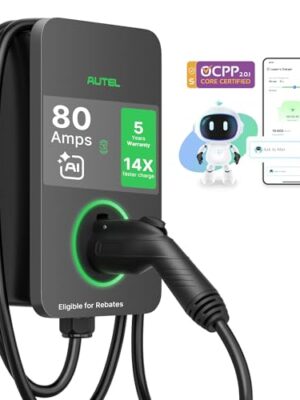
- 80A / 19.2 kW ultra-fast Level 2 charging
- OCPP 2.0 & ISO 15118 smart protocols
- Rugged, pedestal/kiosk-ready design
- Scalable for commercial or fleet use
- Dynamic load management support
- More expensive than competing 80 Amp EV chargers like the Grizzl-E Ultimate 80 Amp EV charger.
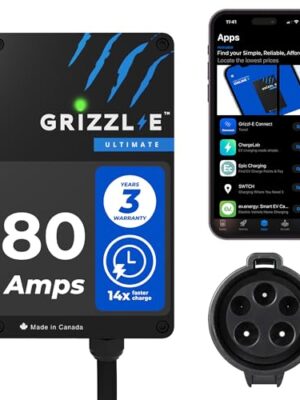
- Budget-friendly 80 Amp EV charger
- True OCPP Compliant
- Industry-leading 80A output for ultra-fast charging
- Rugged, weatherproof aluminum enclosure (NEMA 4X)
- Compatible with all EVs via J1772 or NACS
- Adjustable amperage for multiple breaker sizes
- Works offline and recovers after power interruptions
- Made in Canada with a 3-year warranty
- No plug-in option (hardwired only)
- Smart features limited to OCPP 1.6
- No built-in energy optimization or load sharing
- App interface and diagnostics are basic compared to modern alternatives
What Is a 80 Amp EV Charger?
An 80-amp EV charger is a high-powered Level 2 electric vehicle charger that delivers up to 19.2 kW of power at 240 volts. This translates to approximately 75 miles of range per hour, making it the fastest Level 2 AC charging option available for residential use. These chargers are ideal for homes with high electrical capacity, as well as business, workplace, and commercial EV charging stations, where rapid turnaround is critical.
Over an 8-hour overnight window, an 80-amp charger adds 480-560 miles of range. That covers any single day of driving, including back-to-back highway days with a depleted battery start.
A 131 kWh Ford F-150 Lightning Extended Range can be refilled in about 7.6 hours at 80 amps, comfortably within an overnight window. A 75 kWh Tesla Model Y would theoretically take 4.3 hours, but the car’s 32 amp onboard charger caps charging at 10.9 hours regardless of the wall unit’s capacity.
80 Amp EV Charger Circuit Requirements
Due to their high power demand, 80-amp EV chargers require heavy-duty wiring, including 2 AWG solid copper conductors for the hot lines and an 8 AWG copper ground conductor. The charger must be installed on a dedicated 100-amp circuit protected by a 100-amp circuit breaker. This setup must be supported by either a 200-amp main electrical panel or a dedicated 100-amp sub-panel. Most 80A chargers are hardwired only, and professional installation is recommended to ensure compliance with the National Electrical Code (NEC) and local regulations.
An 80 Amp installation falls fully into the category of commercial-grade electrical work performed in a residential setting. The 100-amp breaker, 4 AWG conductors, and frequent panel-upgrade requirement make this the most expensive and most disruptive EV charger installation in the residential market.
The 100-amp circuit often triggers service-entrance-conductor verification under NEC 230.42(A)(1). Total install cost today runs 2000 to 4500 dollars for a clean install on panels with available capacity, plus 4000 to 8000 dollars if a service upgrade is required. Permits and utility coordination add 2 to 6 weeks to the timeline.
Want charging speed math instead of circuit specs? See our 19.2 kW EV charger archive for range per hour and the time it takes your specific EV to charge.
The 80 Percent Rule Explained: Why 80 Amps Matters
The NEC 80 percent rule allows 80 amps continuous on a 100-amp breaker (100 amps times 80 percent equals 80 amps). This is the highest residential breaker size you can install without entering commercial wiring territory.
Above 80 amps, the install moves into commercial three-phase territory or requires a panel and service upgrade beyond what most residential homes are equipped with. 80 amps is the practical ceiling for single-phase residential AC charging in the U.S.
The 100 amp circuit triggers NEC 230.42(A)(1) service entrance conductor verification. Your home’s main service must be able to supply the additional load. For 200A panels running typical residential loads, adding 80A of EV demand usually pushes the calculated load above panel capacity, requiring a service upgrade.
Hardwired 3-Wire 80 Amp EV Charger Circuit Wiring Diagram
A hardwired 3-wire 80 Amp EV charger wiring configuration setup typically includes two 2 AWG copper conductors – black (L1) and red (L2) – and one 8 AWG copper grounding conductor (green), all rated for 90°C or higher. Power is supplied from a dedicated 100-amp double-pole breaker in the electrical panel, with wiring routed through conduit to either a junction box or directly to the charger, as shown in our 80 Amp EV charger circuit wiring diagram below:
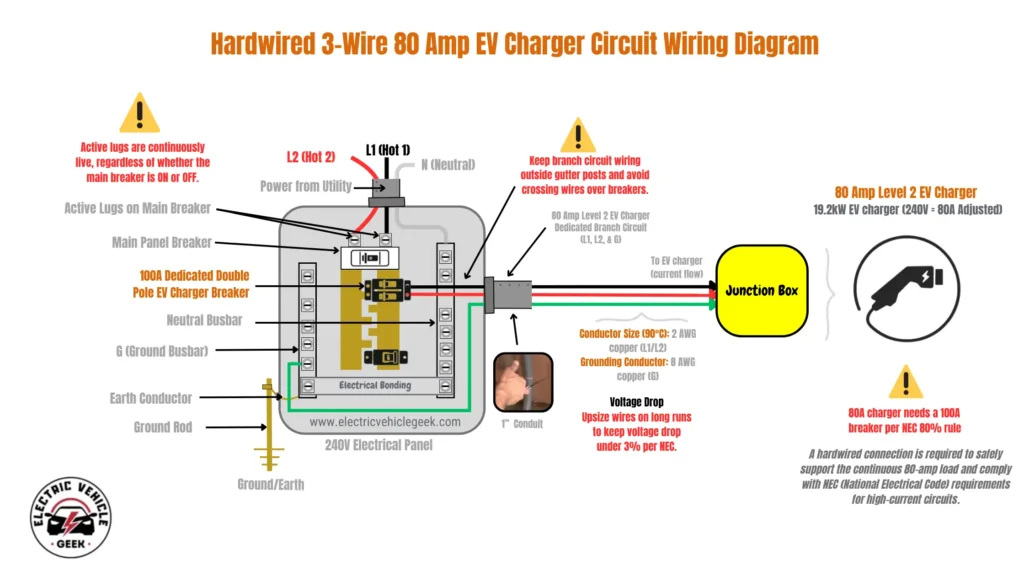
A 3-wire hardwired 240V 80-amp EV charger circuit does not require a neutral wire. Proper EV charger earthing is essential – ensure the grounding conductor is securely bonded to the panel’s ground busbar in full compliance with NEC Article 625 and local code.
Hardwired 4-Wire 80 Amp EV Charger Circuit Wiring Diagram
A hardwired 4-wire 80-amp EV charger circuit uses two 2 AWG solid copper hot wires (L1 and L2), one 2 AWG solid copper neutral (white), and one 8 AWG solid copper ground (green). These conductors are routed through conduit from a dedicated 100A circuit breaker to either a junction box or directly to the EV charger, as shown in the 80 Amp EV charger wiring diagram below:
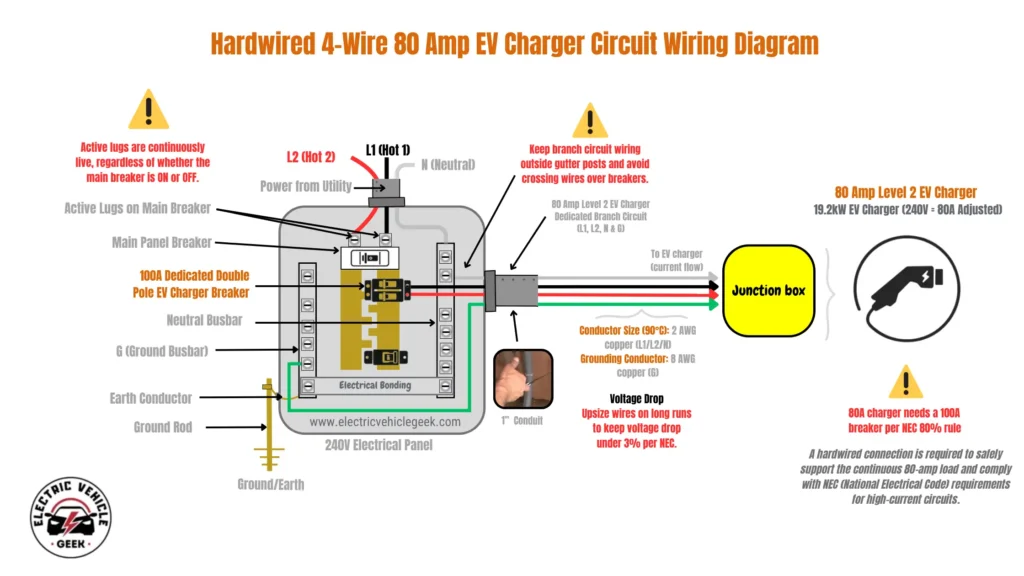
A neutral conductor is used to either power internal electronics or enable smart EV charging features, depending on the charger’s design. Proper EV charger earthing is essential and must comply with NEC Article 250 and Article 625 for safe operation.
80 Amp EV Charger Buyer's Guide
Buying an 80-amp charger is committing to commercial-grade electrical work in a residential setting. The charger hardware costs 800 to 1500 dollars, but the installation cost can exceed the charger itself when panel upgrades are factored in.
When 80 Amp Charging Actually Pays Back
80 amps makes sense in three scenarios. First, when you own a vehicle with an 80-amp onboard charger and need full battery recovery from a depleted state most nights (F-150 Lightning Extended Range used for work, Lucid Air Grand Touring). Second, dual EV households with a combined nightly energy demand exceeding 120 kWh. Third, solar households with daytime production exceeding 12 kW continuously. For typical commuter use, 80 amps is dramatically oversized.
The Panel Upgrade Reality
Adding a 100-amp circuit to a 200A residential service is rarely possible without a panel upgrade. Typical home demand calculations land at 140 to 170 amps before any EV load. Adding 80 amps of continuous EV load pushes total demand well above 200 amps. The fix is upgrading from 200A to 320A service (4000 to 8000 dollars), installing a smart panel (4000 to 7000 dollars), or accepting a service overhaul.
Conductor Sizing and Voltage Drop at 80 Amps
4 AWG copper is the minimum conductor for 80 amps continuous under NEC 110.14(C)(1), but the practical answer is often 2 AWG copper because voltage drop becomes a real engineering concern. For runs under 60 feet, 4 AWG works. For 60 to 100 feet, 2 AWG keeps voltage drop under 3 percent. For runs over 100 feet (detached garages), 1/0 aluminum or 2 AWG copper with parallel runs becomes necessary.
Smart Features Become Mandatory at 80 Amps
At 80 amps continuous, smart features stop being conveniences and become a matter of risk management. Real-time current monitoring lets you catch developing thermal issues. OCPP 2.0.1 compatibility lets the utility throttle your charger during peak load events. Load balancing prevents the circuit from exceeding capacity. Bidirectional charging support is genuinely useful because the same 80-amp circuit can deliver 19.2 kW from home to car or from car to home during outages.
EVs That Match an 80 Amp Charger
80 amps is the engineering match for vehicles with 72 amp or higher onboard chargers, which is a small but growing premium EV segment.
Vehicles that consistently use the full 80 amps include the Ford F-150 Lightning Extended Range and Standard Range, the Lucid Air Grand Touring and Dream Edition, and certain 2024+ Mercedes EQS configurations with the optional 80-amp upgrade. The Tesla Cybertruck (50A onboard) and Rivian R1T/R1S (48A onboard) cap at 12 kW and 11.5 kW, respectively,y even on an 80-amp wall unit. For most other EVs, 80 amps is overkill, delivering no real benefit over 48 amps.
Not Sure 80A EV Charger Is Right for You?
If your home, workplace, business, or commercial installation has limited electrical capacity or you want to avoid panel upgrades, consider a lower-amperage EV charger listed below. Level 1 EV chargers (12–16 amps) are great for overnight charging with standard outlets, while Level 2 EV chargers (16–50 amps) offer faster charging without the heavy-duty electrical requirements of an 80A EV charger installation.
120V, 12A, 1.44 kW
Adds approx. 3–8 miles of range per hour.
120V or 240V, 16A, 1.92–3.84 kW
Adds approx. 3–12 miles of range per hour
240V, 24A, 5.76 kW
Adds approx. 22 miles of range per hour
240V, 32A, 7.68 kW
Adds approx. 26 miles of range per hour
240V, 48A, 11.5 kW
Adds approx. 40 miles of range per hour
240V, 80A, 19.2 kW
Adds approx. 75 miles of range per hour
Need a charger with a different amperage? Our EV Charger Amperage Hub covers every tier from 12 amps to 80 amps and links to each dedicated review archive.
80 Amp EV Charger Frequently Asked Questions
You’ve Got 80 Amp EV Charger Questions, We’ve Got Answers.
Is 80 Amps Overkill for Most American Homes?
Yes, for typical single EV households. The average U.S. EV driver covers 35 miles per day, drawing about 11 kWh, which a 32 amp charger replenishes in 1.6 hours overnight. At 80 amps,s the same daily refill takes 38 minutes. The faster speed offers no practical benefit, since the overnight window provides 8 to 10 hours regardless. The 80-amp tier earns its premium only when daily energy demand exceeds 70 kWh.
How Much Does a Full 80 Amp Install Cost?
For a 200A panel with available capacity, expect $2000 to $4500, including the charger hardware, 2-4 AWG conductors, a 100A two-pole breaker, hardwired termination, permit, and inspection. If your panel requires upgrading to 320A service, add $4,000 to $8,000 for the service upgrade. Worst-case scenarios can reach $10,000 to $15,000. Get three quotes from EVITP-certified electricians before committing.
Can I Use an 80 Amp Charger With My 200 Amp Service?
Only with a load management system or after a service upgrade. A typical 200A panel running standard loads draws about 140-175 amps. Adding 80 amps of continuous EV load pushes the total calculated demand above 200 amps. The fix is to upgrade to 320A service, install a load management system to prevent simultaneous high-draw events, or install a smart panel with load management.
Why Not Install 80 Amps Just for Future Proofing?
Because the install cost premium is real and the future case is uncertain. Going from 60 amps (48A) to 100 amps (80A) adds $ 800 to $1,500 in conductor and labor costs during installation, plus the potential service upgrade cost. That capital can deliver immediate utility (solar panels, battery storage, home efficiency) versus speculative future benefit. For 200A panel homes, 60A circuits cover every current and near-future EV in the U.S. market.
What Onboard Charger Rating Does My Vehicle Need?
72 amps or higher to benefit from 80 amps, ideally 80 amps to use the full capacity. Production vehicles with 80A onboard chargers include the Ford F-150 Lightning (all trims), Lucid Air (all trims), and certain 2024+ Mercedes EQS with the optional 80A upgrade. Tesla Cybertruck caps at 50A onboard. Rivian R1T/R1S caps at 48A. Always verify your specific vehicle and trim's onboard charger rating before paying for this tier.
Can I Use an 80 Amp Charger for Bidirectional V2H Charging?
Yes, on vehicles and chargers that support bidirectional power flow. The Ford F-150 Lightning, paired with the Ford Charge Station Pro and a Sunrun Home Integration System, can power a home for up to 10 days during outages using the Lightning Extended Range battery. The 80 amp power level is useful for V2H because a home's typical load during an outage runs 2 to 8 kW continuous, well within what an 80 amp bidirectional circuit can deliver.
How Loud Is an 80 Amp Charger?
Slightly louder than lower amperage chargers, but still quiet compared to typical home appliances. The contactor stays closed throughout the charge session, so there is no continuous switching noise. The cooling fan runs at a higher RPM than on a 32-amp unit because the internal heat load is roughly 2.5 times higher. Most units register 35 to 45 decibels at 3 feet, about the level of a quiet refrigerator. Premium units are quieter than budget options.
Will an 80 Amp Charger Last as Long as a Lower-Amp Charger?
Generally, yes, with caveats around cable wear. The internal electronics of premium 80-amp chargers are over-engineered for the load and typically outlast lower-amp units on a per-use basis. The weak point is the cable itself, which carries 80 amps and weighs more than mid-amperage cables. Daily flexing, UV exposure, and cold weather handling accelerate cable wear. Brands with replaceable cable designs extend practical lifespan. Expect 10 to 15 years on the electronics, 5 to 8 years on the original cable.