Supported by you via insider access, and when you purchase through links on our site, we may earn an affiliate commission. See our Affiliate Disclosure.

NEMA 5-20 EV Charger Reviews

We recommend NEMA 5-20 EV chargers for Level 1 charging, as they use a standard 120-volt household outlet while delivering up to 16 amps of power (about 5–6 miles of range per hour). This makes them roughly 25% faster than a standard 15-amp (NEMA 5-15) charger, offering a practical upgrade for more efficient overnight charging without the cost and high electrical requirements of a Level 2 charger.

A NEMA 5-20 outlet is the 120V, 20A version of the standard household outlet. It looks similar to a regular NEMA 5-15 but has a T-shaped slot on one side. EV chargers using this outlet draw up to 16 amps continuous, the maximum Level 1 power available in the U.S.

This outlet is the upper limit of 120V home charging. It exists in homes built since the late 1980s in kitchens, workshops, and some garages. If you have one, you can run a 1.92 kW Level 1 charger, which is 33 percent faster than a NEMA 5-15 install.

Every charger reviewed below was tested at a sustained 16 amp continuous draw to confirm it stays within the NEC 80 percent rule for a 20 amp circuit. We watched for nuisance breaker trips, plug heat, and voltage drop at the maximum Level 1 current.

How We Tested This Amp Tier

We test NEMA 5-20 chargers on a dedicated 120V, 20A circuit with 12 AWG copper wiring. Continuous current is measured over 6-hour windows. Thermal imaging checks both the T-slot plug body and the wall outlet face. We verify the charger stays at or below 16 amps under voltage sag (108V to 130V supply range). The T-blade connection is stress tested through 500 plug cycles.

Best EV Chargers With a NEMA 5-20 Plug

Each charger below can deliver up to 16 amps via a standard NEMA 5-20 power plug, allowing it to connect directly to a dedicated 120V household outlet. We evaluate every unit on a 10-point scale across performance, build quality, durability, design, value, and brand reputation. Click any title to read the full hands-on review. While slower than 240V Level 2 chargers, these units offer a meaningful upgrade over standard 12-amp Level 1 charging and are ideal for low- to moderate-mileage drivers, overnight home charging, travel, vacation properties, and emergency backup use.

Use the “Compare” button on each product to select multiple chargers, then click the ⚖️ scale icon to see a full side-by-side comparison.

Add to compare
The Battery Tender eCharge 32 AMP EV Charger is a versatile Level 1+2 electric vehicle charger, compatible with 120V or 240V power sources. Offering 16A or 32A output, this portable EV charger is perfect for indoor and outdoor use, featuring multiple plug options like 5-15p, 5-20p, and NEMA 14-50R for flexible charging. Ideal for fast, reliable EV charging at home or on the go.
Charging Speed: 7.68 kW
Max Amperage: 32 Amps
Charging Level: Level 1, Level 2
Connector Type: J1772
Cable Length: 25 Feet
Connectivity: None
Installation Type: NEMA 14-50, NEMA 5-15
Smart Features: No
Enclosure Rating: IP54
Certifications: Energy Star, ETL, FCC, UL
More details +
The Battery Tender eCharge 32 Amp is one of the more capable portable EV chargers on the market. It handles extreme temperatures, provides real-time data, adapts to your available power source, and doesn't require an app to function. If you want one charger for home and travel without compromise, this one earns its place in your trunk.
Features
9
Real World Usage
9
Materials
8
Durability
8.5
Craftsmanship
8.5
Design
8.5
Monetary Value
7.5
Product Value
8.5
Brand Reputation
9
Expert Valuation
9
PROS:
  • Can be used with both 120V and 240V power inputs, offering flexibility for different charging setups.
  • With options for 16A or 32A output, it provides fast charging times.
  • Suitable for both indoor and outdoor use, ensuring reliability in various conditions.
  • Comes with different plug types (5-15p, 5-20p, NEMA 14-50R) to fit various outlets.
CONS:
  • It’s on the higher end of the price spectrum, but the features justify the cost.
  • The variety of options might be overwhelming for some users.
Add to compare
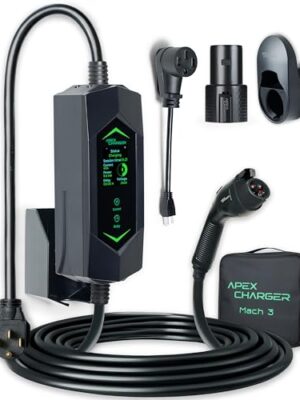
The ApexCharger MACH 3 EV Charger is a portable Level 1/2 dual-connector charger that supports both J1772 and NACS connectors. It features Wi-Fi app control, IP67 weather resistance, and pulsing LED indicators, making it a solid on-the-go and backup charging option.
Charging Speed: 9.6 kW
Max Amperage: 40 Amps
Charging Level: Level 1, Level 2
Connector Type: J1772, NACS
Cable Length: 25 Feet
Connectivity: Bluetooth, Wi-Fi
Installation Type: NEMA 14-50, NEMA 5-15, NEMA 5-20
Smart Features: Yes (BT/Wi-Fi)
Enclosure Rating: IP67
Certifications: CSA, Energy Star, ETL, FCC, UL
More details +
The ApexCharger MACH 3 EV Charger is the best option for EV drivers who want portability without sacrificing speed or smart features. With up to 40 Amps, dual-voltage input, Tesla compatibility, and a rugged, IP67-rated build, it beats most portable chargers on the market - especially in power and feature depth.While the ApexCharger MACH 2 is still the brand’s top-tier home unit, and the MACH 1 is the budget-friendly wall charger, the MACH 3 fills a different and crucial role: on-the-go charging wherever you need it, without calling an electrician.If you need a travel-ready backup or your lifestyle includes frequent road trips, the ApexCharger MACH 3 is one of the smartest, most reliable portable EV chargers available today.
Features
8.5
Real World Usage
9
Materials
8.5
Durability
8.5
Craftsmanship
8.5
Design
8.5
Monetary Value
8.5
Product Value
8.7
Brand Reputation
8.5
Expert Valuation
8.5
PROS:
  • Portable – Plug-in design supports flexible installation.
  • Dual Voltage – Works with both 120V and 240V outlets.
  • Weather-Resistant – Built for reliable outdoor use.
  • Smart Features – App control with scheduling and tracking.
  • Universal – Works with all J1772 EVs and NACS vehicles using the ApexCharger PRO 1 adapter.
CONS:
  • No RFID or user authentication – not ideal for shared or public use
  • No wall-mount option – purely portable
  • Display is small (2.4”) – gets the job done, but less info-rich than MACH 2
  • Limited Tesla App Integration – like all non-Tesla chargers, it won’t show in the Tesla app
Add to compare
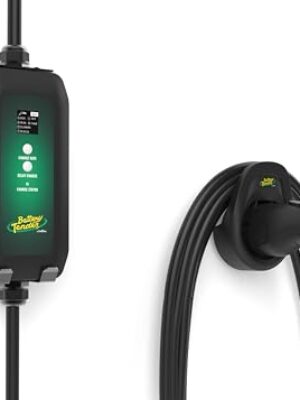
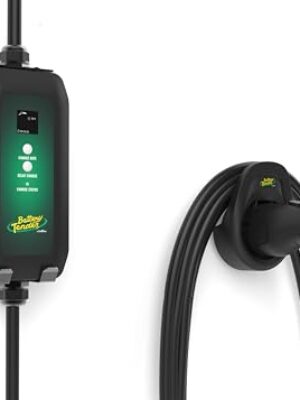
The Battery Tender eCharge 16 AMP EV Charger is a compact and efficient Level 1 charger designed for 120V power, making it perfect for standard wall outlets. Ideal for both indoor and outdoor use, this portable EV charger delivers reliable charging for everyday electric vehicle needs, ensuring convenience and ease of use.
Charging Speed: 2.0 kW
Max Amperage: 16 Amps
Charging Level: Level 1
Connector Type: J1772
Cable Length: 25 Feet
Connectivity: None
Installation Type: NEMA 5-15, NEMA 5-20
Smart Features: No
Enclosure Rating: IP54
Certifications: Energy Star, ETL, FCC
More details +
The eCharge 16 AMP is a simple, affordable, and portable Level 1 charger with standard plugs, ideal for casual EV users, offering good durability and basic functionality, though limited in output, it provides solid value for entry-level needs and maintains Battery Tender’s reputation for reliability.
Features
8.5
Real World Usage
8.5
Materials
8
Durability
8.5
Craftsmanship
8
Design
8.5
Monetary Value
9
Product Value
8.5
Brand Reputation
9
Expert Valuation
8
PROS:
  • Simple plug-and-play design with standard wall plugs (5-15p or 5-20p)
  • Lightweight and easy to transport.
  • Durable enough for various environments.
CONS:
  • Only offers 16A output, which may be slower for some users.
  • Lacks the advanced options of higher-end models.
Show next

Important Key Specs Table Legend: Level 1 = Level 1 only (120V). Level 1/Level 2 = dual-voltage portable (120V or 240V).

How Fast Will an EV Charge on a NEMA 5-20 Charger?

A NEMA 5-20 outlet delivers up to 1.92 kW of power, the absolute maximum of Level 1 charging in the U.S. That works out to 5 to 7 miles of range added per hour.

Over an 8 to 10 hour overnight charge, you get 40 to 70 miles of range. That covers daily commuting for most U.S. drivers with margin to spare.

Full battery recovery still takes a long time. A 75 kWh Tesla Model Y takes about 43 hours to recharge at 1.92 kW. The NEMA 5-20 outlet is fast enough for daily top-ups but not fast enough for overnight empty-to-full charging on a mid-size or large BEV.

What Is a NEMA 5-20 Outlet?

A NEMA 5-20 outlet is a 120V, 20A, 3-prong outlet with a T-shaped left slot. It is the highest amperage 120V outlet used in U.S. residential wiring. Under the NEC 80 percent rule, the maximum continuous load is 16 amps, which delivers 1.92 kW for EV charging. It is the upper ceiling of Level 1 charging in the U.S.

NEMA 5-20 20A 120V outlet

A NEMA 5-20 outlet from a home center costs $8 to $12. The internal contacts and T-blade connection are rated for the load, but cycle fatigue is real at 16 amps continuous for years.

A commercial-grade NEMA 5-20 from Hubbell or Bryant runs 18-28. The blade clamps are heavier, the body materials handle heat better, and the warranty matches the duty cycle. For an EV charger that runs 4 to 8 hours nightly, the upgrade is the highest-leverage reliability fix available.

Replace any 5-20 outlet that shows discoloration, brown marks around the slots, or loose blade fit before installing an EV charger. These signs indicate past overheating, and the outlet will not improve with additional sustained load.

NEMA 5-20 EV Charger Buyer's Guide

Choosing a NEMA 5-20 charger means selecting a single-voltage 16-amp unit or a dual-voltage portable unit. Both work on a 5-20 outlet. The decision depends on whether you move the charger to 240V later. Voltage vs Dual Voltage Chargers

Single Voltage vs Dual Voltage NEMA 5-20 EV Charger

Single-voltage 120V chargers run only on 120V outlets, such as NEMA 5-15 and 5-20. Dual-voltage chargers auto-detect 120V or 240V and switch the output accordingly. Dual voltage costs 50 to 100 dollars more but works on 6-20, 14-50, and other 240V outlets too. If you upgrade to 240V later, the dual-voltage path lets you avoid buying a second charger.

Do Not Use a 5-15 to 5-20 Adapter Going the Wrong Direction

Adapters that convert a NEMA 5-15 plug to fit a NEMA 5-20 outlet are available and safe. The other direction (5-20 plug into a 5-15 outlet) is dangerous and code-violating because the upstream circuit can only carry 15 amps. If your charger has a NEMA 5-20 plug, install a NEMA 5-20 outlet on a real 20A circuit. Do not adapt your way down.

Confirm Your NEMA 5-20 EV Charger Circuit Is Dedicated

A 16-amp continuous load on a 20A circuit leaves only 4 amps for other devices. If your 5-20 outlet is on the same circuit as other loads (lights, garage door opener), the breaker will trip when you charge. The circuit must be dedicated to the EV charger or share only very small loads. If unsure, ask an electrician to confirm the circuit’s other connections.

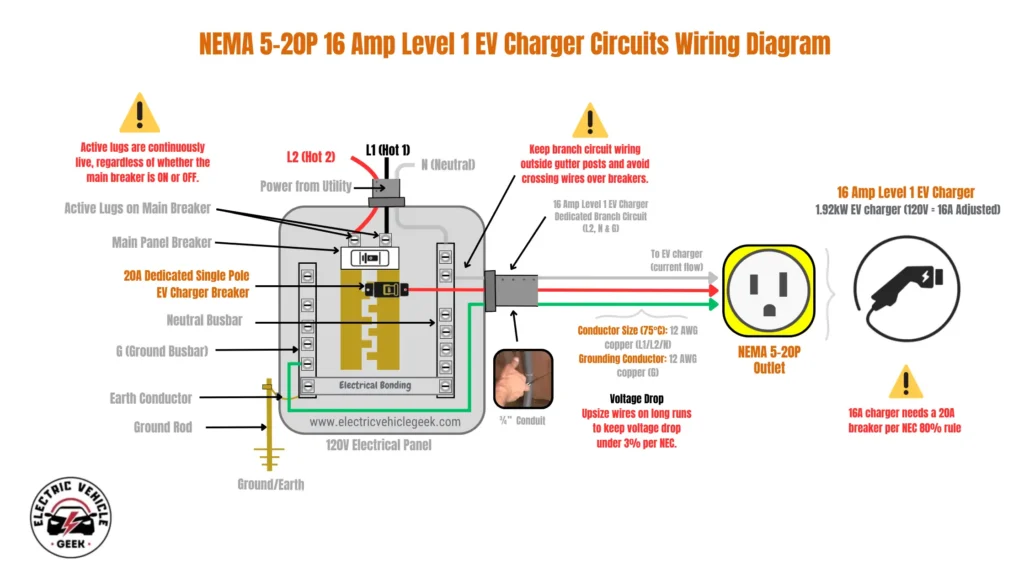
An informative wiring diagram titled "NEMA 5-20P 16 Amp Level 1 EV Charger Circuits Wiring Diagram," created by Electric Vehicle Geek. The diagram illustrates the proper electrical connection for a 16-amp, 120V Level 1 EV charger using a NEMA 5-20P outlet. It shows a 120V electrical panel with power coming from the utility. Inside the panel, a "20A Dedicated Single Pole EV Charger Breaker" is installed. A hot wire (black) connects to this breaker, a neutral wire (white) connects to the neutral busbar, and a ground wire (green) connects to the ground busbar. These three wires, specified as 12 AWG copper, run through a conduit to a NEMA 5-20P outlet. An EV charger with a compatible plug is shown connecting to this outlet. Key information and warnings are highlighted throughout the diagram: "A 16A charger needs a 20A breaker per NEC 80% rule." "Active lugs are continuously live, regardless of whether the main breaker is ON or OFF." "Keep branch circuit wiring outside gutter posts and avoid crossing wires over breakers." "Upsize wires on long runs to keep voltage drop under 3% per NEC." The final charger is specified as a "16 Amp Level 1 EV Charger, 1.92kW."

When NEMA 5-20 Charger Stops Making Sense

A NEMA 5-20 installation gives you a maximum of 1.92 kW. That is the ceiling of Level 1 charging. If you are paying an electrician to install a new circuit anyway, the marginal cost of going to 240V (NEMA 6-20 for 3.84 kW or NEMA 14-50 for 9.6 kW) is small, and the speed gain is huge. Use 5-20 when you already have the outlet. Do not pay to install a new 5-20 circuit when 240V costs barely more.

EVs That Work With a NEMA 5-20 Charger

Most EVs accept NEMA 5-20 charging at the full 1.92 kW. The speed bump over NEMA 5-15 is meaningful for plug-in hybrids and small battery BEVs.

Best matches for a NEMA 5-20 charger include the Toyota RAV4 Prime (full charge in about 11 hours), Jeep Wrangler 4xe (10 hours), Mini Cooper SE (18 hours), Nissan Leaf 40 kWh (23 hours, slightly over one cycle), and Mazda MX-30 (20 hours). Larger BEVs like the Tesla Model Y or the Hyundai Ioniq 5 will charge, but daily recovery only works if you do not arrive home empty.

Related Amp and kW Coverage

A NEMA 5-20 charger supports the same circuit as our 16 Amp EV Charger archive, which covers breaker sizing, conductor gauge, and NEC code citations. For charging speed, mat,h, and vehicle range per hour, see our 1.92 kW EV Charger archive.

NEMA 5-20 EV Charger Frequently Asked Questions

You’ve Got NEMA 5-20 EV Charger Questions, We’ve Got Answers.

Yes. A NEMA 5-15 has two vertical slots and a round ground hole. A NEMA 5-20 has the same layout, but the left slot is T-shaped with a horizontal extension at the bottom. If you see the T, it is a 5-20. The T-shape exists specifically to prevent NEMA 5-20 plugs from being installed on 15A circuits.

Yes. NEMA 5-20 outlets are designed to accept both NEMA 5-15 and NEMA 5-20 plugs. The smaller 5-15 plug fits the upright portion of the T-slot. This is safe because the 20A circuit can easily carry the 12 amps a 5-15 charger draws. The other direction (5-20 plug into 5-15 outlet) does not physically work and is not safe, even with an adapter.

Look at the breaker for that outlet in your electrical panel. A 20A breaker confirms the circuit is rated for the outlet. If the breaker is 15A, the outlet was installed incorrectly, and a 16A EV charger will repeatedly trip the breaker. Have an electrician verify the wiring before relying on the outlet for EV charging.

Yes, by about 33 percent. A NEMA 5-15 delivers 1.44 kW, and a NEMA 5-20 delivers 1.92 kW to a Tesla. Over an 8-hour overnight charge, that is the difference between 24 miles and 32 miles of added range. The speed bump is real but small. For Tesla owners who need real overnight refills, jump to a 240V outlet (NEMA 6-20 or 14-50).

Yes, if the outlet is in a garage, outdoor location, kitchen, or laundry area under NEC 210.8(A). GFCI breakers are available for 20A circuits, or you can install a NEMA 5-20 GFCI outlet. The cost is about $25 to $35 for the GFCI outlet. EV charging on a non-GFCI 5-20 outlet in a garage is a code violation, even though most chargers have internal GFCI.

Only if you hold a residential electrician license, installing a new 5-20 outlet means pulling 12 AWG copper wire, installing a 20A breaker in your panel, and terminating the outlet. Most U.S. jurisdictions require a licensed electrician and a permit for new circuit work. The total cost is typically $ 200 to $ 500, depending on panel access.

Voltage. A NEMA 5-20 is 120V (single hot wire, neutral, and ground). A NEMA 6-20 is 240V (two hot wires plus ground, no neutral). The two outlets are not interchangeable. NEMA 5-20 delivers a maximum of 1.92 kW (Level 1). NEMA 6-20 delivers a maximum of 3.84 kW (Level 2). The plug shapes are different, so you cannot accidentally swap them.

Because the same internal 16-amp current limiter can run on either 120V or 240V if the charger is designed for dual-voltage, plugging it into a NEMA 5-20 delivers 1.92 kW. Plugging the same charger into a NEMA 6-20 with the right adapter delivers 3.84 kW. Dual-voltage gives flexibility but costs more than a 5-20-only single-voltage charger.

Sometimes, slightly. A 16-amp continuous draw can cause a modest voltage drop on shared circuits. If you notice lights dimming when charging starts, the circuit is likely not dedicated to the EV charger. Move the charger to a dedicated circuit, or upgrade the wiring. Persistent voltage drop also reduces the charger's effective output, so fixing it saves charging speed and improves overall electrical health.

Electric Vehicle Geek
Logo
Compare items
  • Total (0)
Compare
4