Supported by you via insider access, and when you purchase through links on our site, we may earn an affiliate commission. See our Affiliate Disclosure.
MPPT Controller for Solar EV Charging (Reviews)
-
 Best Picks By
James Ndungu
Best Picks By
James Ndungu
- last updated February 6, 2026

Our MPPT Controller Reviews focus on real-world performance for both off-grid and grid-tied EV charging setups. Based on hands-on testing and expert evaluations, we dig into build quality, efficiency, smart features, integration ease, and reliability, the key factors that make or break your solar EV charging system.
What Is an MPPT Solar Charge Controller?
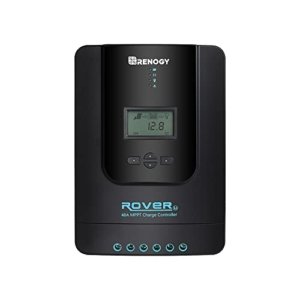
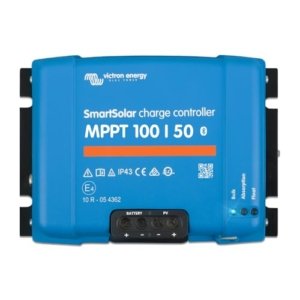
An MPPT solar charge controller is a key device that makes your solar system more efficient at turning sunlight into battery power for EV charging. It constantly finds the best way to capture energy from your solar panels, even in low light or cloudy conditions. This means higher energy output, faster EV charging, and more flexible solar panel setups.
We’re here to help you choose the right MPPT solar charge controller for your solar EV charging system and guide you in designing and building a reliable, high-performing solar EV charging set-up.
Buyer’s Guide
Choosing an MPPT Controller for Off-Grid and Grid-Tied EV Charging
Picking the right MPPT (Maximum Power Point Tracking) controller is key for a smooth solar EV charging setup. This device manages the power from your solar panels and sends it safely to your battery bank or EV charger.
Choosing the right MPPT controller can save you time, money, and hassle. It helps your solar EV charger run efficiently and last longer. Keep these tips in mind, and you’ll find a controller that fits your needs.
Here’s what to look for when buying one.
Efficiency Matters
MPPT controllers are more efficient than older PWM types because they find the best power point for your solar panels. Look for controllers with fast and accurate MPPT tracking. This helps you get the most energy, even when clouds pass or light changes.
Current and Voltage Ratings
Make sure the controller can handle the voltage and current your solar panels produce. For example, if your panels put out 48 volts and 40 amps, pick a controller rated for at least that. It’s better to have some extra capacity to avoid overheating and damage.
Battery Compatibility
Check that the controller supports your battery type, whether it’s lithium or another kind. Each battery chemistry needs different charging settings for safety and longevity.
Energy Management System Communication
A quality MPPT controller doesn’t work alone; it communicates closely with your energy management system (EMS). Think of the EMS as the brain that makes smart decisions about where your solar power goes.
In grid-tied solar EV charging systems, the EMS coordinates power flow between your solar panels, home loads, EV charger, and the utility grid. It ensures you use as much solar power as possible while maintaining grid stability and avoiding overloads.
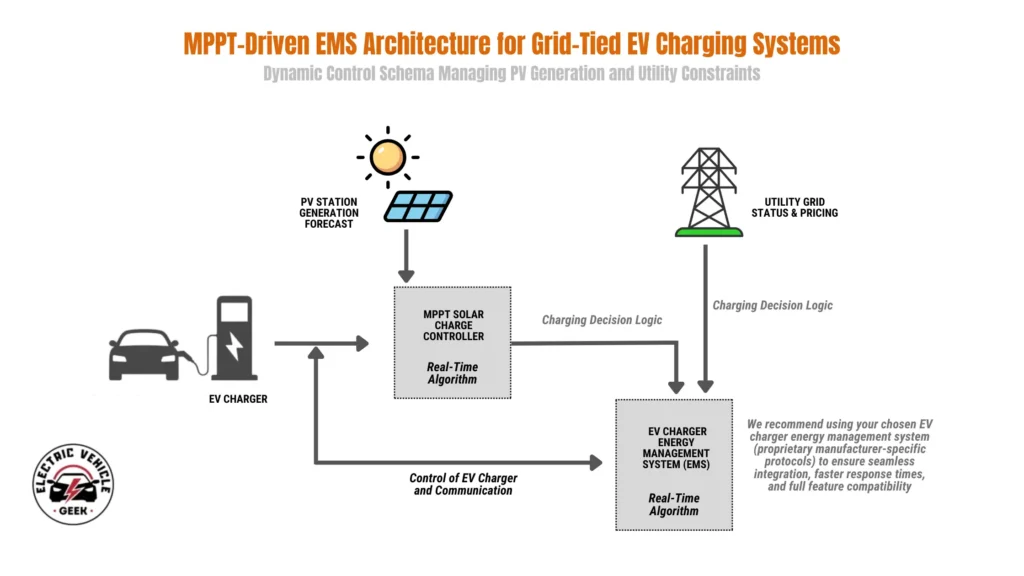
For off-grid EV solar charging setups, the EMS manages limited solar energy carefully. It monitors battery charge levels, house energy use, and off-grid EV charger demands. This helps prevent draining the batteries too low, which can reduce battery life or cause system shutdowns.
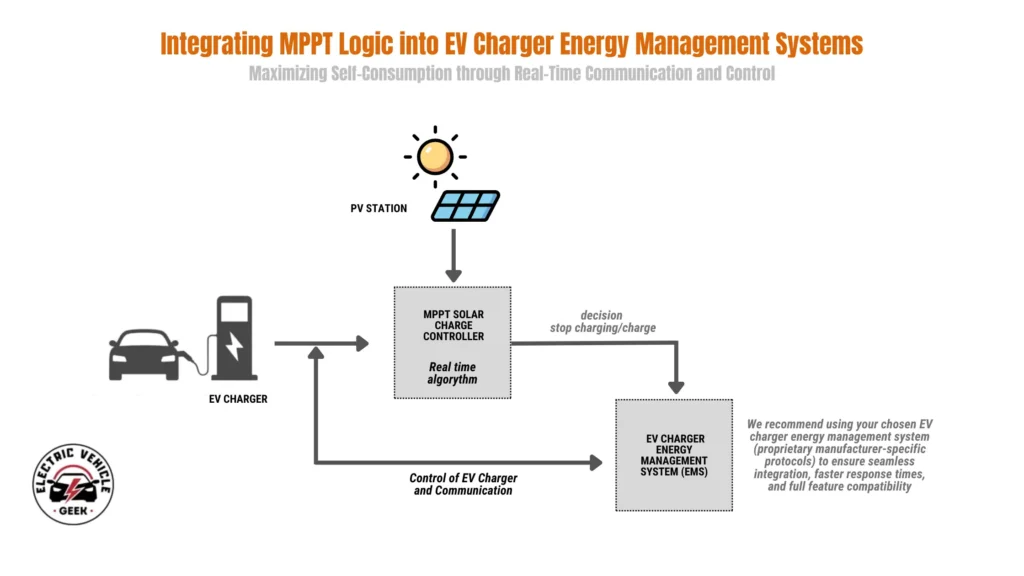
Communication between the MPPT controller and EMS usually happens via Bluetooth, Wi-Fi, or dedicated wired connections. This real-time data exchange lets the EMS adjust charging rates dynamically based on solar availability, battery health, and home energy needs.
Choosing an MPPT controller that supports seamless EMS integration is critical for optimizing your solar EV charging system’s efficiency and reliability, especially when balancing multiple energy sources, multiple loads, and multiple EV chargers sharing a single solar EV charging system.
Smart Features and Connectivity
Many modern controllers connect to apps via Bluetooth or Wi-Fi. This lets you monitor solar production, battery health, and adjust settings from your phone or computer. These features make managing your system easier.
Thermal and Safety Features
Good controllers have heat sinks and sometimes fans to keep cool. They also include safety protections like overcurrent, overvoltage, and short-circuit prevention. These keep your system safe and reliable.
Installation and Wiring
Pay attention to the wiring terminals and space. Larger wires need room to fit and bend safely. Make sure you or your installer follows torque specs to avoid loose connections, which can cause heat buildup.