Grid-tied solar EV charging is the most practical and cost-effective way to power an electric vehicle with renewable energy. It allows your solar panels, your utility grid, and your EV charger to operate as one coordinated system.
You are not replacing the grid.
You are optimizing how you use it.
In this setup, solar production, household demand, and vehicle charging are balanced in real time. The grid acts as a stabilizer, absorbing excess energy and supplying additional power when needed.
For most homes with reliable utility service, this is the smartest long-term home solar EV charging strategy.
Table of Contents
- Grid-Connected Solar EV Charging Architectures
- The Three Operational Modes
- Load Balancing and Electrical Protection
- Smart Communication and Protocols
- How Grid-Tied Solar EV Charging Works with TOU Rates
- Safety and Anti-Islanding Protection
- Inverter Performance and Clipping
- Bi-Directional Energy and the Future
- Real-World Expectations
- Cost and Practicality
- Grid-Tied Solar EV Charging vs Off-Grid EV Charging
- Our Grid-Tied Solar EV Charging Project
- The Bottom Line
Grid-Connected Solar EV Charging Architectures
As electric vehicles (EVs) become more popular, finding clean, efficient charging solutions is critical for a sustainable future. Solar energy is a perfect fit because it’s renewable and abundant. However, integrating solar power with EV charging and the electric grid comes with technical challenges.
Solar panels produce electricity in direct current (DC) form, while EV batteries store energy as DC. Meanwhile, the utility grid supplies alternating current (AC). This difference means that any solar EV charging system connected to the grid must carefully manage power flow and conversions between DC and AC.
There are three main ways to set up grid-connected solar EV charging systems, called architectures, that handle these conversions differently: AC microgrid architecture, DC microgrid architecture, and a combination of both, known as hybrid microgrid architecture.
Each architecture has strengths and weaknesses depending on factors like efficiency, cost, ease of expansion, and charging speed. Understanding how they work helps homeowners, businesses, and planners choose the best system for their needs.
Let’s start by exploring the AC microgrid, the most common and accessible option for homes and readers of Electric Vehicle Geek.
AC Microgrid Architecture for Grid-Connected Solar EV Charging
In an AC microgrid architecture, solar panels, battery storage, and EV chargers all connect to a shared alternating current (AC) power line known as the AC bus. Since the grid and most household electrical devices use AC power, this design fits naturally with existing electrical systems.
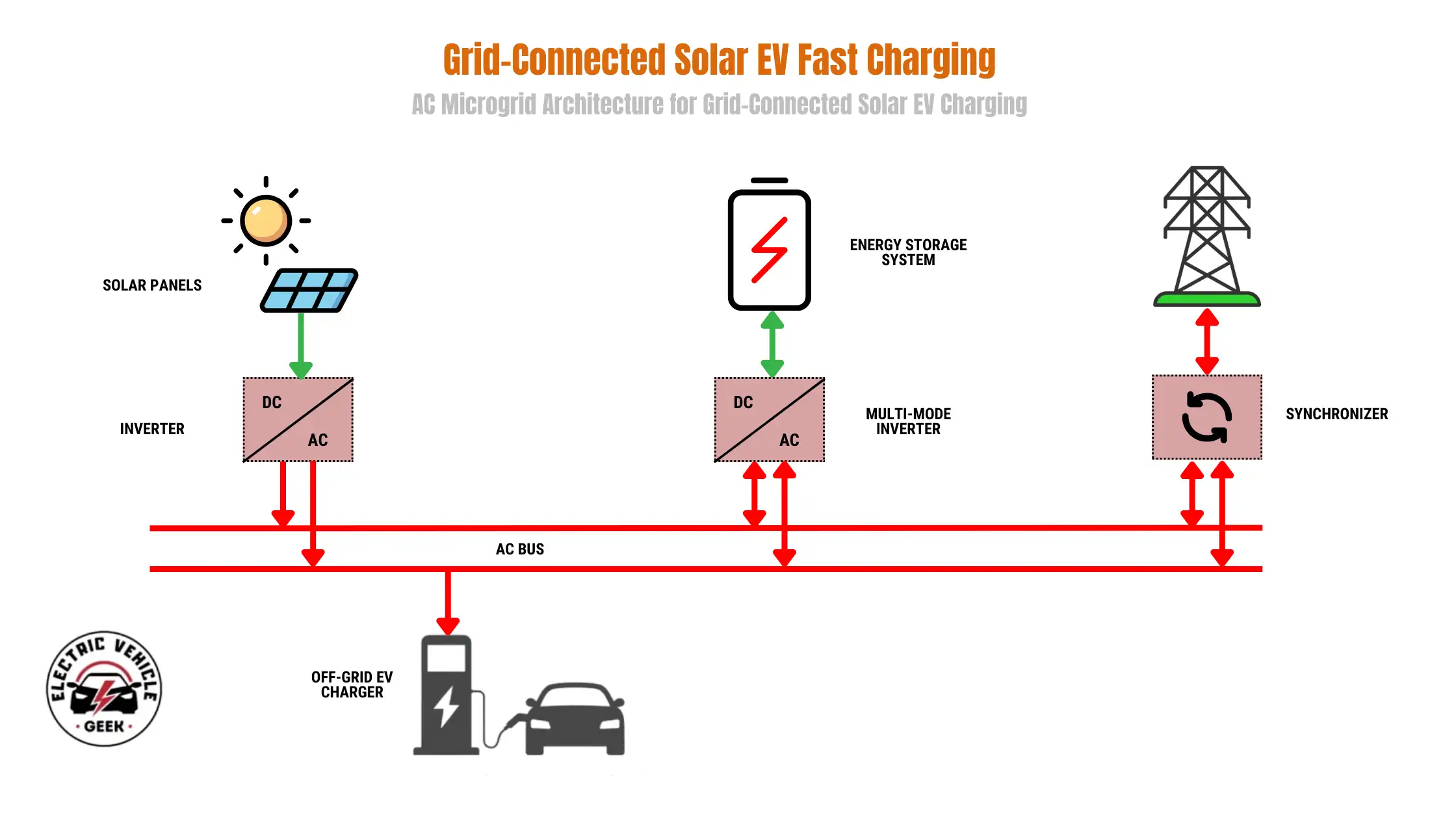
Solar panels generate direct current (DC) electricity, but an inverter converts it to AC before sending it to the AC bus. Similarly, battery storage uses a bidirectional inverter to both draw and supply AC power as needed. EV chargers, especially Level 1/2 AC chargers, rely on the vehicle’s onboard converter to change AC back into DC for battery charging.
This setup benefits from using standard, off-the-shelf equipment that is widely available and easy to install. It’s also flexible: adding more solar panels or chargers is often as simple as connecting to the AC distribution system.
However, there’s a tradeoff. The system experiences some energy loss because solar power must be converted twice: first from DC (solar panels) to AC (bus), then from AC back to DC (EV battery). Each conversion causes about a 3-5% efficiency loss. For many home and workplace scenarios where charging happens over several hours, this loss is acceptable considering the system’s simplicity and lower cost.
DC Microgrid Architecture for Grid-Connected Solar EV Charging
By contrast, the DC microgrid architecture keeps power as direct current (DC) throughout the system wherever possible. This design links solar panels, batteries, and EV fast chargers via a high-voltage DC bus, reducing the number of energy conversions.
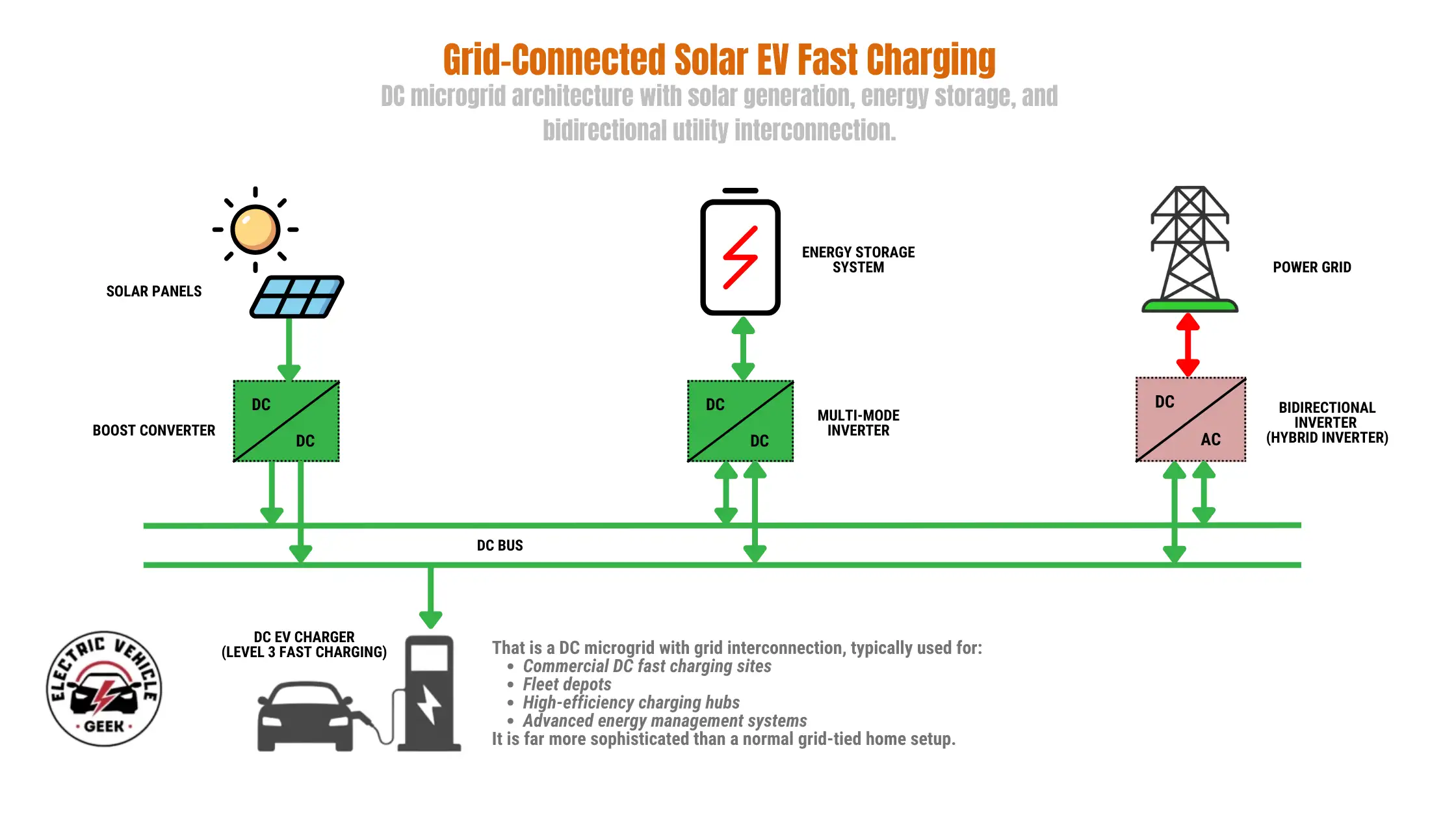
Solar panels connect through DC/DC converters with maximum power point tracking (MPPT) to optimize solar energy collection. EV chargers connect directly to the DC bus via their own DC/DC converters, bypassing the vehicle’s onboard AC charger. Battery storage also ties into the DC bus.
Because the power stays in DC form from the panels all the way to the EV battery, the system avoids the conversion losses seen in AC microgrids. This makes DC microgrids significantly more efficient, which is crucial for fast charging hubs where large amounts of energy are delivered quickly.
Another advantage is centralized control: there’s typically a single large inverter interfacing the DC microgrid with the AC utility grid. This makes it easier to manage peak power loads and grid demand, reducing strain on local transformers.
The downside is that DC microgrids require specialized equipment, like DC breakers and advanced controllers, which can increase upfront costs and complexity. Careful engineering is also needed to maintain system safety and voltage stability.
Because of these factors, DC microgrids are best suited for commercial fast-charging stations and high-power applications.
Hybrid AC and DC Microgrid Architecture for Grid-Connected Solar EV Charging
A hybrid microgrid architecture combines the advantages of both AC and DC microgrids to build a flexible, efficient solar EV charging system. This setup features both AC and DC power buses, allowing different devices to connect to the bus that best matches their electrical requirements.
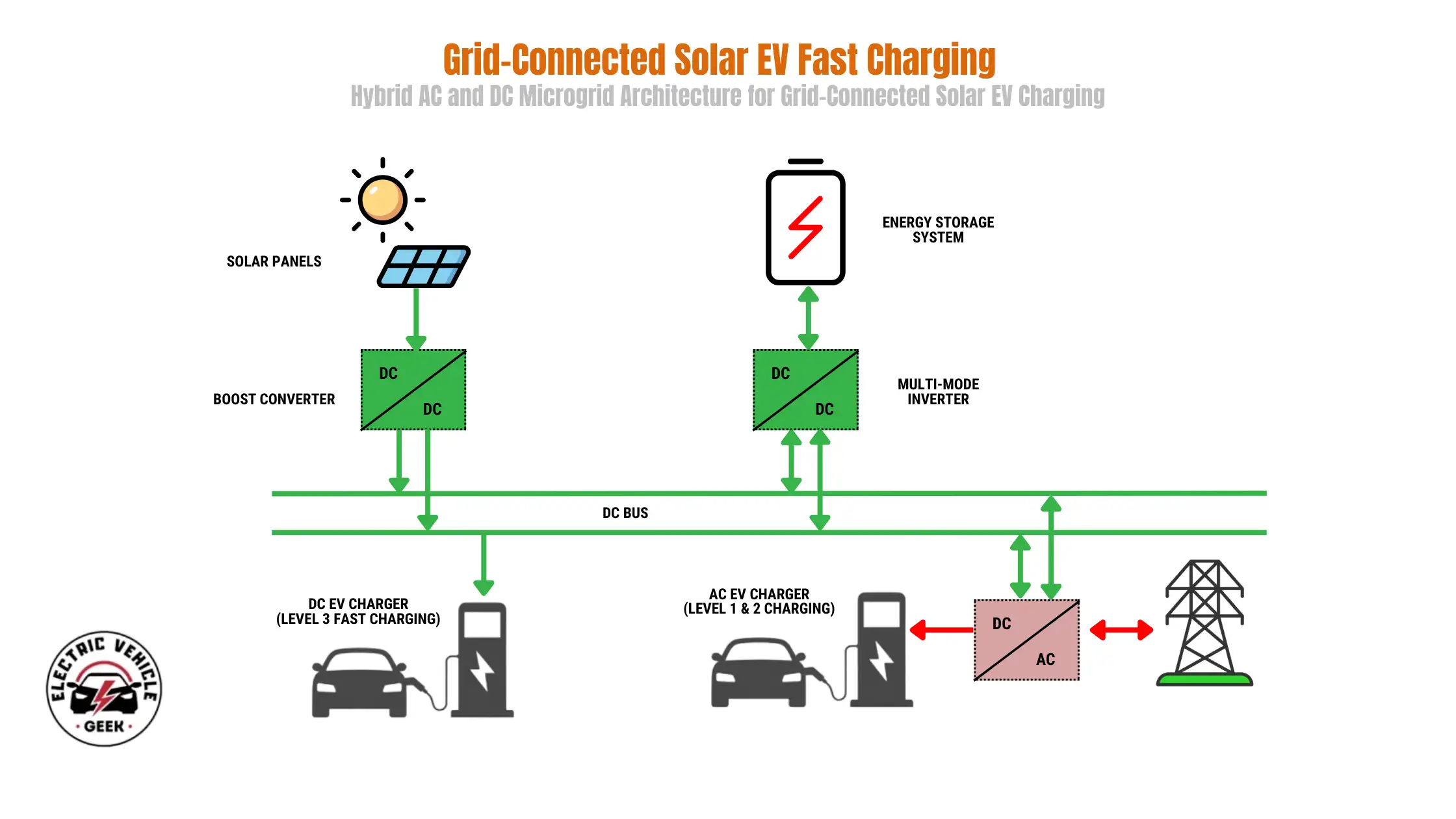
In a hybrid system, solar panels and battery storage feed power to both AC and DC buses through inverters and converters. Some solar energy may be converted to AC to power existing building loads and Level 1/2 AC chargers, while other energy flows as DC directly to fast chargers or battery banks for minimal loss charging.
This approach allows the system to maximize energy efficiency by reducing unnecessary conversions. It also offers great flexibility, supporting a mix of slower AC chargers and fast DC chargers in one location.
The hybrid system improves grid interaction by balancing loads between AC and DC buses, helping to manage energy flow and reduce stress on the grid. Additionally, it is highly scalable: new solar panels, batteries, or chargers can be added to either bus without needing to redesign the entire system.
Hybrid microgrids are ideal for places with varied charging needs, like workplaces, public parking lots, or multi-use garages, where different EVs charge at different speeds.
The Three Operational Modes
A grid-tied solar EV charging system constantly shifts between three modes depending on weather, load demand, and time of day.
Self-Consumption Mode
During strong sunlight, your panels power the home and charge the vehicle simultaneously. Excess production is diverted into the EV battery.
Solar diversion allows the charger to absorb only the surplus energy that would otherwise be exported.
This requires real-time monitoring, typically using CT clamps installed at the service panel. These sensors communicate with the charger and measure production and import levels.
When properly configured, this mode delivers the highest efficiency.
Grid Supplement Mode
Cloud cover reduces production. Evening arrives. Charging demand exceeds solar capacity.
The grid automatically supplies the shortfall.
If your Level 2 charger is set to 40 amps and solar is only producing enough for 18 amps, the remaining power is drawn from the utility seamlessly.
There is no interruption. No manual switching. No performance drop.
This is the core advantage of grid-tied architecture.
Net Metering Mode
When your EV is fully charged, and home loads are low, excess solar energy exports to the grid.
Under Net Metering, your utility credits the energy. Those credits can offset nighttime EV charging or cloudy-day consumption.
In regions with favorable NEM policies, your effective EV fueling cost can be dramatically reduced.
Load Balancing and Electrical Protection
EV charging is classified as a continuous load under NEC rules. A 40-amp charger requires a 50-amp breaker due to the 125 percent rule.
Without proper load balancing, high demand from HVAC systems, ovens, or water heaters can trip your main breaker.
Smart EV chargers solve this by dynamically adjusting amperage based on total household load. When demand spikes, charging current reduces automatically.
This prevents costly service panel upgrades and protects wiring from thermal stress.
In solar-only modes, charging may drop into a trickle charge state. Trickle charging uses low amperage when production is minimal, allowing you to absorb small amounts of surplus solar instead of exporting it.
It is slower, but highly efficient.
Smart Communication and Protocols
Modern grid-tied systems rely on smart device communication to manage energy intelligently.
Many advanced EV chargers support OCPP, the Open Charge Point Protocol. OCPP allows chargers and energy management platforms to work together, enabling monitoring, scheduling, and dynamic current control.
At the hardware level, communication methods like Modbus and CAN bus let inverters, MPPT solar charge controllers, smart EV chargers, and EV charger management systems exchange real-time data. The MPPT controller helps get the most power from solar panels by constantly adjusting the energy flow.
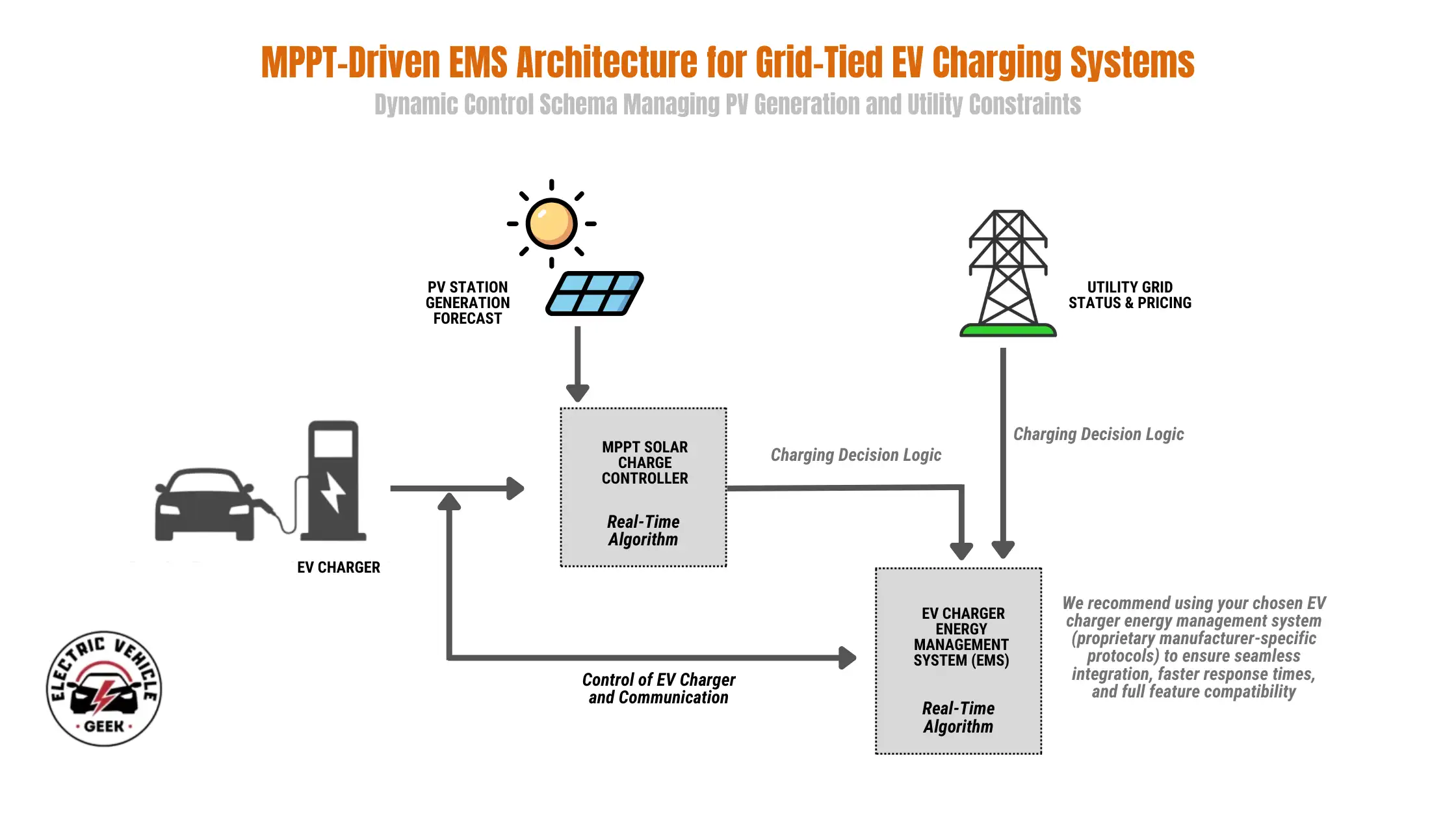
An Energy Management System (EMS) acts like the “brain” of the setup. It uses this data to balance loads by watching solar power, battery charge, and grid conditions. The EMS adjusts the EV charger’s signal so the car uses extra solar energy when available and slows down during busy industrial times. This helps prevent overheating in inverters and avoids draining the battery too much.
CT clamps provide the real-time current measurements that make all this possible. Without them, the charger can’t tell whether you are importing power from the grid or exporting solar energy back.
This smart communication enables solar diversion, load balancing, and dynamic charging adjustment for better efficiency and equipment protection.
How Grid-Tied Solar EV Charging Works with TOU Rates
Utility companies often use Time-of-Use (TOU) pricing. Electricity costs more during peak hours and less during off-peak periods. A well-set-up grid-tied solar system works perfectly with this pricing structure to maximize your savings.
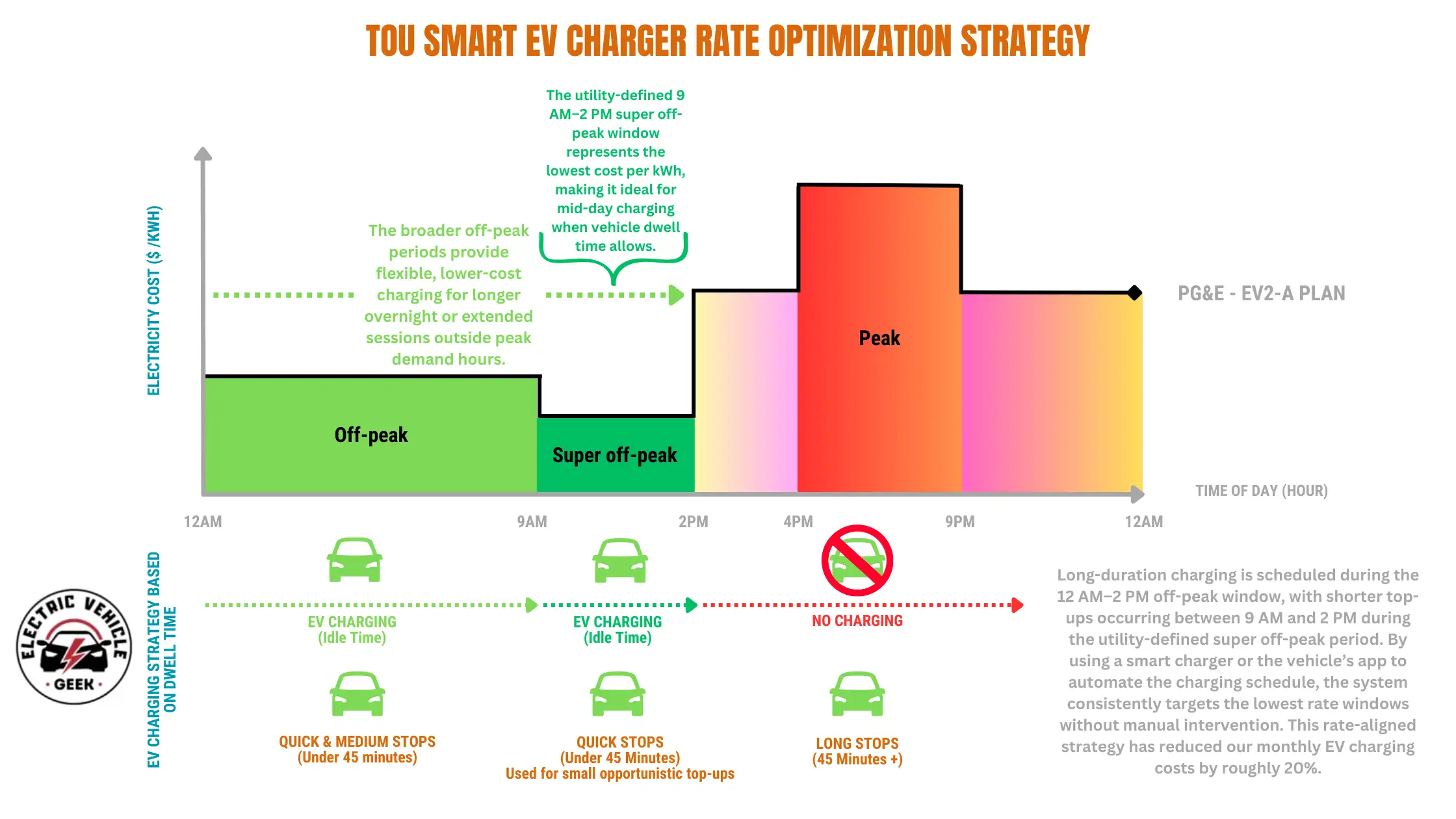
During sunny midday hours, your solar panels produce the most power. Using this solar energy to charge your EV means you avoid paying retail electricity prices completely. This is especially valuable during super off-peak hours from 9 AM to 2 PM when solar production is highest. When solar production drops or isn’t available, you can schedule charging during off-peak hours to keep costs low.
For homes with solar panels and battery storage like Tesla Powerwalls, the strategy becomes even more flexible. We charge our EVs from the grid during super off-peak hours when electricity rates are lowest, while solar panels recharge the batteries during the day. During peak hours from 4 PM to 9 PM, stored battery energy can be sent back to the grid at premium rates for maximum profit.
Smart Charging Modes Give You Control
Smart EV chargers let you switch between Eco mode and Boost mode depending on your needs.
Eco mode prioritizes solar-only charging.
The charger automatically adjusts the charging current to match whatever power your solar panels are producing right now. This means you’re charging purely on free solar energy without drawing from the grid. It’s perfect for daytime charging when you’re not in a hurry.
Boost mode combines both solar and grid power together.
When you need your car charged quickly, Boost mode delivers maximum charging speed by using every available power source. This mode is perfect when time matters more than cost, like before an unexpected trip.
Professional Configuration Makes It Automatic
Professional setup ensures your system works seamlessly with both your solar production patterns and your utility’s pricing schedule. An expert can program your charger to automatically switch modes based on time of day, solar production levels, and your utility’s rate structure. This takes all the guesswork out and maximizes your savings without you having to manage it daily.
Safety and Anti-Islanding Protection
All grid-tied inverters must include anti-islanding protection.
If the grid loses power, the inverter shuts down automatically to prevent energizing a dead line where utility workers may be present.
This means that without battery storage or hybrid inverter capability, solar systems will not operate during outages.
This is not a flaw. It is a safety requirement.
Homeowners seeking outage protection must consider hybrid systems with battery storage or V2H-compatible vehicles.
Inverter Performance and Clipping
Solar EV charging system accessories, such as the solar EV charger inverter, must be properly sized to avoid excessive inverter clipping.
Inverter clipping occurs when your solar array produces more DC power than the inverter can convert to AC. The excess energy is lost as unused potential.
Strategic DC oversizing can improve annual yield, but excessive clipping reduces efficiency and increases thermal stress.
Professional system design balances array capacity and inverter rating carefully.
Bi-Directional Energy and the Future
Advanced grid-tied systems are beginning to integrate V2G, V2H, and broader V2X capabilities.
Vehicle-to-Grid allows the EV to send power back to the utility.
Vehicle-to-Home allows the EV to power your house during outages.
These systems require compatible vehicles, bidirectional chargers, and regulatory approval.
While still emerging in residential markets, they represent the next phase of grid-interactive energy ecosystems.
Real-World Expectations
In strong summer conditions, a properly sized 10 kW system can offset both household loads and daily EV commuting.
In winter, production decreases, and the grid supplements automatically.
There are no autonomy calculations. No generator starts. No battery state-of-charge stress unless you add storage.
The system is dynamic, stable, and scalable.
Cost and Practicality
A typical grid-tied home solar EV charging installation includes an 8–12 kW solar array, a UL-listed grid-tie inverter, a Level 2 smart EV charger, and professional installation.
Costs generally range from $18,000 to $35,000 before incentives, depending on region and roof complexity.
This is significantly lower than building an off-grid solar EV charging microgrid because you are not required to install bigger energy storage systems, typically 80–100 kWh of lithium storage is required for off-grid systems.
The grid functions as your virtual battery.
Grid-Tied Solar EV Charging vs Off-Grid EV Charging
Grid-tied solar EV charging and off-grid solar EV charging are built for different objectives.
A grid-tied system works with the utility. Solar powers your home and EV first through self-consumption, and the grid supplements when production drops. Excess energy flows back through net metering. The grid acts as a virtual battery.
Off-grid EV charging removes that safety net. Every watt must be generated and stored on-site. Large lithium battery banks, industrial inverters, and strict load management are required to support continuous EV charging.
Grid-tied systems prioritize efficiency and lower cost.
Off-grid systems prioritize total energy independence at significantly higher complexity and expense.
See Our Professional Guide to Off-Grid EV ChargingOur Grid-Tied Solar EV Charging Project
This project showcases the design, installation, and cost analysis of a grid-tied solar-powered EV charging system. It highlights real-world performance and savings to help you understand the benefits of combining solar energy with grid-connected EV charging.
See Our Grid-Tied Solar EV Charging ProjectThe Bottom Line
Grid-tied solar EV charging isn’t about cutting ties with the utility.
It’s about optimizing how energy flows through your home and vehicle.
By leveraging self-consumption, solar diversion, load balancing, net metering, Time-of-Use pricing, and smart communication protocols, the system continuously balances supply and demand.
The grid ensures stability.
Solar delivers savings.
Intelligent controls maximize efficiency.
For most homeowners with dependable utility service, this setup offers the ideal mix of cost-effectiveness, reliability, and long-term value.
It’s not a standalone power plant.
It’s a grid-interactive energy ecosystem built to integrate seamlessly with existing infrastructure.

James Ndungu is a certified EV charger installer with over five years of experience in EVSE selection, permitting, and installation. He holds advanced credentials, including certification from the Electric Vehicle Infrastructure Training Program (EVITP) and specialized training in EV charging equipment and installation, as well as diplomas in EV Technology and Engineering Fundamentals of EVs. Since 2021, James has tested dozens of EV chargers and accessories, sharing expert insights into the latest EV charging technologies.