Victron MPPT 100/50 Solar EV Charging Review

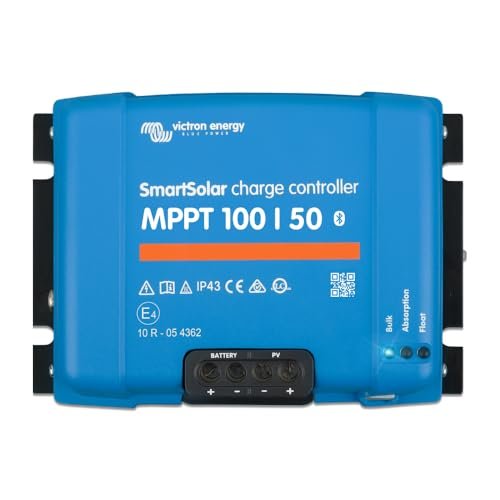
Victron SmartSolar MPPT 100/50 is a high-efficiency solar charge controller delivering up to 50A with ultra-fast MPPT tracking, Bluetooth connectivity, VictronConnect app integration, and robust build quality for reliable off-grid and grid-tied EV charging systems
After testing many MPPT controllers for solar EV charging over the years, I found the Victron MPPT 100/50 Smart Solar Charge Controller to stand out for its build quality, reliability, and smart features. In this review, I’ll share my hands-on experience using it in a real-world off-grid EV charging system
Overview and First Impressions
I’m pretty picky about charge controllers because they’re the “traffic cop” between your panels and your battery bank. If that part isn’t solid, everything else suffers. I’ve always loved Victron components and their VictronConnect app for how reliable and user-friendly they are. Recently, I used the Victron SmartSolar MPPT 100/50 in a small off-grid solar EV charging system, and in my experience, it’s one of the most reliable pieces in my configuration.
Right out of the box, it feels dense and well-built. It’s heavier than it looks, and the aluminum heat sink has that solid, industrial feel.
Build Quality and Terminal Performance
When I landed the 6 AWG wires into the terminals, the clamp pressure felt firm and precise. No spongy screws. That matters when you’re building an off-grid solar EV charging branch circuit.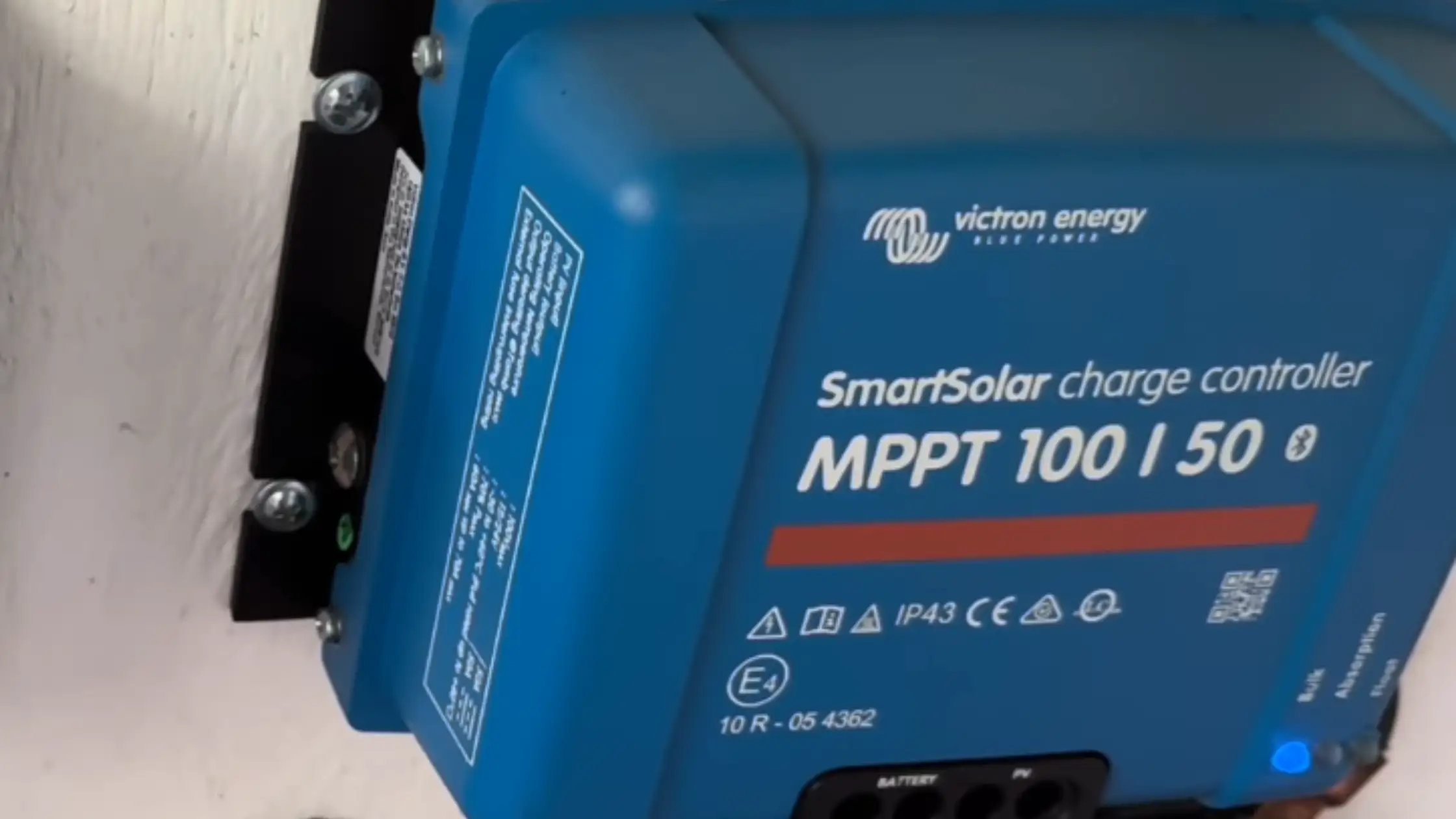
Real-World MPPT Performance During EV Charging
I tested it on a partly cloudy day while charging a home battery bank that feeds an off-grid Level 2 EV charger. This is where the 100/50 really shines. The ultra-fast MPPT tracking isn’t marketing fluff. I watched the live data on the VictronConnect app, and you can actually see it hunting and locking onto the best power point as clouds roll in.
Compared to the EPEVER Tracer AN Series, the difference is night and day in features, efficiency, integration, and future-proofing. The EV battery charges faster, and the system automatically disconnects loads if the battery voltage drops too low.
Bluetooth Setup and App Experience
The Bluetooth setup was painless. I really appreciated being able to remotely use the VictronConnect app to tweak charge settings from my phone. The LED indicators are bright but not blinding at night.
Since it’s fanless, there’s no annoying hum. Just silent operation, even when pushing close to 50 amps.
Historical Data and Solar Sizing Insights
One small thing I loved? The detailed historical graphs in the app. Most people overlook that. But when you’re trying to size solar for EV charging, those daily yield numbers help you see if you’re actually covering your driving miles.
Thermal Management and Field Safety Notes
From a field perspective, here’s something important. While 6 AWG copper is typically fine for 48A continuous loads, I’ve seen terminal heat buildup become the weak point in unconditioned garages above 100°F.
Lug torque matters. I torque to spec, not “hand tight.” Micro-gaps can increase resistance over a long overnight EV charge. If your PV run is long, think about voltage drop and thermal headroom, not just ampacity.
System Integration with Victron GX
Integration is another win. Paired with a Victron GX device, you can prioritize charging your home battery first, then divert excess solar to your EV charger. That kind of control makes a real difference in off-grid or hybrid setups.
System Integration EV Charger Energy Management System
In my setup, the MPPT 100/50 doesn’t directly control the EV charger. It works as the solar harvesting engine. It feeds real-time production data to a Victron GX device, which acts as the system brain.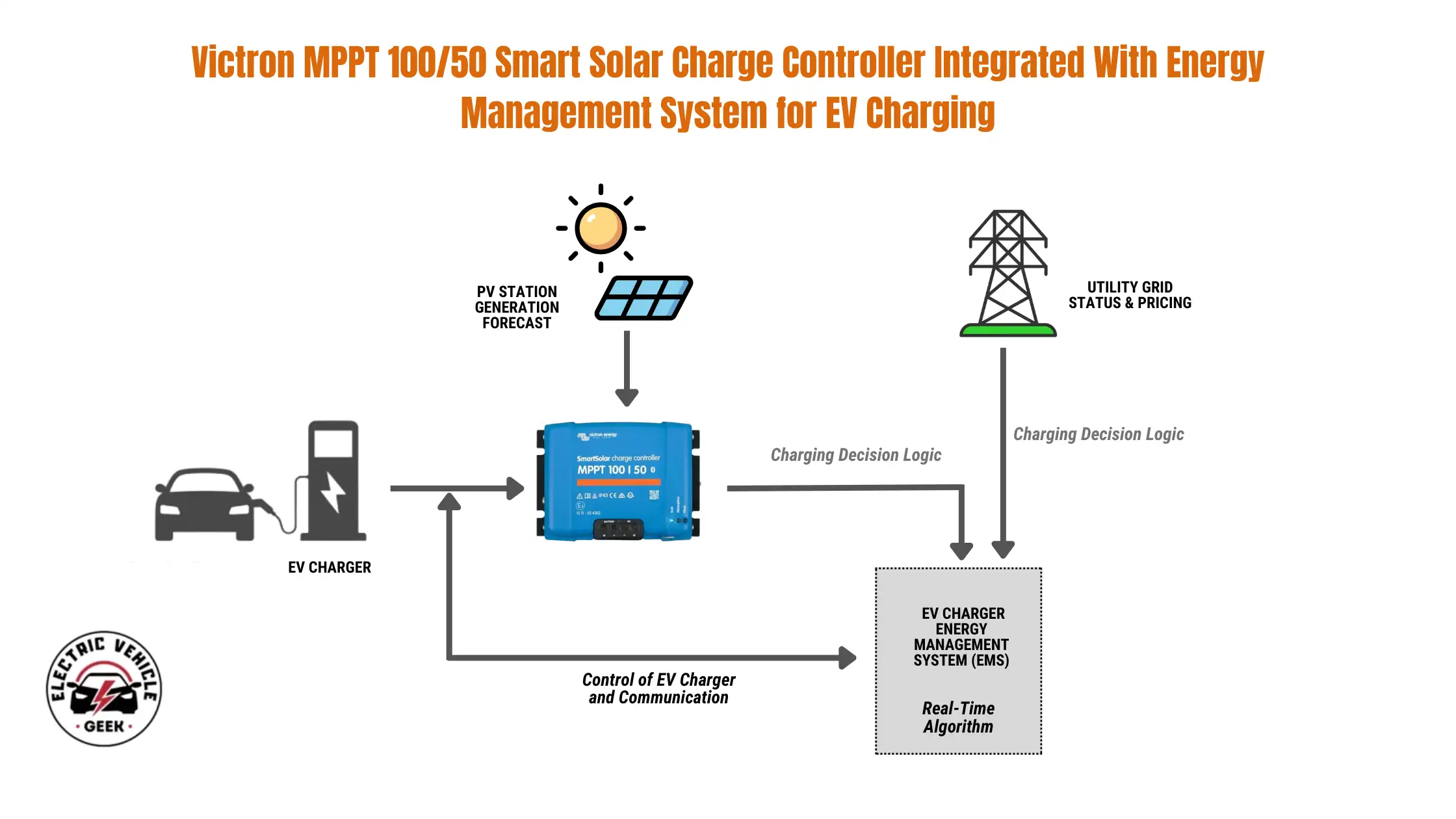
From there, the energy management logic decides how much power the EV charger is allowed to draw based on:
- Battery state of charge
- Total house loads
- Available solar input
On a strong sunny day, once my batteries are nearly full, the system allows higher EV charging current. But if clouds roll in or loads spike in the house, the charging throttles down automatically. I don’t have to step in and manage it manually.
That balance is critical in an off-grid home. The MPPT produces the power. The energy management system decides where it goes.
Final Verdict: Is the Victron SmartSolar 100/50 Worth It?
Overall, I trust the Victron 100/50. It’s not the cheapest controller out there, but in my experience, it earns its price in efficiency, reliability, and data visibility. For solar EV charging, that peace of mind is worth it.
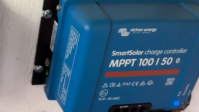 The Victron SmartSolar MPPT 100/50 impresses with solid build quality and reliable performance for both off-grid and grid-tied EV charging. Its fast MPPT tracking and seamless VictronConnect app integration make monitoring effortless. Tight wiring space is a minor drawback, but overall, it delivers efficiency and peace of mind for serious solar setups.
- Solid build quality
- Reliable performance
- Fast MPPT tracking
- Seamless VictronConnect app integration
- Fanless, silent operation
- Detailed historical data
- Good system integration with other Solar EV charging accessories
- Tight wiring space
- Terminal heat buildup risk in hot environments
- Higher price point
There are no reviews yet.