If you have an EV charger installed at home or your business, it’s important to know that, like any smart device, it could be vulnerable to hacking if not properly secured. EV chargers communicate with your car and often connect to your home network, which means attackers/cybercriminals could potentially exploit weaknesses.
Vulnerabilities in the charging ecosystem, including chargers, EV charging accessories, smartphone apps, back-end networks, and communication protocols, could expose personal and EV charging data, disrupt service, or potentially affect the power grid.
For example, during the Pwn2Own Automotive 2025 hacking competition sponsored by Tesla and Alpitronic, Synacktiv demonstrated how the Tesla Gen 3 Wall Connector’s firmware could be downgraded to an older version with debug features. This downgrade allowed them to bypass security measures and gain control of the charger through the charging port in just 18 minutes.
This exploit exposed serious flaws not only in the charger’s update system but also underscored the importance of protecting the charger physically from unauthorized personnel, as physical access can be a critical factor in such attacks. Securing both firmware and physical access is essential to safeguarding all EV chargers.
Here’s a straightforward guide to help you keep your EV charger and your EV charging network safe from hackers.
Table of Contents
- How You Can Protect Your EV Charger from Being Hacked
- Purchase Chargers Supporting the Latest Communication Protocols
- Install Your Charger in a Secure Location
- Keep Firmware and Software Updated
- Use a Separate Network or VLAN
- Avoid Public or Shared Wi-Fi for Your Charger
- Monitor Your Network for Unusual Activity
- Choose Certified and Experienced Installers
- Secure Your Home Network
- What Should Manufacturers Do?
- Final Tips
How You Can Protect Your EV Charger from Being Hacked
Purchase Chargers Supporting the Latest Communication Protocols
When selecting an EV charger, prioritize models that support the most up-to-date communication protocols and security standards, such as the Autel MaxiCharger 80A, which supports the Open Charge Point Protocol (OCPP) 2.0.1.
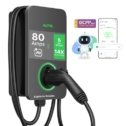
Autel MaxiCharger 80A EV Charger Review Best Smart Features
This protocol offers enhanced security features, including certificate-based authentication, improved device management through a modular device model, and native Plug & Charge (ISO 15118) integration. Compared to earlier versions such as OCPP 1.6, OCPP 2.0.1 enables smarter charging, improved diagnostics, reservation capabilities, and seamless smart grid integration.
Although adoption of OCPP 2.0.1 is still growing, with newer versions like 2.1 emerging, it remains a crucial standard for future-proofing your charging infrastructure. Chargers supporting these modern protocols benefit from stronger encryption, robust authentication, and advanced safeguards against common vulnerabilities, significantly reducing the risk of interception, unauthorized access, and manipulation. Choosing a charger with current, well-maintained protocols helps ensure your EV charging system remains secure against evolving cyber threats.
Additionally, we recommend purchasing EV charging accessories, such as cables, connectors, and network modules, from the same manufacturer as your charger to ensure compatibility and interoperability and enhance overall system security. Brand-matched EV charging accessories are designed to meet the manufacturer’s specifications and security standards, reducing the risk of hardware-related vulnerabilities and ensuring seamless communication across all components of your charging setup.
Install Your Charger in a Secure Location
Ensure your EV charger is installed in a secure location accessible only to trusted individuals. We recommend investing in a dedicated EV charger lockbox, such as the Ufixed Outdoor EV Charger Enclosure, especially for outdoor EV charger installations.
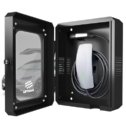
Ufixed Outdoor EV Charger Enclosure Review Best Overall
Avoid mounting the device in public or unsecured areas vulnerable to physical tampering. Additionally, disable any unused ports and interfaces to minimize attack surfaces and implement role-based access control within the charger’s firmware to restrict unauthorized access at the software level.
Keep Firmware and Software Updated
We have seen real-world cases of firmware vulnerabilities being exploited. One notable example is the WOLFBOX Level 2 EV Charger, where a security researcher successfully chained multiple firmware flaws, one of which was already known but not fully mitigated. Another example is the Tesla Wall Connector, where a numeric range comparison vulnerability (CWE-839) in the firmware allowed attackers to gain control remotely.
EV charger manufacturers regularly release firmware updates to fix security flaws, patch known vulnerabilities, and improve overall performance. Many of these issues are not visible to users but can be exploited remotely over a network if left unaddressed.
We recommend always installing official firmware updates as soon as they become available. Avoid offline or manual upgrades unless explicitly recommended by the manufacturer, and never download update files from unofficial or untrusted sources, as these may contain modified or malicious code.
Keeping your charger on verified, up-to-date firmware/software is one of the most effective ways to protect it from remote attacks and long-term security risks.
Use a Separate Network or VLAN
If possible, place your EV charger on its own isolated network segment separate from your main home devices. This limits an attacker’s ability to access your other electronics if the charger is compromised.
Avoid Public or Shared Wi-Fi for Your Charger
Do not connect your charger to public Wi-Fi or networks you don’t fully control. These networks are common attack points.
Monitor Your Network for Unusual Activity
If you have the know-how or support, use network monitoring tools or a firewall to monitor data traffic from your charger within your smart EV charging infrastructure. Early security auditing and vulnerability assessment of unusual activity can help detect and stop breaches quickly.
Choose Certified and Experienced Installers
Have your charger installed by professionals who understand both electrical safety and cybersecurity best practices to reduce vulnerabilities from the start.
Secure Your Home Network
Make sure your home Wi-Fi uses strong passwords, WPA3 encryption if available, and that your router’s firmware is up to date. A secure network protects all your connected devices.
What Should Manufacturers Do?
While you focus on securing your charger and network, manufacturers must also:
- Keep firmware secure and patched regularly.
- Disable unused ports or features to minimize attack surfaces.
- Encrypt communication between the charger, vehicle, and cloud services.
- Implement strong access control and authentication.
Final Tips
Your EV charger is a critical part of your electric vehicle experience, but it’s also part of your connected home. Treat it like any important device:
- Physically protect it.
- Keep its software up to date.
- Control its network access.
- Use strong home network security.
Doing these simple things helps you enjoy the benefits of EV charging without risking your security or privacy.

James Ndungu is a certified EV charger installer with over five years of experience in EVSE selection, permitting, and installation. He holds advanced credentials, including certification from the Electric Vehicle Infrastructure Training Program (EVITP) and specialized training in EV charging equipment and installation, as well as diplomas in EV Technology and Engineering Fundamentals of EVs. Since 2021, James has tested dozens of EV chargers and accessories, sharing expert insights into the latest EV charging technologies.