Supported by you via insider access, and when you purchase through links on our site, we may earn an affiliate commission. See our Affiliate Disclosure.
V2L Discharger & Adapter Reviews
Hands-on V2L Discharger & Adapter tests, real-world verdicts, and honest recommendations for every V2L-capable EV.
Welcome to our V2L discharger and adapter review hub. This is where we publish every hands-on test we have run on V2L hardware, from cheap passive plugs for the Hyundai Ioniq 5 to heavy active inverter boxes for Tesla owners.
Every V2L discharger and adapter on this page has been tested with a real EV. We measured continuous output, tested startup surge behavior, checked weather resistance, and tried each unit in the use cases buyers actually care about – camping, blackout backup, and mobile work.
Which Type Do I Need?
Before you read any review, you need to know which type of product your car requires. Buying the wrong category is the single most expensive mistake new V2L shoppers make.
If You Drive a Hyundai, Kia, Genesis, BYD, or MG
You need a passive V2L adapter. Your car already has a built-in inverter and makes household AC power on its own. The adapter is just a smart plug that signals the car to start.
If You Drive a Tesla Model 3, Y, S, or X
You need an active V2L discharger. These cars do not have a built-in V2L inverter. The discharger does the DC-to-AC conversion outside the car, inside its own housing, which is why it is bulkier and more expensive.
Read Past the Product TitleOnline retailers use "V2L adapter" and "V2L discharger" interchangeably to catch search traffic. Never trust the title alone. Confirm two things before you click buy: that your exact car is listed as compatible, and that the device matches your category (passive plug or active inverter box).
Passive V2L Adapter Reviews
These are the lighter, cheaper plugs designed for cars with built-in V2L. Every product below has been tested for handshake reliability, continuous output, weather sealing, and real-world durability.
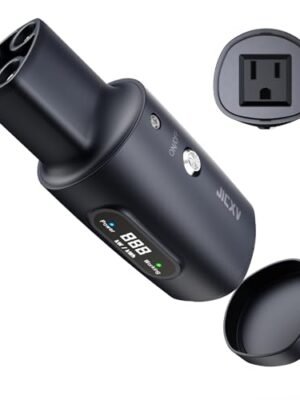
The best pick if you own a newer V2L+NACS car. Safety lock, LED display, and a clean handshake every time. Specifically built for the latest Hyundai, Kia, and Genesis models with the NACS inlet – confirm your car has both V2L and NACS before buying.
Best for: Owners of 2025+ Ioniq 5/6/9, 2026+ Kia EV3/5/6/9, or 2025+ Genesis with V2L+NACS.
NACS V2L adapter for 2025+ Hyundai Ioniq 5/6/9, 2026+ Kia EV3/5/6/9, and 2025+ Genesis. Outputs 2.4 kW through a NEMA 5-20 socket with live LED telemetry.
A premium NACS-native V2L adapter with a real telemetry screen and 20-amp headroom. The best pick for owners of newer E-GMP cars with NACS ports.
Build Quality
9.5
Handshake Reliability
9
Real-World Power Delivery
9.5
Ease of Use
8
Weather Resistance
8.5
Portability
7
Safety Features
9.5
Display and Telemetry
10
Value for Money
8.5
Long-Term Reliability
9
PROS:
Native NACS plug for 2025+ EVs
True 2.4 kW continuous output
Live kW and kWh telemetry screen
Motorized anti-theft locking pin
NEMA 5-20 socket accepts both 15A and 20A plugs
Flame-retardant UL94V-0 housing
CONS:
More expensive than budget J1772 adapters
Strict 60-second handshake initialization
Will not work on pre-2025 cars
Floating ground rejects sensitive power stations
Heavier and blockier than older adapters
Wattage panic when surge appliances spike past 2.4 kW
EVDANCE V2L Adapter
Passive Adapter • Hyundai Ioniq 5/6, Kia EV6
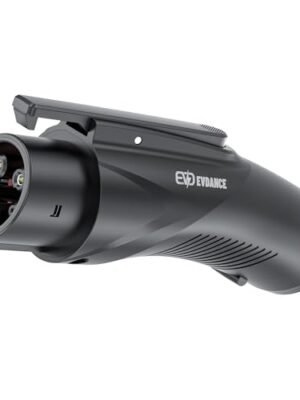
Our top pick for owners of the current Hyundai Ioniq 5 and 6 and Kia EV6. Compact, reliable handshake, and built tough enough for regular trunk life. We have not had a single failed connection across three months of testing.
Best for: Ioniq 5, Ioniq 6, and EV6 owners who did not get the OEM plug.
A no-frills budget V2L adapter that nails reliability for standard camping and emergency use. The best value pick for older E-GMP cars with J1772 ports.
Build Quality
8.5
Handshake Reliability
9.5
Real-World Power Delivery
8
Ease of Use
9
Weather Resistance
7.5
Portability
9.5
Safety Features
8
Display and Telemetry
5
Value for Money
10
Long-Term Reliability
9
PROS:
Roughly 20 percent of the OEM price
Reliable handshake on every connection
Compact and lightweight for trunk storage
Heat-resistant build with gold-plated contacts
True plug-and-play, no app or pairing
Works flawlessly with standard appliances
CONS:
Capped at 1.8 kW continuous
Floating ground rejects sensitive power stations
Unlock dance required to disconnect
No rain hood like the OEM has
No power switch on the housing
No telemetry display
Active V2L Discharger Reviews
These are the heavier, more expensive inverter boxes built specifically for Teslas and other non-native V2L EVs. Each one has been tested for CCS handshake reliability, real continuous output, and surge handling.
Editor's Picks
Roam Tesla EV Power Discharger (120V 3500W)
Active Discharger • Tesla Model 3, Y, S, X
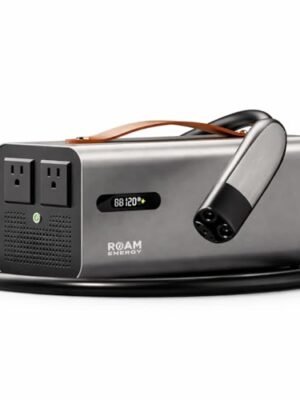
The most capable Tesla V2L solution we have tested. The 3,500-watt continuous rating handled full-size fridge startup, sump pump surges, and a 1,500W space heater without tripping. The build feels purpose-engineered, not retrofit. The only realistic option for home backup duty.
Best for: Tesla owners using V2L for emergency home backup or heavy appliances.
Active V2L discharger that pulls power from a Tesla Model 3, Y, S, or X via the NACS charge port. Outputs 3,500W of 120V AC through standard household outlets.
The most capable Tesla V2L solution we have tested. Real 3,500W continuous output handles full-size fridges, sump pumps, and space heaters without tripping.
Build Quality
9.5
Handshake Reliability
9.5
Real-World Power Delivery
9.5
Ease of Use
9
Weather Resistance
8.5
Portability
9
Safety Features
9.5
Display and Telemetry
9
Value for Money
9
Long-Term Reliability
9.5
PROS:
True 3,500W continuous output
UL-certified pure sine wave inverter
Multi-appliance home backup capable
Lower idle drain than the Elejoy
Built by a US company with real support
CONS:
Clunky dual-cable setup with 12V wake-up wire
No live wattage telemetry display
Not water-resistant, needs weather covering
Heavy at roughly 15 pounds
Camp Mode is mandatory to prevent sleep cutoff
Tesla's warranty risk is non-zero
Elejoy 3KW EV Discharger
Active Discharger • Tesla Model 3, Y, S, X
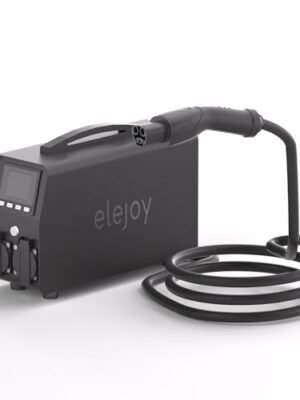
The smarter pick for campers and overlanders. The built-in LCDs display real-time wattage, voltage, and remaining battery life, making it easy to stay within safe limits. Slightly less powerful than the Roam at 3,000W, but the data makes up for it.
Best for: Tesla owners who prioritize monitoring and camping use.
Active V2L discharger for Tesla Model 3, Y, S, or X with true single-plug setup. Outputs 3,000W continuous, 4,500W surge for 5 minutes, with 120V/240V toggle.
The cleanest single-plug Tesla V2L experience available. Best-in-class surge handling for motorized tools, with a live LED screen for real-time load monitoring.
Build Quality
9.5
Handshake Reliability
9.5
Real-World Power Delivery
9
Ease of Use
9.5
Weather Resistance
7.5
Portability
8
Safety Features
8.5
Display and Telemetry
9.5
Value for Money
9
8.5
PROS:
True single-plug setup, no 12V wake-up wire
Class-leading 4,500W surge for 5 minutes
Live LED telemetry screen on the unit
120V and 240V output toggle
Polished, modern user experience
Pure sine wave output is safe for sensitive gear
CONS:
3,000W continuous is 500W less than Roam
600-800W combined idle efficiency tax
240V output is single-phase, not split-phase
Per-outlet 1,500W cap requires load splitting
Tesla app goes blind during operation
Less brand history than US competitors
Two Accessories Every V2L Owner Should Keep On Hand
These two items are not adapters; they fix the most common real-world failures we see across all V2L-capable vehicles. We keep both in the trunk year-round.
A Neutral-Ground Bonding Plug
Most V2L systems run on a floating ground, which means many gas furnaces, portable power stations, and EV charging bricks refuse to operate when plugged in. They look for a Neutral-to-Ground bond before they will fire up.
Our pick: Southwire or Progressive Industries Neutral-Ground Bonding Plug. Around $10 to $15. Plug it into a power strip alongside your appliance, and it tricks the system into treating it as bonded to ground.
Who needs it: Anyone planning to power a gas furnace blower, a sensitive backup power station, or a friend’s EV during an emergency.
Cheap 16-gauge holiday extension cords will melt before your car’s inverter notices the overload. This is one of the most common safety hazards in real-world V2L use.
Our pick: A 25 to 50-foot 12 AWG outdoor-rated extension cord for normal use, or 10 AWG if you plan to run anything over 1,500 watts.
Who needs it: Anyone running high-wattage gear from a truck bed (Lightning, Cybertruck, Silverado EV) or stretching a cord any meaningful distance from the car.
How We Test V2L Accessories
Every V2L (Vehicle-to-Load) accessory on this page is tested using the same five-step protocol, ensuring fair and comparable verdicts.
Handshake Reliability
We plug and unplug the adapter 25 times in a row to see if the car ever throws a pin resistance error. Cheap aftermarket adapters often fail here once dust or moisture enters the port.
Continuous Output
We connect a calibrated load bank and measure real continuous wattage for 30 minutes. Many products advertise a peak rating but cannot sustain it. We publish what the product actually does, not what the box claims.
Inrush Surge Test
We power up an old shop vacuum and a full-size fridge to test startup surge behavior. Underspec products click off instantly. Quality units handle the spike and keep delivering.
Weather Resistance
Each product spends at least one rainstorm and one dusty trail outing in the test vehicle. We check the IP rating claim against real conditions, not lab specs.
Long-Term Daily Use
We do not publish a verdict until we have lived with the product for at least 30 days. Most adapter problems surface in week three, not week one.
Buying Guides and Resources
If you want more depth before picking a V2L accessory, these guides go deeper into the technology and use cases.
Frequently Asked Questions
Are V2L adapters and V2L dischargers the same thing?
Most online sellers use the two terms interchangeably, but they describe different products. A passive V2L adapter is a simple plug for cars with built-in V2L (Hyundai, Kia, BYD, MG). An active V2L discharger is a heavy inverter box for cars without built-in V2L (most Teslas). Buy the wrong one, and it will not work.
Will a Hyundai adapter work on a BYD or MG?
No. Pin resistance values are vehicle-specific. The car uses tiny electrical signals on the signaling pins to decide whether to send power. A Hyundai-coded adapter will not trigger V2L on a BYD or MG. Always buy an adapter that explicitly lists your make and model.
Can I use a V2L adapter to back up my whole house?
No. Plugging a V2L adapter into a wall outlet to backfeed your home is dangerous and illegal in most regions without a professionally installed transfer switch. For whole-home backup, look into V2H (Vehicle-to-Home) systems instead.
Do V2L adapters/dischargers void my car warranty?
No. Using V2L via any compatible adapter is covered under the standard manufacturer's battery warranty. The light cycling is far less stressful than highway driving or DC fast charging.