EvoCharge Home 50 EV Charger Review

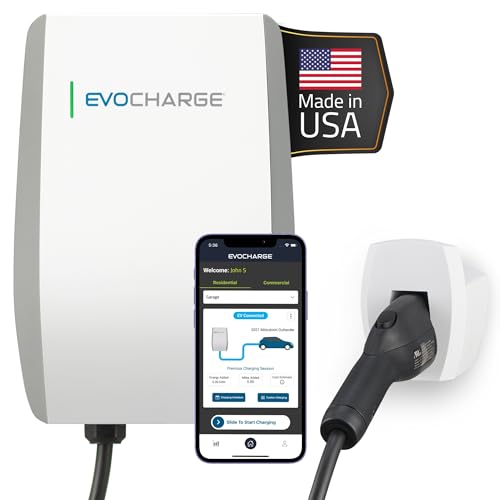
The EvoCharge Home 50 EV Charger is a 50 Amp, 240V Level 2 EV charger available in J1772 or NACS (Tesla) versions. Hardwired for safety, it delivers up to 45 miles of range per hour with smart scheduling, remote control, and energy tracking. Ideal for indoor or outdoor home installation.

This is my expert review of the EvoCharge Home 50 EV Charger, a 50 Amp hardwired Level 2 EV charger designed for residential and light commercial use.
EvoCharge is a U.S.-based EVSE manufacturer known for UL-listed, Energy Star-certified equipment made to meet the demands of modern EV owners. The Home 50 is their most powerful home unit – offering fast 50A EV charging (12kW), advanced smart EV charging features, and rugged reliability in a compact, code-compliant design.
This EvoCharge Home 50 EV Charger requires professional hardwired installation and is also UL-listed and Energy Star Certified. If portability and simpler installation are a priority, the plug-in EvoCharge iEVSE® Home 32 with its NEMA 6-50 plug is a better fit, providing solid charging speeds and convenience without sacrificing reliability.
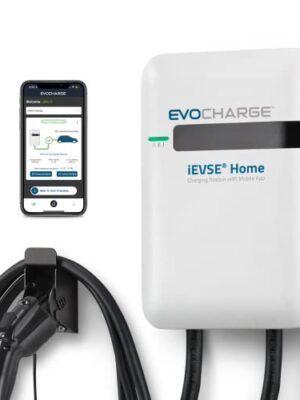
I’ve tested the EvoCharge line of chargers, including the first-generation EvoCharge iEVSE® Home 32 Smart Level 2 EV Charger, alongside the EvoCharge Home 50 and other top-rated high-amp EVSEs like the Wallbox Pulsar Plus 48A, Emporia Pro EV Charger, and ApexCharger MACH 2.
Here’s how the EvoCharge Home 50 EV Charger stacks up based on installation, performance, smart EV charging features, and day-to-day use.
Summary
The EvoCharge Home 50 EV Charger is a 50-amp, 240V Level 2 charging station that delivers up to 12 kW of power – adding approximately 45 miles of range per hour, depending on the EV. It comes hardwired with a 25-foot cable and is available in two connector options: a J1772 for universal EV compatibility, or a NACS (Tesla) connector for direct Tesla/NACS EV charging.
Unlike its first-generation plug-in unit, the EvoCharge iEVSE® Home 32 Smart Level 2 EV Charger, the hardwired design ensures greater safety, higher reliability, and NEC compliance for continuous high-amperage use. The charger is housed in a NEMA 4 weather-rated enclosure, meaning it’s built to operate safely in rain, snow, or dusty garages year-round.
Smart EV charging functionality is managed through the Epic Charging app and desktop portal. The charger supports the OCPP 1.6J communication protocol, allowing compatibility with third-party smart EV charging applications. Through the Epic app, users can remotely start and stop charging, schedule sessions, monitor real-time charging status, enable multi-user access, track costs, and view detailed energy usage.
The Home 50 is Made in the USA, UL listed, and Energy Star certified, with a clean, durable design meant for long-term residential installations.
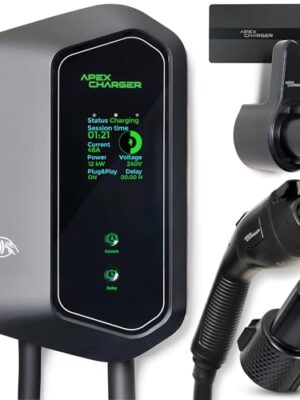
One thing we noted when unboxing the EvoCharge Home 50 J1772 EV Charger is that it doesn’t include a J1772 to NACS (Tesla) adapter. In contrast, competitors like the ApexCharger MACH series EV chargers include their own PRO 1 adapter in the box. If you own both a J1772 EV and an NACs EV, you’ll need to buy a third-party SAE J1772 to Tesla adapter separately. For better value and built-in compatibility, consider the ApexCharger EV Chargers, which include the adapter at no extra cost and are generally more budget-friendly.
Why Choose the EvoCharge Home 50?
If you want fast, safe charging at home and prefer a professional, hardwired setup, the EvoCharge Home 50 EV Charger delivers exactly that. With a max output of 50 Amps, it charges faster than competing hardwired EV chargers like the ChargePoint Home Flex or Tesla Wall Connector (when capped at 48A), and its hardwired-only design makes it ideal for homeowners looking for a permanent high-powered 50A EV charger installation, if their EV onboard charger supports 12kW.
Other key reasons to consider the EvoCharge Home 50 EV Charger:
- Up to 45 miles of range added per hour (vehicle-dependent)
- Adjustable amperage from 16A to 50A to match your home’s capacity
- The 25-foot-long cable gives you the flexibility to reach either side of a two-car garage
- Hardwired installation is safer, cleaner, and NEC-compliant for 50A use
- Smart charging app and portal make daily use seamless, including cost estimates and sharing access with household members
This unit is best suited for EV owners who want high performance with minimal complexity, and who value long-term electrical safety over plug-in convenience.
Specs & Features
- Power Output: Up to 50A (adjustable from 16A–50A)
- Voltage: 240V
- Connector Type: SAE J1772 or NACS Connector
- Charging Speed: Up to 45 miles of range/hour
- Cable Length: 25 feet
- Smart Features: Schedule, monitor, control, and share with up to 5 users.
- Connectivity: Wi-Fi via the Epic Charging app and the desktop portal
- Enclosure Rating: NEMA 4 (indoor/outdoor weatherproof)
- Installation: Hardwired only (NEC-compliant for >40A)
- Certifications: UL Listed, Energy Star Certified
- Made in: USA
- Warranty: Direct manufacturer support and returns are no longer available.
App Control & Smart Features
In October 2025, EvoCharge officially transitioned its smart EV charging services to the Epic Charging network, ending support for the original EvoCharge app on October 31, 2025.
To retain smart features and remote connectivity, all EvoCharge users must now switch to the Epic Charging app. While the shutdown of the familiar EvoCharge app disappointed many, the Epic app introduces a modernized approach to charger control and monitoring.
The migration to the Epic Charging app is mandatory for continued smart functionality, but EvoCharge ensured the transition is free for existing customers. Chargers not migrated by the end of 2025 lost app connectivity, but can still provide basic charging without remote control or scheduling.
The Epic Charging app offers several useful features. We have noticed that the ability to remotely start, stop, or adjust charging power from a smartphone provides great convenience. The session scheduling feature helps optimize charging times to take advantage of off-peak electricity rates, helping save on energy costs. The app’s detailed energy insights give clear visibility into charging history, power usage, and costs, making it easier to manage EV charging expenses.
Additionally, the app supports universal access beyond home use, allowing payments at thousands of public charging stations. Some locations also include a virtual waitlist feature that notifies users when a charger becomes available, reducing wait times.
As long-time users of the EvoCharge app, we’ve noticed issues with smart app connectivity, integration, and UI performance since the transition. Specifically, we’ve encountered UI issues such as confusing navigation and layout changes, confusion between the “Charge Now” function and scheduled charging sessions, occasional app crashes, delays in charger status updates, unstable Wi-Fi connections, and difficulties accessing chargers via the OCPP protocol – particularly problems logging into the internal web portal due to unclear or non-working passwords.
Epic Charging recommends reaching out to their support team for assistance with these problems. Additionally, performing a hard reset, power cycling both your Wi-Fi router and EV charger for several minutes, typically resolves most connectivity glitches.
Due to these transition hiccups and the app change, we have adjusted EvoCharge’s features rating from a 9 in 2025 to an 8 in 2026.
Overall, while the loss of the EvoCharge app is disappointing, the Epic Charging app provides a solid and expanded smart feature set, keeping EvoCharge hardware relevant and future-ready in the growing EV charging landscape.
Performance in Real-World Testing
I tested the EvoCharge Home 50 J1772 EV Charger with a Tesla Model 3 (using the J1772 to NACS adapter – the EvoCharge Home 50 EV Charger has a NACS version if you own a NACS EV), a Rivian R1S, and a Chevrolet Bolt EUV. All vehicles are charged at full-rated speeds depending on the configured amperage.
- Tesla Model 3: ~48 miles/hour (50A configuration)
- Rivian R1S: ~26 miles/hour (48A configuration – Rivian R1S has an onboard AC charger that is limited to 11.5 kW)
- Chevy Bolt EUV: ~40 miles/hour (50A configuration)
The unit remained cool and quiet, even during back-to-back full charges. It automatically resumed charging after a simulated power outage and triggered no breaker trips or thermal faults over several weeks of testing.
Safety & Certifications
This is one of the most rigorously safety-tested units I’ve reviewed:
- UL Listed (certified to meet U.S. electrical safety standards)
- Energy Star Certified (meets efficiency guidelines)
- Built-in GFCI protection
- NEMA 4 weather-rated enclosure
- Complies with NEC for continuous 50A use
If you’re looking for a future-proof Level 2 charger that meets inspection requirements and EV charging system supports high-amperage 12 kW onboard EV chargers – like those in the Hummer EV, Ford F-150 Lightning, or dual-motor Teslas – the EvoCharge Home 50 delivers on every front. While the EvoCharge Home 50 EV Charger is notoriously durable, direct manufacturer support and returns are no longer available.
EvoCharge Home 50 EV Charger Installation
The EvoCharge Home 50 EV Charger is a hardwired-only unit, which aligns with NEC code requirements for EV chargers delivering more than 40A. That means you’ll need a licensed electrician to install it, but the benefit is a cleaner, more secure, and code-compliant hardwired install. EvoCharge partners with EV Connect, Chargie, AmpUp, and Wevo, whom we recommend requesting installation quotes from all for comparison purposes, as installation costs vary by installer.
The EvoCharge Home 50 EV Charger installation is straightforward with a clear wall template and flexible conduit entry points. The slim profile (13.8″ H × 9.7″ W × 3.5″ D) and included mounting brackets provide flexibility for installation inside a garage, on an exterior wall, or on an EV charger pedestal. However, the EV charger wall mounting bracket sliding mechanism used to mount the charger from the bottom up can be challenging in tight spaces like EV charger lockboxes with side panels that restrict movement during installation.
The EvoCharge Home 50 EV Charger offers two power cable knockouts – one on the rear and one on the bottom – allowing for flexible, clean installation whether you’re mounting the charger on a wall, pedestal, or inside a lock box.
The included 25-foot cable offers plenty of reach without creating clutter, and the NEMA 4 rating means it’s fully weather-sealed for outdoor use. Rain, sleet, and snow won’t slow it down.
Unlike hardwired EV charger competitors like the Wallbox Pulsar Plus 48A, Emporia EV Charger, ApexCharger MACH 1, and ApexCharger MACH 2, which are limited to 48A (11.5kW), the EvoCharge Home 50 delivers 50A (12kW) – 2 amps and 0.5kW more – for faster charging. This is especially beneficial if your EV has a larger battery and requires quicker charging times. However, choosing the 50A configuration requires a higher-rated dedicated circuit breaker of 70A, and thicker conductors (4 AWG hot and 8 AWG ground), compared to the 48A setup, which needs a 60A breaker, 6 AWG hot wires, and 10 AWG ground conductor – potentially increasing installation costs.
Since the EvoCharge Home 50 EV Charger amperage (16A, 24A, 32A, 40A, 48A, and 50A) is selected manually through a hard cap physical dipswitch located inside the EV charger, the EV charger can be hardwired in 6 different configurations, with different breaker ratings, and conductor sizes depending on your home EV charging load.
EvoCharge Home 50 EV Charger installation inspections are essential to guarantee a safe and reliable charging setup. These inspections, typically conducted by licensed electricians or qualified professionals, ensure compliance with electrical codes, manufacturer guidelines, and safety standards. Inspectors carefully assess wiring quality, proper grounding, breaker sizing, and the overall integrity of the charging system.
A common issue we’ve encountered involves EV chargers with remote amperage adjustment features failing inspections due to incorrect installation at lower-rated breakers and wire sizes. Because remote amperage can be inadvertently increased beyond the installed capacity, it risks overloading the circuit, leading to potential safety hazards and code violations. Proper adherence to the highest-rated configuration for breaker and conductor sizing is critical to passing inspection and maintaining long-term system safety.
EvoCharge Home 50 EV Charger Installation Guide
The EvoCharge Home 50 EV Charger offers flexible installation options to accommodate a wide range of home electrical panel loads for EV charging. It supports multiple current configurations based on internal switch positions, each requiring specific breaker ratings, conductor sizes, and grounding conductors. Below are the supported configurations, with installation details for each.
Note: All hardwired EvoCharge Home 50 EV Charger installations must comply with EV Charger Earthing requirements, including proper grounding and bonded grounding at the main service panel, following NEC 2023 guidelines. EvoCharge Home 50 EV Charger installation must be performed by qualified EV charger installers. Terminal block connections must be torqued to spec using a calibrated torque driver or wrench to ensure safe, reliable operation. For a smooth, professional install, check out our EV Charger Installation Tools – the exact professional tools we use when installing high-powered EV chargers like the EvoCharge Home 50.
EvoCharge Home 50 EV Charger 16A Charging Configuration (Switch Position 3)
This 16A Level 2 EV charger delivers 240 volts of power, offering up to 3.83 kW of charging output – ideal for overnight charging and light-duty EV use.
For light-duty charging applications, the 16A EvoCharge Home 50 EV Charger configuration is ideal and easy to integrate into most existing electrical systems.
- Breaker Rating: 20A
- Minimum Conductor Size (75°C): 12 AWG copper (L1/L2)
- Minimum Equipment Grounding Conductor: 12 AWG copper (G)
- Terminal Torque Requirements: 18–10 AWG: 20 lb-in (2.3 N·m)
Depicted here is the circuit wiring design for a 16A hardwired EvoCharge Home 50 EV Charger installation.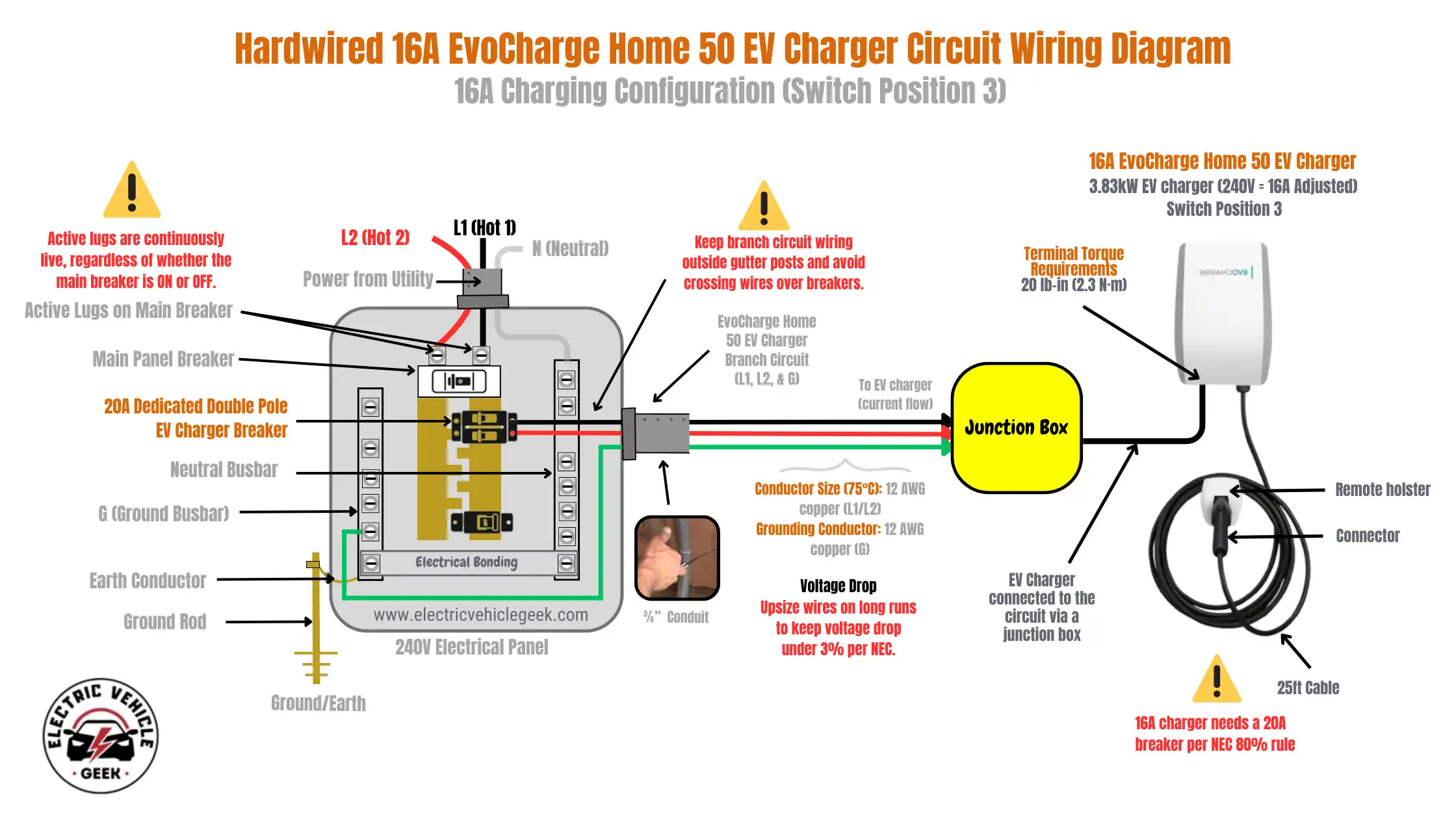
EvoCharge Home 50 EV Charger 24A Charging Configuration (Switch Position 4)
Engineered for higher efficiency, this 24A configuration supplies 5.8 kW at 240V, making it a solid mid-range option for faster home EV charging.
This EvoCharge Home 50 EV Charger setup balances faster-charging speed with moderate electrical load requirements.
- Breaker Rating: 30A
- Minimum Conductor Size (75°C): 10 AWG copper (L1/L2)
- Minimum Equipment Grounding Conductor: 10 AWG copper (G)
- Terminal Torque Requirements: 18–10 AWG: 20 lb-in (2.3 N·m)
The following illustration details the circuit wiring connections for a 24A hardwired EvoCharge Home 50 EV Charger setup.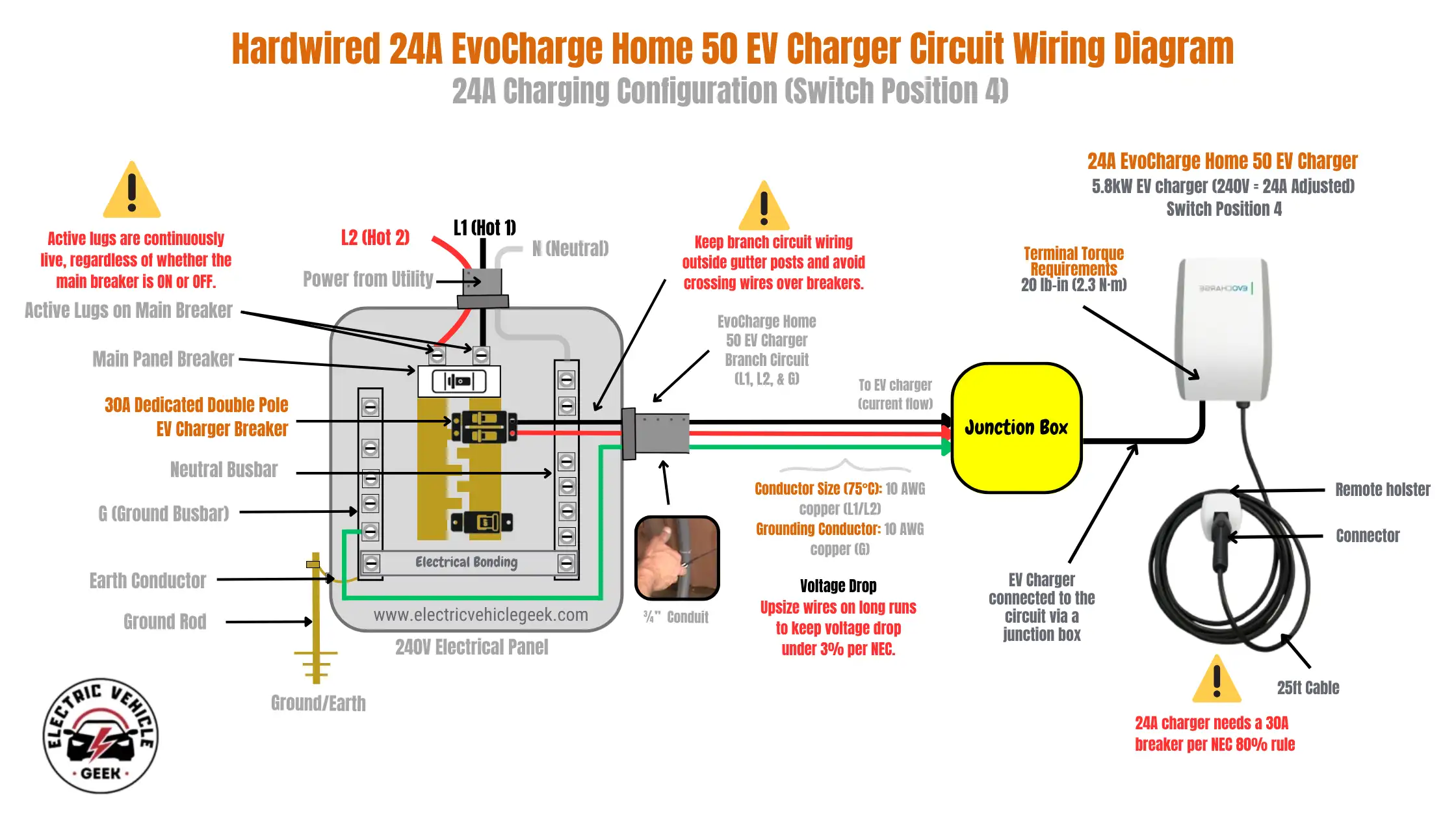
EvoCharge Home 50 EV Charger 32A Charging Configuration (Switch Position 5)
With a 7.68 kW output at 240 volts, this 32A charger strikes a balance between speed and compatibility, suitable for most electric vehicles.
For households seeking quicker overnight charging without maxing out panel capacity.
- Breaker Rating: 40A
- Minimum Conductor Size (75°C): 8 AWG copper (L1/L2)
- Minimum Equipment Grounding Conductor: 10 AWG copper (G)
- Terminal Torque Requirements: 8 AWG: 20 lb-in (2.8 N·m)
This diagram presents the circuit wiring configuration for a 32A hardwired EvoCharge Home 50 EV Charger.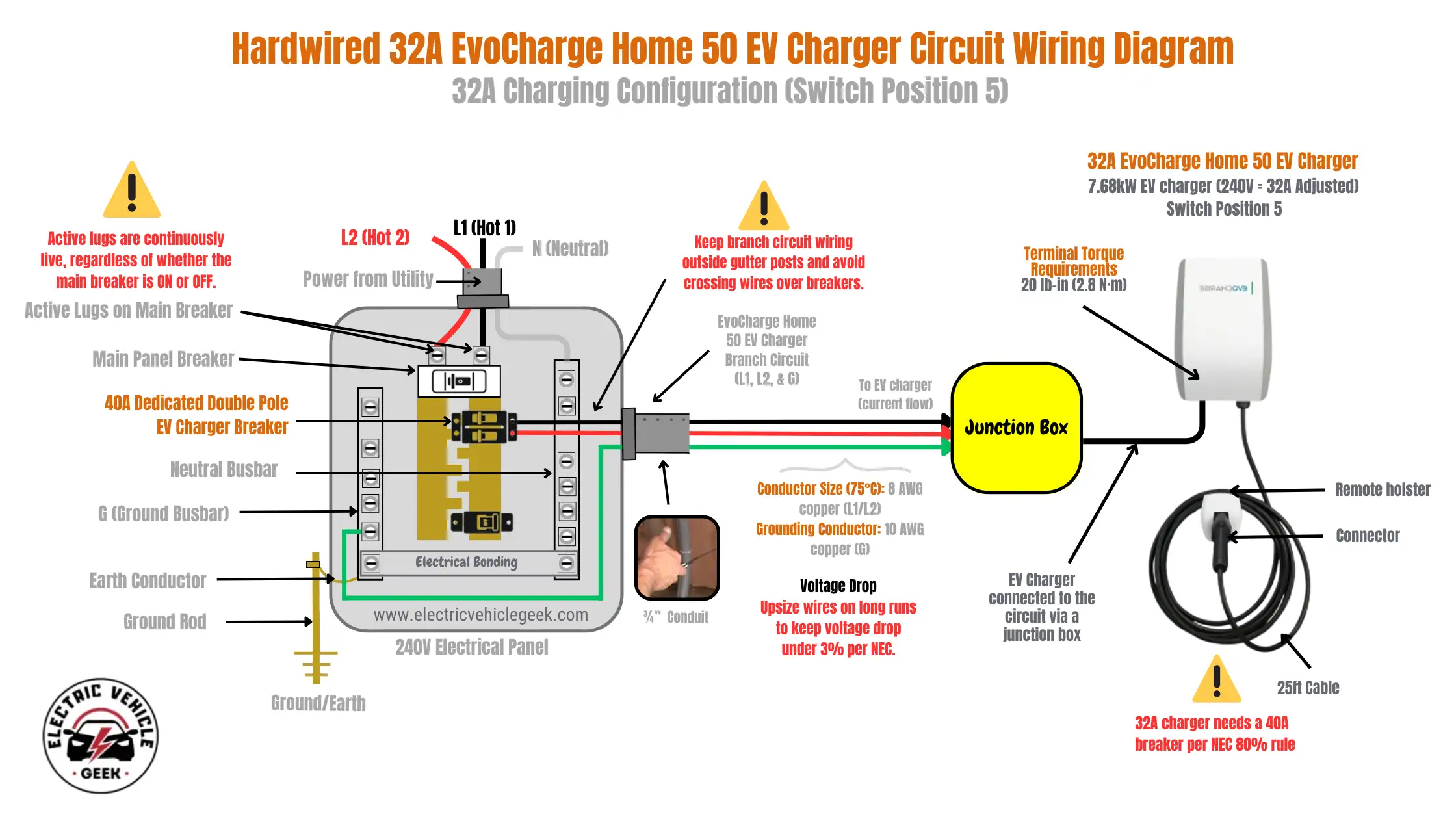
EvoCharge Home 50 EV Charger 40A Charging Configuration (Switch Position 6)
This powerful 40A model delivers up to 9.6 kW, providing significantly faster charging times – ideal for daily drivers and high-capacity EV batteries.
Ideal for most modern EVs with larger batteries requiring shorter charging times.
- Breaker Rating: 50A
- Minimum Conductor Size (75°C): 8 AWG copper (L1/L2)
- Minimum Equipment Grounding Conductor: 10 AWG copper (G)
- Terminal Torque Requirements: 8 AWG: 20 lb-in (2.8 N·m)
Below is the electrical circuit wiring diagram for a 40A hardwired EvoCharge Home 50 EV Charger.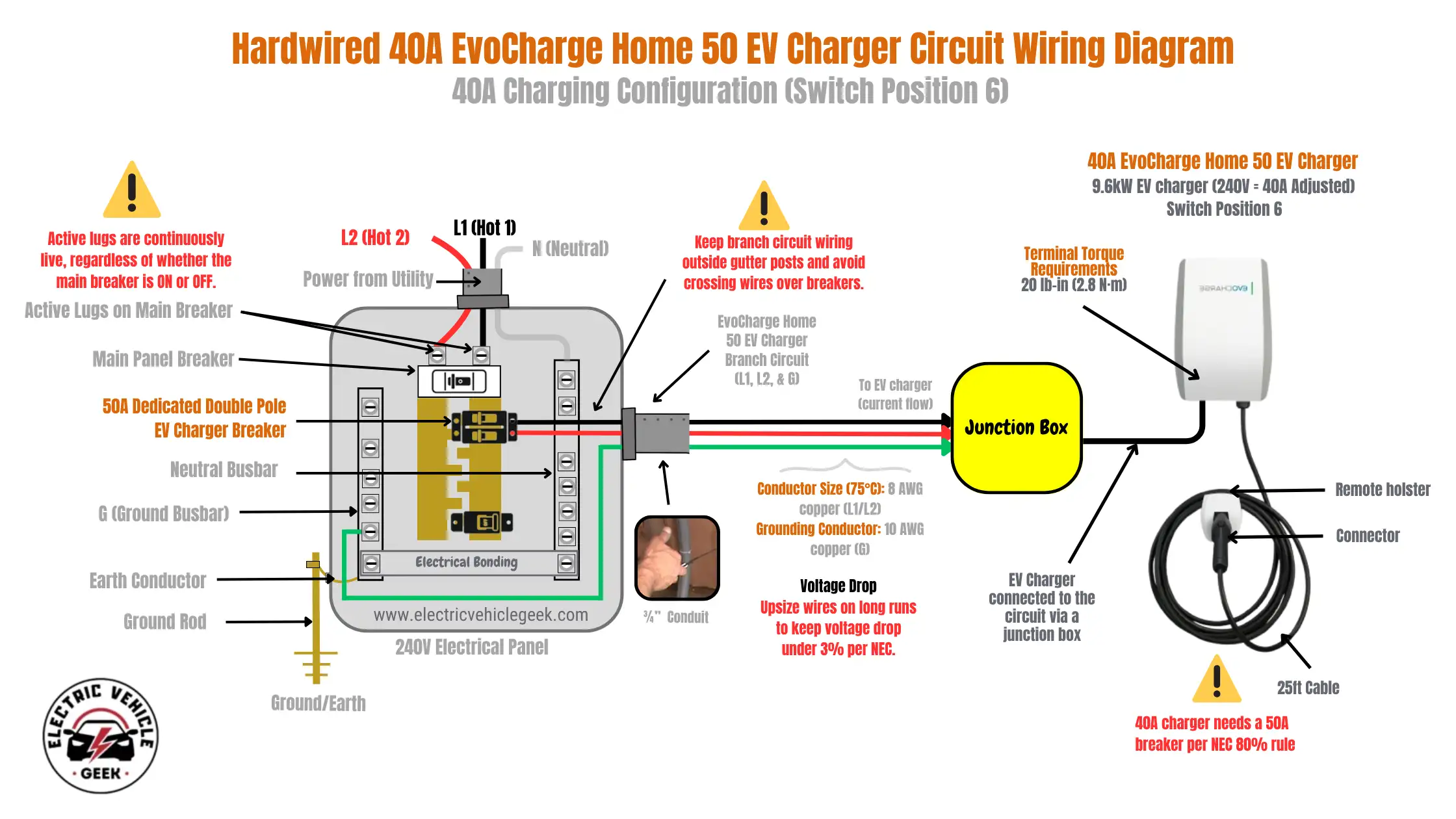
EvoCharge Home 50 EV Charger 48A Charging Configuration (Switch Position 7)
Offering a robust 11.5 kW at 240 volts, the 48A charger is designed for performance-oriented EVs and drivers seeking reduced charge cycles.
Recommended for users who want to maximize the EvoCharge Home 50’s output under NEC guidelines.
- Breaker Rating: 60A
- Minimum Conductor Size (75°C): 6 AWG copper (L1/L2)
- Minimum Equipment Grounding Conductor: 10 AWG copper (G)
- Terminal Torque Requirements: 6–4 AWG: 35 lb-in (4.0 N·m)
Shown below is the circuit wiring layout for a 48A hardwired EvoCharge Home 50 EV Charger installation.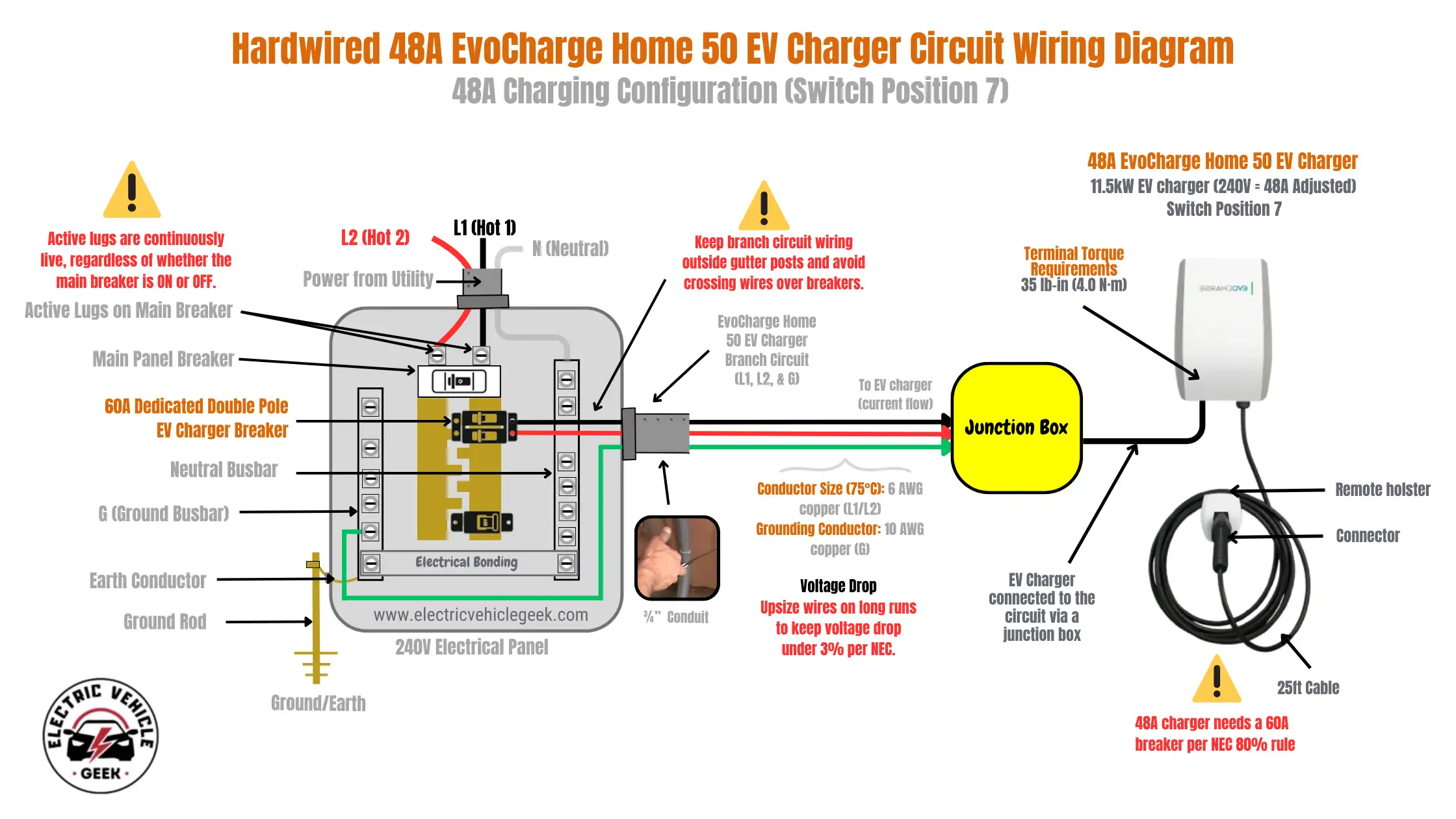
EvoCharge Home 50 EV Charger 50A Charging Configuration (Switch Position 8)
At the top end of residential charging, this 50A EV charger delivers 12 kW of power, maximizing speed for vehicles that support high-amperage charging.
The highest selectable output of the EvoCharge Home 50 EV Charger, offering top-tier fast charging performance for larger EVs or future-proofing.
Note: Before installing a 50A high-power charger, we recommend checking if your EV has an onboard AC charger that is limited to 11.5 kW – such as the Rivian R1S. Under such a scenario, we recommend installing the 48A Charging Configuration (Switch Position 7), or purchasing a compatible 48 Amp EV charger.
- Breaker Rating: 70A
- Minimum Conductor Size (75°C): 4 AWG copper (L1/L2)
- Minimum Equipment Grounding Conductor: 8 AWG copper (G)
- Terminal Torque Requirements: 6–4 AWG: 35 lb-in (4.0 N·m)
The diagram below illustrates the circuit wiring for a 50A hardwired EvoCharge Home 50 EV Charger setup.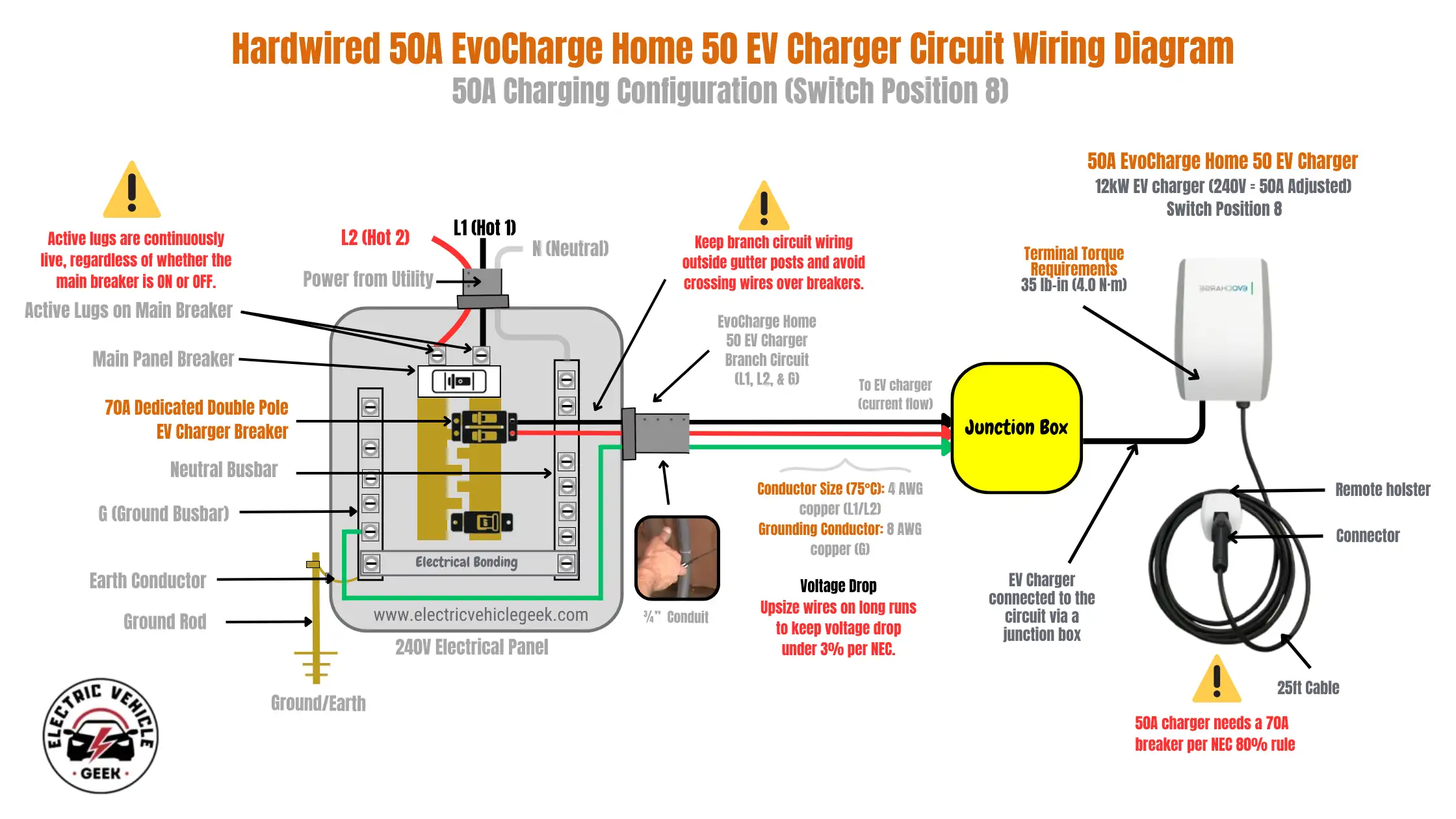
Specification: EvoCharge Home 50 EV Charger Review
| Charging Specifications | ||||||||
|---|---|---|---|---|---|---|---|---|
| ||||||||
| Electrical & Power Specifications | ||||||||
| ||||||||
| Cable & Connector Specifications | ||||||||
| ||||||||
| Connectivity & Smart Features | ||||||||
| ||||||||
| Certifications & Safety Standards | ||||||||
| ||||||||
There are no reviews yet.