Supported by you via insider access, and when you purchase through links on our site, we may earn an affiliate commission. See our Affiliate Disclosure.
EV Charger Rebate Finder
See every federal, state, utility, and local EV charger rebate and tax credit you may qualify for. We match each program requirement to certified chargers we have tested, so you buy a unit that actually qualifies. Reviews are run by an EVITP certified EV charger installer.
Enter your details below to instantly scan thousands of federal, state, and utility incentives for your home installation.
Level 1 vs Level 2: What the Rebate Actually Buys You
Most people using this tool are upgrading from the slow Level 1 cord that came with the car to a fast Level 2 station. Here is the daily difference.
120V outlet
per hour
240V smart charger
per hour
A Level 2 unit turns an overnight 8 hour charge from about 32 miles into 200 to 320 miles of range.
EV Charger Amperage and Circuit Guide
Match the charger output to what your electrical panel can support. Each tier below shows the required breaker size and real world charging speed.
NEMA 5-15 outlet (120V)
NEMA 6-20 or hardwired
NEMA 14-30 or hardwired
NEMA 14-50 or hardwired
NEMA 14-50 or hardwired
Hardwired only
Hardwired only
Hardwired only
The 80 percent rule: a circuit runs continuous loads at only 80 percent of its rated capacity, which is why a 48 Amp charger needs a 60 Amp breaker.
EV Charger Rebate FAQ
What Is an EV Charger Rebate and How Does It Work?
An EV charger rebate is money back from a federal agency, your state, or your electric utility to help cover the cost of buying and installing a home charging station. Depending on the program, you get the money as a direct check, a credit on your electric bill, or a non-refundable tax credit when you file your taxes. Use the tool above to see which programs apply to your ZIP code.
What Is the Difference Between a Utility Rebate and the Federal Tax Credit?
They come from different sources and can usually be combined. Utility rebates come directly from your local electric company and typically pay back $200 to $1,000 for installing a qualifying Level 2 charger. The federal 30C tax credit covers 30 percent of your hardware and installation cost, up to $1,000. The 30C credit is set to expire for equipment placed in service after June 30, 2026, and is limited to non-urban or low-income census tracts.
Do Level 1 Chargers Qualify for Rebates, or Do I Need Level 2?
Standard Level 1 chargers almost never qualify. Nearly every utility and government program requires a 240-volt Level 2 charging station. Browse our Level 2 EV charger reviews to find a qualifying model.
What Is a Smart Charger and Why Do Rebates Require One?
A smart charger connects to the internet over Wi-Fi to track your energy use and manage when your car charges. Most utility rebate programs require one so you can participate in managed charging or Time-of-Use plans. See our smart EV charger reviews for certified picks.
Can I Install the Charger Myself and Still Get the Rebate?
Most substantial rebates require professional installation by a licensed electrician, along with proof of a local electrical permit. Hardware-only rebates sometimes allow self-installation.
Do Rebates Cover Installation Costs Like Labor and Panel Upgrades?
Many programs cover more than just the charging unit. The federal 30C credit and many utility Make-Ready programs let you include labor, permit fees, and in some cases panel upgrade costs in your total claimable amount.
Does the Rebate Limit Which Charger Model I Can Buy?
Yes. Most programs require safety certification by UL or ETL, and many also require Energy Star certification and a standard connector such as SAE J1772 or NACS.
Can I Claim a Rebate for a Used or Refurbished EV Charger?
No. Every program requires the charger to be new and unused. You must provide an original itemized receipt showing the model number and purchase date.
What Documents Do I Need to Submit to Get My Rebate Approved?
You typically need the itemized hardware receipt, the electrician's invoice, a copy of the signed electrical permit, a recent utility bill, and photos of the installed charger showing the model sticker.
How Long Do I Have to Apply After Installing My Charger?
Utility rebate windows typically run 60 days to 6 months after installation. For the federal 30C credit, file IRS Form 8911 with your tax return for the year the charger was installed and placed in service.
This tool is for educational purposes and shows estimates only, not a guarantee of eligibility or final amounts. Program rules, caps, and deadlines change. Confirm details with the program administrator and a licensed tax professional before purchasing.
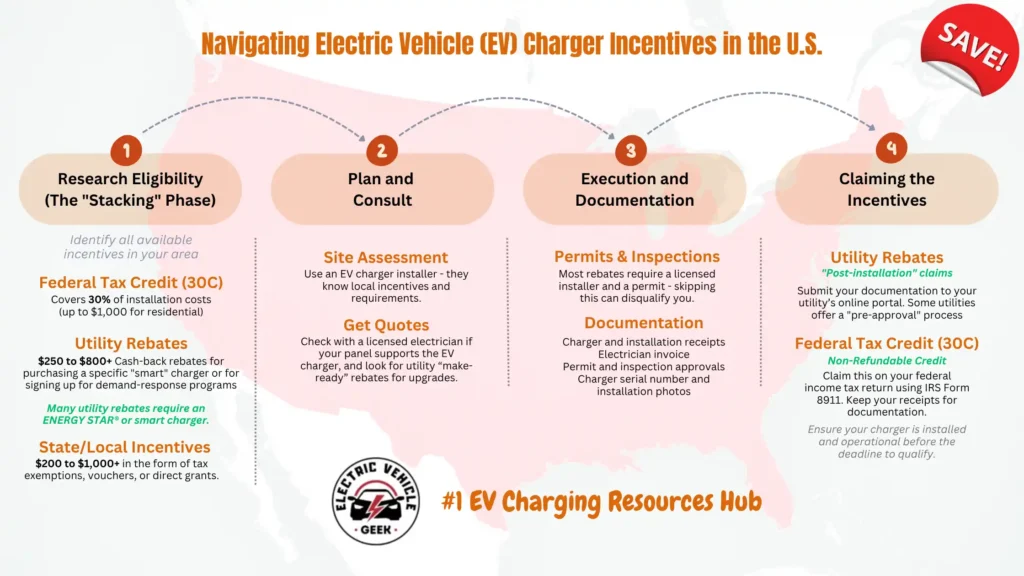
Check Out Our 4-Step Guide to Move From Research to Rebate Flawlessly.
This infographic provides a step-by-step roadmap process for accessing federal tax credits, utility rebates, and state incentives across the United States.
Data Attribution
Data is sourced from the Rewiring America API and cross-referenced with secondary sources such as the Database of State Incentives for Renewables & Efficiency (DSIRE), the U.S. Department of Energy, and select utility program databases to help catch discrepancies that may occur if the primary API is experiencing downtime or data lag.