Supported by you via insider access, and when you purchase through links on our site, we may earn an affiliate commission. See our Affiliate Disclosure.
A dual-voltage EV charger is the most versatile home charging tool available because it automatically operates on both 120V and 240V, detecting the outlet voltage and adjusting its output without any settings changes or adapter swaps.
A standard household outlet dual-voltage EV charger delivers Level 1 charging at 12 to 16 amps. On a 240V circuit, it steps up to Level 2 at 16 to 40 amps, covering every home outlet scenario from a beach house with only a garage light circuit to a dedicated NEMA 14-50 at a primary residence. That range is what makes the category genuinely different from other charger types rather than just a marketing label.
The buyer who benefits most from a dual-voltage charger is the one who cannot or does not want to commit to a single outlet permanently.
Renters who cannot install a 240V circuit today but may move to a home with one next year get full Level 2 speed the moment their circumstances change without buying a second charger. Multi-property owners who charge at both a city apartment and a weekend house with different outlets use one unit at both locations with the right adapter kit. Road trippers who need to charge at destinations where the outlet type is unknown carry one unit that works on whatever they find.
In all three scenarios, the dual voltage design is not a compromise but the correct engineering answer.
Every charger we’ve listed below was tested on both 120V and 240V circuits by an EVITP-certified installer to verify clean-voltage detection, accurate amperage limiting at both supply levels, and stable long-term performance during switching between circuits. Scores from 1 to 10 cover performance, build quality, cable handling, thermal management, adapter kit quality, and value.
Tip: Our EV Charging Calculator lets you work out how long your specific battery takes to charge at each outlet and amperage combination before choosing a unit.
Dual Voltage EV Chargers We Recommend
Every EV charger below auto-detects 120V or 240V and adjusts output without manual switching. The grid includes compact travel portables, hybrid portables powerful enough to serve as primary home chargers, and dual-voltage wall-mount units. Click any title for the full hands-on review.
Use the “Compare” button on each product to select multiple chargers, then click the ⚖️ scale icon to see a full side-by-side comparison.
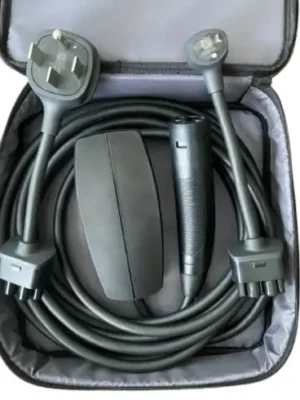
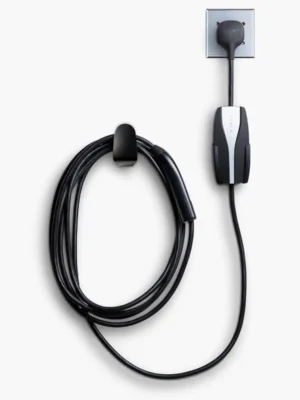
The Tesla Gen 3 Mobile Connector is the latest Tesla mobile charger, delivering up to 7.6 kW (32 amps at 240V) via a NEMA 14-50 or 6-50 adapter, which is roughly 30 miles of range per hour. It also works with standard 120V outlets at 1.3 kW. Offers PowerShare support on compatible vehicles like the Cybertruck and Model Y Performance, enabling basic bi-directional charging, including Vehicle-to-Load (V2L) and Vehicle-to-Vehicle (V2V), making it the most capable portable Tesla charger yet.
Charging Speed:7.68 kW
Max Amperage:32 Amps
Charging Level:Level 1, Level 2
Connector Type:NACS
Cable Length:20 Feet
Connectivity:Wi-Fi
Installation Type:NEMA 14-50, NEMA 5-15, NEMA 6-50
The Tesla Mobile Connector Gen 3 is our #1 rated NACS mobile charger here at Electric Vehicle Geek. It's a serious upgrade over its predecessor, bi-directional charging (Vehicle-to-Load (V2L), Vehicle-to-Vehicle (V2V), Vehicle-to-Grid (V2G), PowerShare support, and a higher charging capacity make it the most capable portable Tesla charger yet. It's the ideal pick for owners who want flexible, on-the-go charging without committing to a permanent wall installation.
Features
9
Real World Usage
8.5
Materials
8.5
Durability
9
Craftsmanship
8.5
Design
9
Monetary Value
9
Product Value
8.5
Brand Reputation
9.5
Expert Valuation
9
PROS:
Bi-directional charging (V2L & V2V)
PowerShare support
Portable and plug-and-play
Higher charging capacity than previous gen
No installation required
CONS:
No V2H & V2G support
Lower amperage than Universal Wall Connector
Requires compatible vehicle for bi-directional features
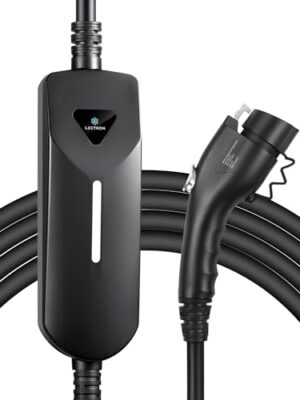
The Lectron Level 1 / Level 2 EV Charger is a practical, versatile, and affordable option for most EV drivers. It covers both charging speeds, works with virtually every J1772 vehicle, and goes wherever you go. The lack of smart features keeps the experience simple, and for many drivers, that's exactly what they want.It won't win any awards for cutting-edge technology, but it doesn't need to. What it does, it does well. If you're looking for a dependable portable charger that handles everyday needs without any hassle, the Lectron is a solid pick.
Features
9
Real World Usage
8
Materials
8.5
Durability
9
Craftsmanship
9
Design
9
Monetary Value
8.5
Product Value
8
Brand Reputation
9
Expert Valuation
8.5
PROS:
Dual plug compatibility (NEMA 5-15 & 14-50)
Supports both Level 1 and Level 2 charging
Portable and travel-friendly with carrying case
Safety features: overvoltage, overcurrent, short circuit protection
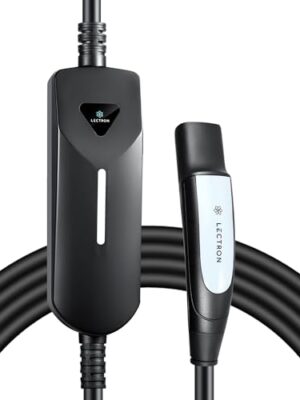
The Lectron Level 1/2 Tesla/NACS Charger offers portable, flexible charging with interchangeable 120V and 240V plugs. It supports Tesla Models 3, Y, S, X, and other NACS EVs, delivering up to 9.6 kW for reliable home or travel charging.
The Lectron Level 1/2 is a versatile dual-mode charger with solid in-built safety features and dependable performance at both 12A and 40A. It’s a smart pick if you want one unit that covers both slow overnight charging and faster Level 2 sessions.You might want to look at Tesla’s chargers, such as the Tesla Wall Connector or the Tesla Universal Wall Connector, if seamless integration with your Tesla and the Tesla app is a priority. Tesla’s native units offer smart charging features and real-time monitoring directly through the app. By contrast, the Lectron Level 1/2 keeps things simple: a reliable plug-and-charge unit without connectivity.Should you upgrade if you own the Lectron Level 1 Portable Charger? Yes, if you’re ready for faster 240V charging. Otherwise, stick with your Level 1 unless you hate its slow charging speeds.
Features
9
Real World Usage
8
Materials
8.5
Durability
9
Craftsmanship
9
Design
9
Monetary Value
8.5
Product Value
8
Brand Reputation
9
Expert Valuation
8.5
PROS:
Dual-level charging (12A Level 1 & 40A Level 2)
Compatible with Tesla and other NACS EVs
Interchangeable NEMA 5-15 and 14-50 plugs
Portable and travel-friendly
ETL certified with built-in safety protections
Real-time LED charging status indicators
CONS:
Level 2 charging requires NEMA 14-50 outlet installation
Not hardwired, less durable than wall chargers
Limited maximum amperage compared to some hardwired chargers
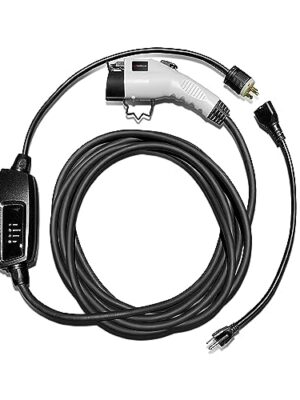
The Tesla Mobile Connector is a portable charger compatible with standard 120V and 240V outlets using interchangeable adapters. It delivers up to 7.6 kW of power, providing flexible, reliable charging for Tesla Models 3, Y, S, and X at home or on the go with a simple setup.
The Tesla Mobile Connector offers portability and ease of use, ideal for occasional charging or travel. However, it falls short as a daily home charger due to slower speeds, a lack of smart features, and update limitations, especially for non-Tesla owners. Best suited as a backup or secondary charger.
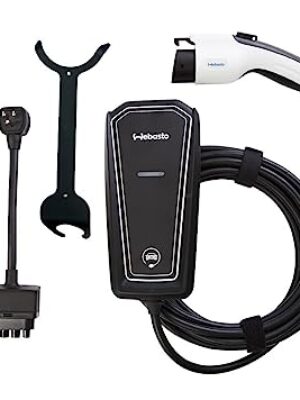
The Webasto Go Dual Voltage Portable EV Charger offers Level 1 and Level 2 charging (120V & 240V), ideal for home or on-the-go use. UL and IP67 rated for safety and durability, it delivers up to 7.7kW of power, charging up to 30 miles per hour. Compatible with all J1772-equipped EVs, including Tesla with an adapter.
The Webasto Go is a reliable, easy-to-use charger ideal for everyday use. It’s safe, efficient, and built with the needs of EV owners in mind, though potential buyers should consider its waterproof shortcomings.
Features
8
Real World Usage
8.5
Materials
9
Durability
9
Craftsmanship
8.5
Design
8.5
Monetary Value
9
Product Value
8.7
Brand Reputation
9
Expert Valuation
8
PROS:
Dual voltage (120V and 240V) for flexible charging
Advanced safety features with UL and cUL certifications
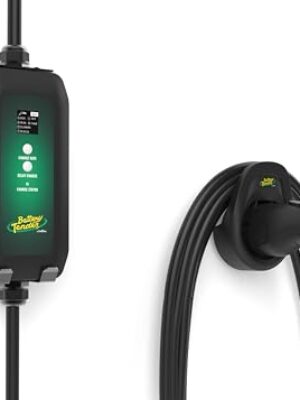
The Battery Tender eCharge 32 AMP EV Charger is a versatile Level 1+2 electric vehicle charger, compatible with 120V or 240V power sources. Offering 16A or 32A output, this portable EV charger is perfect for indoor and outdoor use, featuring multiple plug options like 5-15p, 5-20p, and NEMA 14-50R for flexible charging. Ideal for fast, reliable EV charging at home or on the go.
The Battery Tender eCharge 32 Amp is one of the more capable portable EV chargers on the market. It handles extreme temperatures, provides real-time data, adapts to your available power source, and doesn't require an app to function. If you want one charger for home and travel without compromise, this one earns its place in your trunk.
Features
9
Real World Usage
9
Materials
8
Durability
8.5
Craftsmanship
8.5
Design
8.5
Monetary Value
7.5
Product Value
8.5
Brand Reputation
9
Expert Valuation
9
PROS:
Can be used with both 120V and 240V power inputs, offering flexibility for different charging setups.
With options for 16A or 32A output, it provides fast charging times.
Suitable for both indoor and outdoor use, ensuring reliability in various conditions.
Comes with different plug types (5-15p, 5-20p, NEMA 14-50R) to fit various outlets.
CONS:
It’s on the higher end of the price spectrum, but the features justify the cost.
The variety of options might be overwhelming for some users.
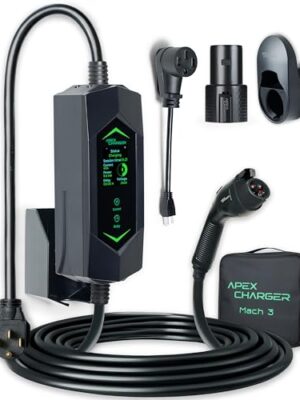
The ApexCharger MACH 3 EV Charger is a portable Level 1/2 dual-connector charger that supports both J1772 and NACS connectors. It features Wi-Fi app control, IP67 weather resistance, and pulsing LED indicators, making it a solid on-the-go and backup charging option.
Charging Speed:9.6 kW
Max Amperage:40 Amps
Charging Level:Level 1, Level 2
Connector Type:J1772, NACS
Cable Length:25 Feet
Connectivity:Bluetooth, Wi-Fi
Installation Type:NEMA 14-50, NEMA 5-15, NEMA 5-20
The ApexCharger MACH 3 EV Charger is the best option for EV drivers who want portability without sacrificing speed or smart features. With up to 40 Amps, dual-voltage input, Tesla compatibility, and a rugged, IP67-rated build, it beats most portable chargers on the market - especially in power and feature depth.While the ApexCharger MACH 2 is still the brand’s top-tier home unit, and the MACH 1 is the budget-friendly wall charger, the MACH 3 fills a different and crucial role: on-the-go charging wherever you need it, without calling an electrician.If you need a travel-ready backup or your lifestyle includes frequent road trips, the ApexCharger MACH 3 is one of the smartest, most reliable portable EV chargers available today.
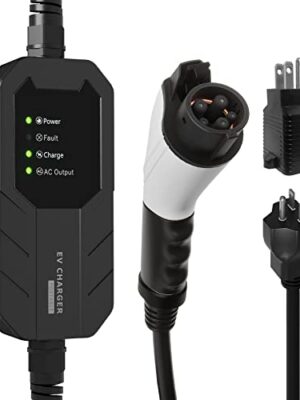
The Schumacher 16 Amp EV Charger is a reliable, 16A portable charger with a 28-ft cable, Level 1/2 support, 120V/240V compatibility, and efficient EV charging.
The Schumacher Schumacher 16 Amp EV Charger is a reliable, portable EV charger that caters to both Level 1 and Level 2 charging needs. Its ergonomic design, durable construction, and flexible cable make it a practical choice for EV owners. However, those seeking advanced features like adjustable amperage or smart connectivity might need to explore other options.
Features
8
Real World Usage
8.5
Materials
8.5
Durability
9
Craftsmanship
8.5
Design
8.3
Monetary Value
8
Product Value
8.5
Brand Reputation
9
Expert Valuation
8.5
PROS:
Portable and lightweight, easy to carry or store
28-foot cable offers excellent reach for most parking setups
Universal J1772 connector compatible with all major EVs
Supports both Level 1 (120V) and Level 2 (240V) charging
Durable construction with water-resistant features
LED indicators provide clear charging status
CONS:
Fixed 16-amp output; no adjustable amperage
Lacks smart features such as Wi-Fi, app control, or scheduling
Slightly bulky compared to small, plug-and-play Level 1 chargers
Slower charging on 120V adapter compared to full 240V output
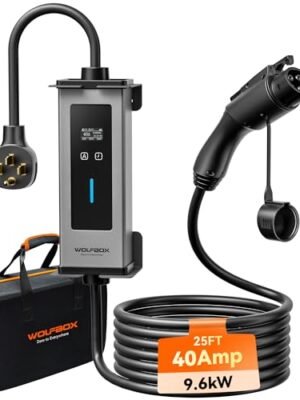
The WOLFBOX PE40 is a portable Level 2 charger delivering 40 amps and up to 9.6 kW with a J1772 connector. Its sleek design and 25-foot cable make it perfect for flexible, powerful charging at home or on the go for most electric vehicles.
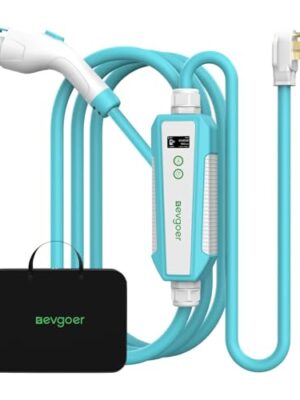
Evgoer J1772 40A Level 2 EV Charger delivers fast, safe charging with an adjustable 8A-40A current. The 20ft cable ensures flexibility. IP66's waterproof design supports indoor and outdoor use. Compatible with all J1772 electric vehicles.
The Evgoer J1772 40A EV Charger is a reliable Level 2 charging solution with dual voltage support (120V/240V), fast speeds, and adjustable current settings. It’s UL-certified, weather-resistant, and compatible with all J1772 EVs, including Tesla (adapter required). Easy installation, robust safety features, and versatile charging make it a top choice.
Features
9
Real World Usage
8.5
Materials
8
Durability
8.5
Craftsmanship
8
Design
8.5
Monetary Value
9
Product Value
8.5
Brand Reputation
8
Expert Valuation
8
PROS:
Fast charging speeds (up to 7x faster than Level 1)
Adjustable current settings for power optimization
Advanced safety features (short circuit, overcurrent, overheating protection)
IP66 waterproof rating for outdoor use
Portable design with a carrying case
Compatible with all J1772 EVs
Supports Level 1 and Level 2 charging
1-year warranty and lifetime support
Proven reliability in real-world conditions
Strong customer support experience
CONS:
NEMA 5-15P to 14-50R adapter sold separately
Increased risk of loose connections and voltage drop by using the NEMA 5-15P to a 14-50R adapter
The Skysword Ⅱ is a versatile, portable EV charger. It offers both Level 1 and Level 2 charging, supporting 100-240V and 16A. With a 25-foot cable and included NEMA 6-20 and 5-15 plugs, it provides flexibility. It’s a safe, simple solution with LED indicators, ideal for home and travel.
The MEGEAR Skysword Ⅱ is a 25-foot portable charger, designed for convenience and practicality, making it ideal for everyday use whether at home, work, or while traveling.
Features
7.5
Real World Usage
8.5
Materials
8
Durability
7.5
Craftsmanship
8.5
Design
8
Monetary Value
8.5
Product Value
8
Brand Reputation
8.5
Expert Valuation
8
PROS:
Compatible with most electrical panels without requiring upgrades.
An affordable charging solution.
Built with a rigid structure for reliable portability.
Features straightforward error detection for easy troubleshooting.
boasts a smart-chip detection system that monitors charging issues
CONS:
1-year limited warranty for manufucturing defects and technical queries
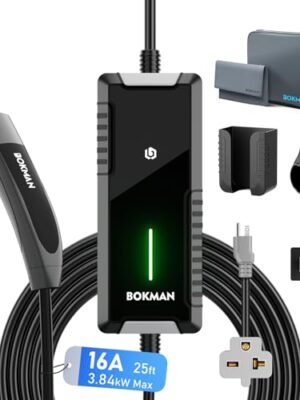
The Bokman Level 2 Mobile Charger delivers fast, efficient charging for Tesla vehicles, including Model 3/Y/X/S/Cybertruck. With a 16Amp power output and a 25ft cable, it features a NEMA 6-20 plug for Level 2 charging and NEMA 5-15 compatibility for Level 1, ensuring versatile, reliable performance at home or on the go.
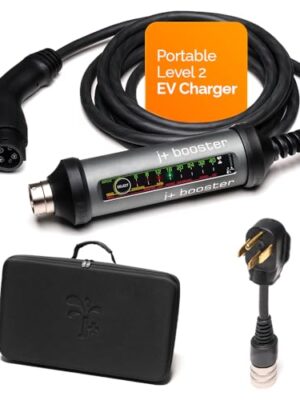
The J+ Booster 2 Portable EV Charger offers fast Level 2 charging (9.6 kW, 240V) for all-electric vehicles. With a 21ft cable, NEMA 14-50 plug, and ETL certification, it provides reliable power both indoors and outdoors. The included carrying case ensures easy storage and portability for convenient home charging.
Important Key Specs Table Legend:Level 1 = Level 1 only (120V). Level 1/Level 2 = dual-voltage portable (120V or 240V).
How Fast Is a Dual Voltage EV Charger on Each Outlet?
The same dual-voltage charger delivers dramatically different speeds depending on the outlet it is connected to, and understanding that range is key to knowing what you are actually buying. At a 120V NEMA 5-15 outlet, the output is 1.44 kW, adding 3 to 5 miles of range per hour and covering average daily commuting in an overnight window for most PHEVs and light BEV users.
On a 240V NEMA 14-50 outlet, the same charger steps up to 7.68 kW at 32 amps or 9.6 kW at 40 amps, adding 24 to 36 miles per hour and fully recovering any modern BEV overnight.
The intermediate outlets in between fill out the range in useful ways, since a NEMA 14-30 dryer outlet at 240V delivers 5.76 kW and adds 18 to 22 miles per hour, while a NEMA 6-20 workshop outlet at 240V delivers 3.84 kW and adds 12 to 15 miles per hour.
Because a dual voltage charger with a good adapter kit works on all of these without modification, it can use a dryer circuit at one property, a workshop outlet at another, and a NEMA 14-50 at a third, stepping automatically to whatever speed each circuit supports.
The speed ceiling for any dual-voltage charger is determined by its rated maximum amperage at 240V, which typically ranges from 16 amps on entry-level dual-voltage units to 40 amps on premium hybrid portables.
A charger rated for 40 amps at 240V delivers 9.6 kW on a NEMA 14-50, the same as a dedicated Level 2 wall unit at that outlet, so premium dual-voltage units offer no speed penalty compared to single-voltage Level 2 chargers at the same amperage and outlet.
The 80 Percent Rule: How It Applies Across Both Voltages
The NEC 80 percent continuous load rule applies to every outlet a dual-voltage charger uses, and the charger’s firmware enforces it internally by limiting the continuous draw to 80 percent of the upstream breaker’s rating, regardless of voltage. This is why a 16-amp dual voltage unit draws exactly 16 amps at 240V on a 20-amp circuit (80 percent of 20 amps) and exactly 12 amps at 120V on a 15-amp circuit (80 percent of 15 amps), since the charger measures the available supply and limits itself accordingly rather than pushing against the upstream protection.
For dual-voltage chargers with adjustable amperage settings, the correct procedure when switching to a lower-rated outlet is to set the charger’s amperage to the lower rating before plugging in, rather than relying solely on auto-detection, because some older circuits have outlets larger than their breaker rating due to non-standard legacy installations. A 40-amp dual-voltage charger connected to a NEMA 14-50 outlet on a 30-amp circuit (which does exist in some older homes) will overload that circuit unless the charger is set to 24 amps, matching the 80 percent of 30 amps limit.
The practical guidance is simple: confirm the breaker rating behind any outlet you use before plugging in a high-amperage, dual-voltage unit at an unfamiliar location. The outlet face shows the NEMA pattern but not the upstream circuit size, and a 14-50 outlet can be wired to a 30, 40, or 50 amp breaker depending on how the original install was done. A quick check of the panel label before plugging in takes 30 seconds and prevents nuisance trips or unsafe operation.
How Dual Voltage Auto-Detection Works
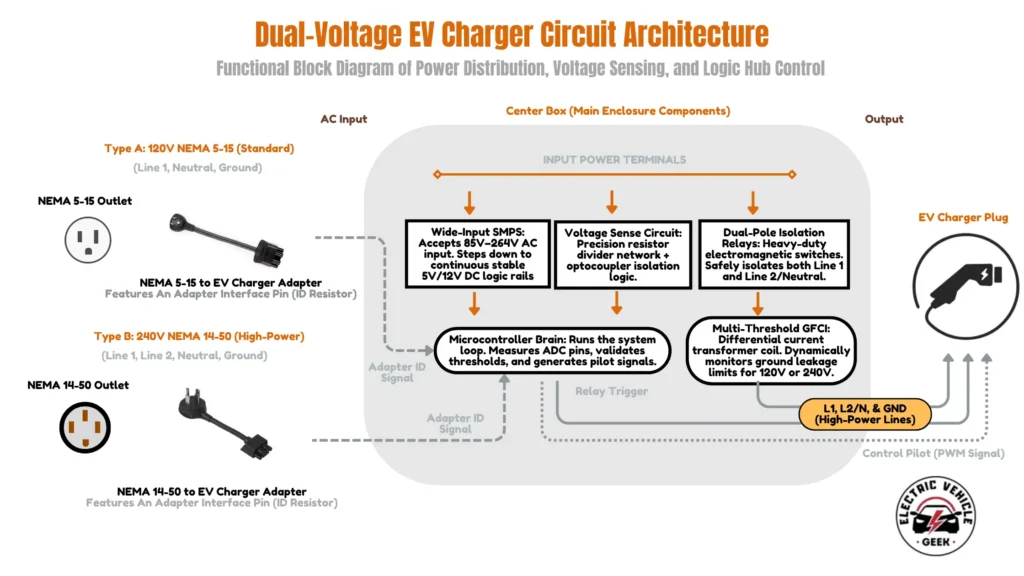
Architecture of a dual-voltage EV charger, illustrating the "logic hub" control system that enables safe operation across 120V and 240V power sources via intelligent adapter sensing and multi-threshold safety monitoring.
Auto-detection is the core technology that makes a dual-voltage charger work, and understanding it helps explain why quality matters more in this category than in a single-voltage unit.
The Detection Circuit
When a dual-voltage charger is plugged into an outlet, its internal detection circuit measures the supply voltage before the main charging relay closes. A reading near 120V (typically 110V to 130V in real-world conditions) triggers the Level 1 operating mode at the charger’s 120V rated amperage. A reading near 240V (typically 220V to 250V) triggers the Level 2 mode at the higher rated amperage. The main relay does not close until detection is complete, which is why plugging in a dual voltage charger takes one to three seconds before charging begins.
Why Detection Quality Varies Between Units
Cheap dual-voltage chargers use simple threshold detectors that can misread the supply voltage during fluctuations, particularly in areas with older grid infrastructure, where 120V can drop to 108V or 240V can sag to 215V under load. A misread can cause the charger to operate in the wrong mode, which either under-delivers power (Level 2 mode triggered on a 120V circuit) or overloads the circuit (Level 1 mode triggered on a 240V circuit that then draws more current than the 120V rating).
Quality dual voltage units use active voltage sensing that remains accurate across the full supply range, which is one of the specific things we test before recommending any unit in this grid.
Switching Between Voltages Over Time
A dual-voltage charger can be used at 120V for months, then moved to a 240V outlet, and then back to 120V without any degradation in detection accuracy or charging performance, since the detection circuit is designed for repeated voltage switching throughout the charger’s full service life. The only exception is chargers with separate hardware adapters rather than true auto-detection, where the wrong adapter physically prevents the wrong voltage from being used rather than detecting it electronically. Both approaches are safe; auto-detection is more convenient and less prone to adapter loss.
Dual Voltage Outlet Guide
One of the most practical features of a dual voltage charger is the range of outlets it can serve. This table shows every outlet combination available with the right adapter, the speed delivered on each, and the circuit that each outlet requires.
Dual Voltage vs Single Voltage
A dual-voltage charger costs roughly 50 to 150 dollars more than a comparable single-voltage 120V unit, and the premium is worth paying in specific scenarios while being unnecessary in others. Knowing which category you fall into before you purchase is the best way to avoid overspending or under-buying.
When Dual Voltage Is Clearly the Right Choice
Dual voltage makes clear financial sense in any of these situations. You currently have only 120V available, but plan to add a 240V circuit within the next two years, because the premium over a 120V-only charger is less than the cost of a replacement charger when you upgrade.
You own or rent multiple properties with different outlet types and want to carry one unit rather than two or three. You travel frequently and charge at destinations where outlet types are unpredictable. You are a new EV owner who has not yet assessed the home electrical situation and wants maximum flexibility while you figure it out.
When a Single Voltage 240V Charger Is the Better Call
A dedicated single-voltage 240V charger is the better choice when you are doing a permanent install at a property you own, have already identified the outlet you will use, and want the maximum reliability from a unit that never has to detect or switch voltages.
Hardwired 240V units in particular deliver marginally higher long-term reliability because they have fewer internal switching components. When you know you will never need 120V operation, paying for dual-voltage detection circuitry adds cost without benefit.
Adapter Kits: What to Look For and What Each Adapter Does
The adapter kit included with or available for a dual-voltage charger is often as important as the charger itself, because the range of outlets the charger can use is determined entirely by the available adapters. A charger with a comprehensive factory adapter kit is more valuable than a slightly cheaper unit that forces you to buy third-party adapters separately.
The Core Adapter Set
The minimum useful adapter set for a dual voltage EV charger covers NEMA 5-15 (standard 120V household outlet), NEMA 5-20 (T-slot 20-amp 120V outlet), and NEMA 14-50 (240V 50-amp Level 2 outlet). With these three adapters, you can charge at virtually any location in the U.S. with accessible electrical infrastructure, since together they cover standard homes, workshops with 20-amp circuits, and most dedicated EV-ready garage outlets.
Extended Adapter Coverage
A more comprehensive kit adds NEMA 14-30 (240V modern dryer outlet), NEMA 6-50 (240V welding outlet), and NEMA TT-30 (RV park pedestal outlet). With all six adapters, the same charger works at a friend’s house with only kitchen outlets, at a workshop with welding infrastructure, at an RV park, at a vacation rental with a dryer outlet, and at a dedicated home charging installation.
EV chargers like the Tesla Mobile Connector Gen 2 and ApexCharger MACH 3 offer the broadest factory adapter coverage in the category.
Adapter Quality and Safety
Every adapter is a connection point carrying the full charging current continuously for hours, so adapter quality matters more than it appears at first. Look for UL- or ETL-listed adapters rated for the full charging amperage, a heavy-gauge cord between the plug and inlet, and robust strain relief at both ends. Cheap third-party adapters that are not certified to the relevant safety standard have caused fires during EV charger installations. Hence, buying adapters from the charger manufacturer or reputable brands with explicit amperage ratings is not optional.
Dual Voltage EV Charger Buyer's Guide
Check the 240V Amperage Rating, Not Just the Dual Voltage Label
Dual voltage is a feature description, not a performance tier, which means two chargers both labeled dual voltage can deliver very different 240V charging speeds. A 16-amp dual-voltage unit delivers 3.84 kW on a NEMA 6-20, while a 40-amp dual-voltage unit delivers 9.6 kW on a NEMA 14-50, a 2.5x speed difference at the same outlet tier. Always check the maximum 240V amperage rating, not just whether the charger is labeled dual voltage.
True Auto-Detection vs Adapter-Based Switching
Some dual-voltage chargers use true electronic auto-detection that reads the supply voltage and adjusts accordingly. Others use separate hardware adapters that signal the charger the voltage. Both approaches are safe and effective, but auto-detection is more convenient for frequent outlet switching and requires less effort to remember to change an adapter. If you plan to switch between outlets regularly, auto-detection is worth specifying.
Connector Type for Your Vehicle
Dual-voltage chargers ship with either a J1772 connector (for non-Tesla EVs and older Teslas with an adapter) or a NACS connector (for Tesla natively and 2024-plus Ford, GM, and Rivian). Some units offer interchangeable connectors or ship with both. Since the dual-voltage feature is about outlet flexibility rather than car connector flexibility, confirm that the car-side connection matches your vehicle before choosing a unit.
Cable Length and Cold Weather Performance
Dual-voltage chargers travel more than wall-mounted units, so cable length and cold-weather flexibility are more important than they are for a permanent install. Look for at least 20 feet of cable, flexibility rated to minus 22 degrees Fahrenheit or lower for northern climates, and a storage bag included or sold separately. A cable that stiffens and cracks after a winter of car-trunk storage is the most common physical failure mode on frequently handled dual-voltage units.
ENERGY STAR and Utility Rebates
Some dual-voltage chargers carry ENERGY STAR certification, which is the qualifying criterion for most U.S. utility rebate programs offering $200 to $1,500 on Level 2 charger purchases. Because ENERGY STAR certification requires smart grid capabilities and specific efficiency levels, certified dual voltage units tend to be hybrid portable or wall-mount form factors rather than compact travel portables.
Every EV sold in the U.S. supports both Level 1 and Level 2 charging via its onboard charger, so every vehicle is compatible with a dual-voltage unit at both voltages. The question is which 240V amperage tier matches your vehicle’s onboard charger rating for full Level 2 speed.
Plug-in hybrids with small batteries (Toyota Prius Prime, Ford Escape PHEV, BMW 330e, Jeep 4xe) fully charge overnight on 120V and see a useful but not essential speed boost from 240V operation. For these vehicles, the dual voltage feature is primarily about flexibility and travel rather than home charging speed. Standard- and mid-range BEVs (Chevy Bolt EV, Nissan Leaf, Hyundai Kona Electric, VW ID.4 standard battery) benefit meaningfully from 240V Level 2 charging for daily recovery, since overnight 120V charging can fall short on heavier-use days.
Long-range BEVs (Tesla Model Y, Hyundai Ioniq 5, Ford Mach-E, Kia EV6, Rivian R1T) genuinely need 240V Level 2 for reliable overnight recovery from typical daily depletion levels. Hence, a dual-voltage charger with a 32-40-amp 240V rating is the right specification for these vehicles. The 40-amp tier delivers the same 9.6 kW as any Level 2 NEMA 14-50 charger, and for these vehicles, the dual-voltage feature means full home speed plus the ability to charge wherever they end up.
Which EVs Work Best With a Dual Voltage Charger
Every EV sold in the U.S. supports both Level 1 and Level 2 charging via its onboard charger, so every vehicle is compatible with a dual-voltage unit at both voltages. The question is which 240V amperage tier matches your vehicle’s onboard charger rating for full Level 2 speed.
Plug-in hybrids with small batteries (Toyota Prius Prime, Ford Escape PHEV, BMW 330e, Jeep 4xe) fully charge overnight on 120V and see a useful but not essential speed boost from 240V operation. For these vehicles, the dual voltage feature is primarily about flexibility and travel rather than home charging speed. Standard- and mid-range BEVs (Chevy Bolt EV, Nissan Leaf, Hyundai Kona Electric, VW ID.4 standard battery) benefit meaningfully from 240V Level 2 charging for daily recovery, since overnight 120V charging can fall short on heavier-use days.
Long-range BEVs (Tesla Model Y, Hyundai Ioniq 5, Ford Mach-E, Kia EV6, Rivian R1T) genuinely need 240V Level 2 for reliable overnight recovery from typical daily depletion levels. Hence, a dual-voltage charger with a 32-40-amp 240V rating is the right specification for these vehicles. The 40-amp tier delivers the same 9.6 kW as any Level 2 NEMA 14-50 charger, and for these vehicles, the dual-voltage feature means full home speed plus the ability to charge wherever they end up.
Compare Other Charger Types
Dual voltage covers the widest range of outlet scenarios, but it is not the only answer for every buyer. Our 120V EV charger archive covers dedicated Level 1 units for buyers who only need 120V. Our 240V EV charger archive covers the full range of Level 2 chargers, including hardwired tiers above 40 amps. Our portable EV charger archive covers travel-first units, and our hardwired EV charger archive covers permanent installs above the 40-amp plug-in ceiling.
Dual Voltage EV Charger Frequently Asked Questions
You’ve Got Dual Voltage EV Charger Questions, We’ve Got Answers.
What Does Dual Voltage Mean on an EV Charger?
It means the charger automatically detects whether it is connected to a 120V or 240V outlet and adjusts its output accordingly. On 120V, it operates as a Level 1 charger at 12 to 16 amps. At 240V, it operates as a Level 2 charger at 16-40 amps, depending on the unit's maximum rating. The switching is handled by the charger's internal voltage-detection circuit rather than by manual selection or adapter changes.
How Does a Dual Voltage Charger Know Which Outlet It Is Plugged Into?
Before the main charging relay closes, the charger's detection circuit reads the supply voltage. A measurement near 120V triggers Level 1 mode, and a measurement near 240V triggers Level 2 mode. Quality units use active sensing that remains accurate across the full supply range (108V to 130V for 120V circuits, 208V to 252V for 240V circuits) and rechecks after any supply interruption.
Is a Dual Voltage Charger as Fast as a Dedicated Level 2 Charger?
On the same 240V outlet at the same amperage, yes, because the output is identical. A 40-amp dual-voltage charger on a NEMA 14-50outlet delivers the same 9.6 kW as a dedicated 40-amp Level 2 charger on the same outlet. The dual-voltage feature adds flexibility without reducing peak performance at any supported outlet tier.
Can I Use a Dual Voltage Charger as My Only Home Charger?
Yes, and this is one of the primary use cases for the category. A 32- to 40-amp dual-voltage hybrid portable on a NEMA 14-50 outlet delivers full Level 2 speed at home while remaining portable for travel. For buyers who want one unit rather than a dedicated home charger and a separate travel charger, a high-amperage dual-voltage unit is the right choice.
Do I Need to Change Any Settings When Switching From 120V to 240V?
With true auto-detection units, no. The charger handles the transition automatically when you connect it to a different outlet. With adjustable amperage units, you should confirm the amperage setting is appropriate for the new outlet's circuit before plugging in, since a charger set to 40 amps should be dialed down to 24 amps before connecting to a 30-amp dryer circuit, even if the outlet shape accepts the plug.
Which Adapter Kit Do I Need With a Dual-Voltage Charger?
The minimum useful set is NEMA 5-15 (standard 120V household outlet), NEMA 5-20 (T-slot 20-amp 120V outlet), and NEMA 14-50 (240V 50-amp Level 2 outlet). Adding NEMA 14-30 (dryer outlet), NEMA 6-50 (welding outlet), and NEMA TT-30 (RV park pedestal) covers virtually every residential and light commercial outlet in the U.S. Always buy UL- or ETL-listed adapters rated for the full charging amperage.
Will a Dual Voltage Charger Work at an RV Park?
Yes, with the right adapter. RV park pedestals offer NEMA TT-30 (30-amp 120V), NEMA 14-50 (50-amp 240V), or both. A dual voltage charger with a TT-30 adapter charges at Level 1 on a TT-30 pedestal and at Level 2 on a 14-50 pedestal. Confirm the pedestal is rated for continuous EV charging load before relying on it for overnight charging.
Are Dual-Voltage Chargers More Expensive Than Single-Voltage Chargers?
Slightly. A dual-voltage charger typically costs 50 to 150 dollars more than a comparable single-voltage 120V unit. Compared to a single-voltage 240V Level 2 unit at the same amperage, the price difference is usually smaller and sometimes negligible at the premium tier. The relevant comparison for most buyers is whether the flexibility the dual-voltage feature provides is worth the premium, given their specific outlet situation.
Can a Dual Voltage Charger Damage My Car if It Detects the Wrong Voltage?
In practice, no, because the car's onboard charger and battery management system control the actual charging rate regardless of what the wall unit delivers, and will not accept more power than the battery can safely receive. A misdetection that causes the charger to operate in the wrong mode would result in under-charging (Level 2 mode on a 120V circuit delivering less power than expected) or a tripped breaker (Level 1 mode on a 240V circuit drawing too much current), neither of which damages the vehicle. Quality EV chargers with accurate voltage sensing make this scenario essentially impossible in normal use.