
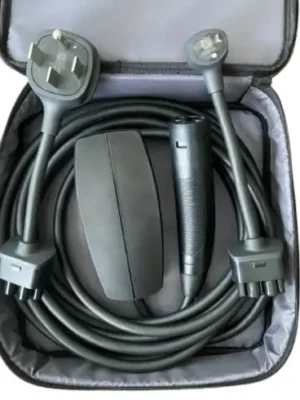
The Tesla Gen 3 Mobile Connector is the latest Tesla mobile charger, delivering up to 7.6 kW (32 amps at 240V) via a NEMA 14-50 or 6-50 adapter, which is roughly 30 miles of range per hour. It also works with standard 120V outlets at 1.3 kW. Offers PowerShare support on compatible vehicles like the Cybertruck and Model Y Performance, enabling basic bi-directional charging, including Vehicle-to-Load (V2L) and Vehicle-to-Vehicle (V2V), making it the most capable portable Tesla charger yet.
★★★★★
More details +
The Tesla Mobile Connector Gen 3 is our #1 rated NACS mobile charger here at Electric Vehicle Geek. It's a serious upgrade over its predecessor, bi-directional charging (Vehicle-to-Load (V2L), Vehicle-to-Vehicle (V2V), Vehicle-to-Grid (V2G), PowerShare support, and a higher charging capacity make it the most capable portable Tesla charger yet. It's the ideal pick for owners who want flexible, on-the-go charging without committing to a permanent wall installation.
PROS:
- Bi-directional charging (V2L & V2V)
- PowerShare support
- Portable and plug-and-play
- Higher charging capacity than previous gen
- No installation required
CONS:
- No V2H & V2G support
- Lower amperage than Universal Wall Connector
- Requires compatible vehicle for bi-directional features
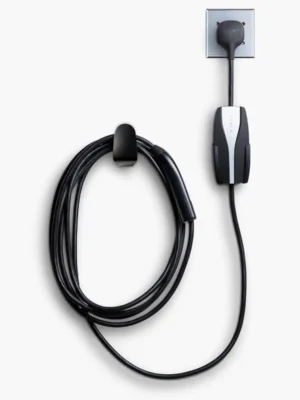
The Tesla Mobile Connector is a portable charger compatible with standard 120V and 240V outlets using interchangeable adapters. It delivers up to 7.6 kW of power, providing flexible, reliable charging for Tesla Models 3, Y, S, and X at home or on the go with a simple setup.
★★★★★
More details +Tesla Mobile Connector Review
The Tesla Mobile Connector offers portability and ease of use, ideal for occasional charging or travel. However, it falls short as a daily home charger due to slower speeds, a lack of smart features, and update limitations, especially for non-Tesla owners. Best suited as a backup or secondary charger.PROS:
- Portable and flexible
- Interchangeable outlet adapters
- Compatible with 120V and 240V outlets
- Reliable hardware build
- No permanent installation required
CONS:
- Limited charging speed (up to 7.6 kW)
- Not designed for daily frequent use
- No firmware updates without a Tesla vehicle
- Lacks smart app features
- Compatibility issues with non-Tesla EVs
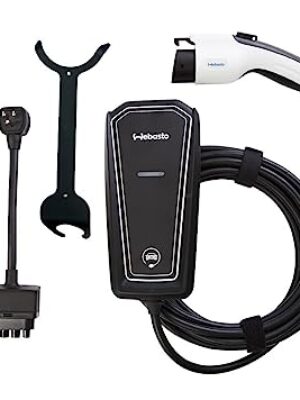
The Webasto Go Dual Voltage Portable EV Charger offers Level 1 and Level 2 charging (120V & 240V), ideal for home or on-the-go use. UL and IP67 rated for safety and durability, it delivers up to 7.7kW of power, charging up to 30 miles per hour. Compatible with all J1772-equipped EVs, including Tesla with an adapter.
★★★★★
More details +
The Webasto Go is a reliable, easy-to-use charger ideal for everyday use. It’s safe, efficient, and built with the needs of EV owners in mind, though potential buyers should consider its waterproof shortcomings.
PROS:
- Dual voltage (120V and 240V) for flexible charging
- Advanced safety features with UL and cUL certifications
- Works in cold weather with a flexible cable
- Easy plug-and-play setup
- Durable construction with rubberized corners
CONS:
- Relatively expensive
- Short 2-year warranty
- No built-in cable management
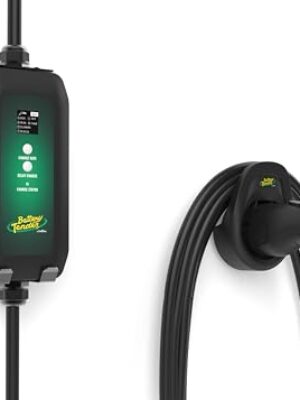
The Battery Tender eCharge 32 AMP EV Charger is a versatile Level 1+2 electric vehicle charger, compatible with 120V or 240V power sources. Offering 16A or 32A output, this portable EV charger is perfect for indoor and outdoor use, featuring multiple plug options like 5-15p, 5-20p, and NEMA 14-50R for flexible charging. Ideal for fast, reliable EV charging at home or on the go.
★★★★★
More details +
The Battery Tender eCharge 32 Amp is one of the more capable portable EV chargers on the market. It handles extreme temperatures, provides real-time data, adapts to your available power source, and doesn't require an app to function. If you want one charger for home and travel without compromise, this one earns its place in your trunk.
PROS:
- Can be used with both 120V and 240V power inputs, offering flexibility for different charging setups.
- With options for 16A or 32A output, it provides fast charging times.
- Suitable for both indoor and outdoor use, ensuring reliability in various conditions.
- Comes with different plug types (5-15p, 5-20p, NEMA 14-50R) to fit various outlets.
CONS:
- It’s on the higher end of the price spectrum, but the features justify the cost.
- The variety of options might be overwhelming for some users.
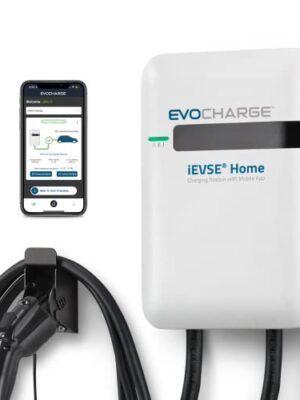
The EvoCharge iEVSE® Home 32 Smart Level 2 EV Charger offers up to 32 Amps of 240V charging, delivering up to 25 miles of range per hour. With WiFi connectivity, a 25-foot cable, and a NEMA 6-50 plug, it’s UL-listed for safety and suitable for both indoor and outdoor installations.
★★★★★
More details +
The EvoCharge iEVSE® Home 32 Smart Level 2 EV Charger is a reliable, easy-to-use, and energy-efficient solution for home EV charging, offering fast charging, Wi-Fi connectivity, and the potential for rebates.
PROS:
- Fast charging up to 8 times faster than Level 1 chargers.
- Wi-Fi connectivity for easy scheduling and control via the Epic charging app.
- Compatible with all North American EVs, including Tesla with J1772 adapter.
CONS:
- Manufacturer support and warranty returns are no longer provided directly.
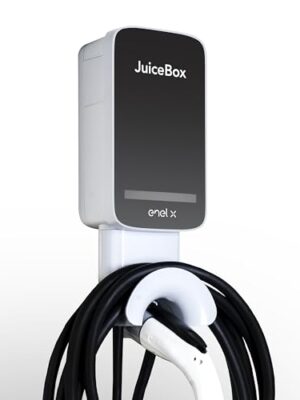
The JuiceBox 32 Amp EV Charger delivers reliable Level 2 charging with a 25-foot cable and NEMA 14-50 plug. UL and Energy Star certified, it’s perfect for indoor or outdoor use. Wi-Fi connectivity lets you schedule charging, monitor energy, and control your EV charger from anywhere.
★★★★★
More details +
Overall, I would say the JuiceBox 32 is a solid, dependable EV charger. It’s easy to install, performs consistently, and the smart features are genuinely useful. If you want something that feels professional and gives you flexibility, it’s a good choice.
PROS:
- Fast charging up to 7.7 kW
- Durable indoor and outdoor design
- WiFi connectivity and Alexa compatibility
- Plug-in installation with NEMA 14-50R outlet
- Smart grid savings and rebate eligibility
CONS:
- Manufacturer leaving the U.S.
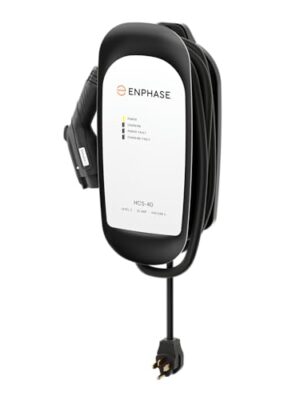
The Enphase 32 Amp Plug-in EV Charger (HCS-40) with NEMA 14-50 plug offers 7.7kW power for fast, reliable charging. Featuring a durable 25 ft cable and J1772 ruggedized connector, it ensures compatibility with all EVs. Backed by a 5-year warranty, this charger provides robust, long-term performance for home use.
★★★★★
More details +
The Enphase HCS-40 Level 2 EV Charger offers fast, safe charging with a durable design and easy installation. It works with all plug-in EVs and integrates with Enphase solar systems. While it’s pricier and has a tangling rubber cord, its reliability and performance make it a solid choice.
PROS:
- Fast charging up to 7.7 kW, seven times faster than Level 1 chargers.
- ETL safety certified and ENERGY STAR rated for reliability.
- Durable, weatherproof NEMA 4 enclosure.
- Easy installation with NEMA 14-50R outlet and 40 Amp circuit.
- Compatible with all plug-in EVs, ideal for models up to 7.7 kW.
- Integrates with Enphase solar systems for eco-friendly charging.
- Includes 5-year warranty and 24/7 support.
- 25-foot cable with storage options for convenience.
CONS:
- Expensive compared to other chargers.
- Rubberized cord can tangle and is hard to manage.
- Bulkier than some alternatives.
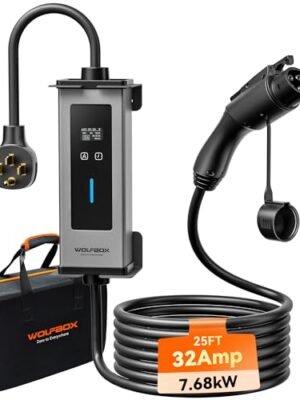
The WOLFBOX PE32 is a slim, portable Level 2 charger with a 32 amp output and a J1772 connector. Featuring a 25-foot cable and 7.68 kW power, it offers flexible, on-the-go charging for most electric vehicles and home use with easy portability.
★★★★★
More details +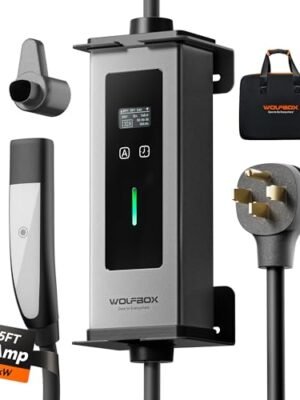
The WOLFBOX PE32T offers portable Level 2 charging with 32 amps and a built-in NACS connector, made specifically for Tesla vehicles. With a 25-foot cable and 7.68 kW output, it’s ideal for Tesla owners seeking a compact, versatile charger for home or travel.
★★★★★
More details +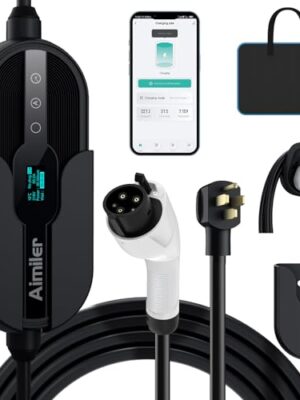
The Aimiler 32 Amp Level 2 EV Charger delivers 220V-240V power with a NEMA 14-50 plug and a 25ft cable, offering versatile indoor/outdoor charging. ETL listed and WiFi-enabled, it features a delay timer for customized charging schedules. Compatible with SAE J1772 EVs, it ensures fast, efficient, and reliable performance.
★★★★★
More details +
The Aimiler 32 Amp Level 2 EV Charger delivers fast, reliable charging with essential safety features and app-based control. Its durable design and compatibility with most EVs make it a great home portable EV charging solution. While the app offers basic scheduling, it lacks advanced smart features.
PROS:
- Fast charging (up to 7.68 kWh)
- Adjustable amperage (16A–32A)
- Built-in safety features (CCID20 protection)
- Durable, weather-resistant design
- 25-foot cable for flexible charging
CONS:
- Limited app functionality
- Not ideal for direct sun or heavy rain exposure
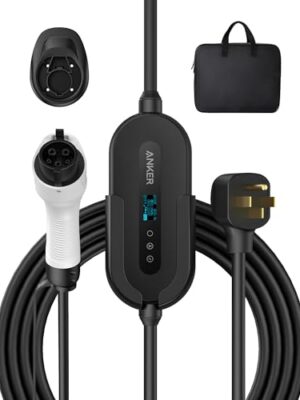
The Anker Electric Vehicle Charger is a 7.6 kW Level 2 portable fast charger featuring a J1772 connector and 25 ft cable. With a NEMA 14-50 plug and scheduled charging, it works with both EV and hybrid vehicles, offering reliable home and outdoor charging convenience with fast, efficient performance.
★★★★★
More details +Show next