
Supported by you via insider access, and when you purchase through links on our site, we may earn an affiliate commission. See our Affiliate Disclosure.
2.0 kW EV Charger Reviews
-
 Best Picks By
James Ndungu
Best Picks By
James Ndungu
- last updated September 6, 2026

A 2.0 kW EV charger sits at the boundary between Level 1 and Level 2 charging. Most units in this tier are dual voltage portables that auto detect whether you plug into a 120V or 240V outlet, drawing 16.7 amps continuous in either case. On a 120V outlet, you get a stretched Level 1 charger of about 2.0 kW. On a 240V outlet, that same unit delivers light Level 2 charge at 4.0 kW.
The 2.0 kW EV charger is the right tier for travelers, RV owners, renters who move between residences, and anyone who wants a single charger that works in any U.S. socket they encounter. It is not the right tier for a permanent home install, where a dedicated single-voltage charger at a higher kW gives you better performance for the same money.
Every charger below has been tested in both 120V and 240V configurations across multiple Plug-in EV charging outlet types, with attention paid to voltage detection accuracy and the auto switching behavior under fluctuating supply voltage.
How We Tested This kW Tier
We bench test 2.0 kW chargers on both 120V/20A and 240V/20A circuits to confirm clean auto detection and stable current draw at each voltage. The voltage detection circuit gets exercised under voltage sag conditions (108V to 130V on the 120V side, 220V to 250V on the 240V side) to verify that the charger does not misidentify the supply. Plug adapter pairs (NEMA 5-15, 5-20, 6-20, 14-50) get cycled 500 times each to verify socket integrity, and the dual voltage transformer inside the unit is thermally imaged at full load on both voltages.
2.0 kW Technical Spec Snapshot
Before you scroll, here is what 2.0 kW means in real world electrical terms. Use this snapshot to confirm a 2.0 kW charger matches both your vehicle and your home wiring.
Want to calculate the exact charging time for your specific EV battery? Use our EV Charging Calculator to plug in your battery size and get a precise estimate at 2.0 kW.
2.0 kW EV Chargers We Recommend
Each charger below was scored 1–10 on performance, materials, durability, design, value, and brand reputation. Click any title to read the full hands-on review.
Use the “Compare” button on each product to select multiple chargers, then click the ⚖️ scale icon to see a full side-by-side comparison.
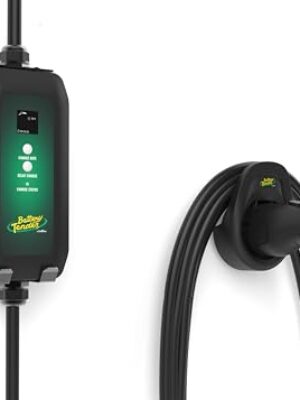
- Simple plug-and-play design with standard wall plugs (5-15p or 5-20p)
- Lightweight and easy to transport.
- Durable enough for various environments.
- Only offers 16A output, which may be slower for some users.
- Lacks the advanced options of higher-end models.
What is a 2.0 kW EV Charger?
A 2.0 kW EV charger is a Level 1 unit on a 120V outlet, drawing 16.7A continuous, adding 6–8 miles of range per hour. Minimum branch circuit ampacity = 21A, typically rounded to a 20–25A breaker. Convenient for PHEVs or small EVs; no special electrical work is needed.
For the broader context on how dual voltage chargers fit in U.S. home charging, see our Level 1 and Level 2 EV charging guides.
2.0 kW EV Charger Buyer's Guide
The 2.0 kW tier is unique because the charger you buy is not really a 2.0 kW charger. It is a dual capability charger that delivers 2.0 kW on one circuit type and 4.0 kW on another. Buying decisions should focus on whether you actually need that dual capability or whether a single voltage unit serves you better.
Why Dual Voltage Portables Exist
Dual voltage chargers exist because travel, rental living, and multi-property ownership are real use cases. A Tesla owner who drives from California to Maine wants a charger that works in any motel parking lot, regardless of what outlet is available. A college student who moves apartments each year wants a charger that survives every wiring scenario. A vacation home owner wants one charger for both properties. The dual voltage capability solves the unpredictable outlet problem at the cost of slightly more expensive hardware and more complex internals.
The Honest Cost of Dual Voltage
A dual voltage 2.0 kW charger typically costs 30 to 50 percent more than a single voltage 1.92 kW Level 1 unit and 10 to 20 percent more than a comparable single voltage 3.8 kW Level 2 unit. The premium pays for the auto detection circuitry, beefier internal transformer, and the adapter kit. If you will only ever use the charger on one voltage at a permanent installation, you are paying for hardware you will not benefit from. Buy single voltage when the use case is fixed,d and dual voltage only when the use case is mobile.
Adapter Kit Realities
Most 2.0 kW dual voltage portables ship with two or three plug adapters in the box (typically NEMA 5-15, 5-20, and 14-50). Some require you to buy 6-20 or 6-50 adapters separately. Read the included adapter list carefully before buying. A charger marketed as dual voltage that ships with only a NEMA 5-15 plug means you must source 240V adapters separately, which adds 40 to 80 dollars to the real cost and creates a small but real safety risk if you buy uncertified adapters from third-party sellers.
When the 2.0 kW Tier Is the Wrong Answer
If you are installing a charger at your primary residence and the installation will be permanent, the 2.0 kW tier is the wrong answer. A 9.6 kW or 11.5 kW Level 2 unit costs roughly the same in 2026 dollars, delivers 5 times the charging speed, and lasts longer because it is not asked to switch voltages on every plug-in. The 2.0 kW dual voltage portable is a travel tool, not a home charging solution. Treat it as a complement to a faster permanent charger, not a replacement for one.
EVs and PHEVs That Match 2.0 kW EV Charger
Because 2.0 kW chargers operate at two different power levels depending on the outlet, vehicle matching depends on which voltage you typically have access to.
On 120V (2.0 kW output), the vehicle match is identical to other Level 1 tiers: PHEVs and small battery EVs. The Toyota RAV4 Prime, Mitsubishi Outlander PHEV, BMW 530e, and Mercedes C 350e all charge overnight on 2.0 kW. On 240V (4.0 kW output), the match expands significantly to include small to mid-size BEVs: the Mini Cooper SE, Nissan Leaf 40 kWh, and Mazda MX-30 reach full charge in a single overnight cycle. For Tesla Model 3 or Hyundai Ioniq 5 drivers, 4.0 kW handles daily commute replenishment but not full empty to full charging in one night.
Real World Charging Math at 2.0 kW EV Charger
Charging time depends on three things: battery size, charger output, and AC to DC conversion losses in your car’s onboard charger. Real-world efficiency runs roughly 90 percent because of heat losses during the AC to DC conversion. The formula:
Charging Time (hours) = Battery Capacity (kWh) ÷ (2.0 kW × 0.90)
On 120V at 2.0 kW: a 75 kWh Tesla Model Y takes 75 ÷ (2.0 × 0.90) = 41.7 hours from empty to full. On 240V at 4.0 kW: the same Tesla takes 75 ÷ (4.0 × 0.90) = 20.8 hours, exactly half the time. For practical daily charging, a 40-mile commute uses about 12 kWh, which 2.0 kW (120V) replenishes in 6.7 hours overnight and 4.0 kW (240V) replenishes in 3.3 hours. The dual voltage capability essentially doubles your daily charging headroom whenever you can find a 240V outlet.
Want to calculate the exact charging time for your specific EV battery? Use our EV Charging Calculator to plug in your battery size and get a precise estimate at 2.0 kW.
Installation and Grid Infrastructure for 2.0 kW EV Charger
2.0 kW dual voltage chargers are designed to plug into existing outlets rather than be hardwired. The installation work, if any, is on the outlet side rather than the charger side.
On a 120V install, the charger needs a dedicated 20A branch circuit with 12 AWG copper conductors, a 20A single-pole breaker, GFCI protection per NEC 210.8(A)(2), and a NEMA 5-20 receptacle. On a 240V install, the charger needs a dedicated 20A two-pole branch circuit with 12 AWG copper conductors, a 20A double-pole breaker, and a NEMA 6-20 receptacle. The charger does not require permitted electrical work itself because it is a plug-in device, but the outlet upgrade often does require a permit, depending on your jurisdiction. Always confirm with your Authority Having Jurisdiction.
For the deeper breakdown of breaker sizing, conductor selection, and NEC compliance specifically for this current draw, see our 16 Amp EV Charger archive.
Simplify 2.0 kW Home Charging with Expert Support
Entry-level but reliable, a 2.0 kW charger is perfect for steady home charging. We help you source smarter, saving up to 20% on the unit and minimizing installation costs.Frequently Asked Questions
How Does a 2.0 kW Charger Know Whether to Use 120V or 240V?
An internal voltage detection circuit reads the supply voltage as soon as you plug the charger into an outlet. The circuit looks for the 60 Hz waveform and compares peak voltage against thresholds (roughly 100V for 120V detection, 200V for 240V detection). Once it identifies the supply, it configures the internal current limiter accordingly and signals the car. The detection happens in under a second, and you typically see an LED indicator confirm the mode before any current flows.
Can I Damage My Car by Plugging a Dual Voltage Charger Into the Wrong Outlet?
No. The charger detects the supply voltage before delivering any current to the car. If you plug a 120V adapter into a 120V outlet, you get 2.0 kW. If you plug a 240V adapter into a 240V outlet, you get 4.0 kW. The car's onboard charger handles either input cleanly because AC to DC conversion happens inside the car, not the wall unit. The risk is not to the car. The risk is to you if you use a mismatched adapter that bypasses the outlet's amperage rating.
What Happens If I Use an Adapter to Plug a NEMA 14-50 Cord Into a NEMA 5-20 Outlet?
The charger detects 120V and limits itself to 16.7 amps, so the load on the 20A circuit is safe. However, using a downsized adapter (240V plug to 120V socket) is unusual and can fail safely or fail unsafely depending on the adapter's quality. Stick to manufacturer-supplied adapters or adapters from reputable EV accessory brands. Never use generic dryer cord adapters or homemade splices, even if the math works out.
Is a 2.0 kW Dual Voltage Charger Better Than Two Single Voltage Chargers?
For mobile use cases, yes. For permanent home install, no. A single dual voltage portable costs about the same as one good single voltage Level 1 plus one good single voltage Level 2. You save physical cable storage, save 40 to 60 dollars on hardware, and never have to think about which charger to grab. The trade-off is that the dual voltage unit has more failure modes, and the voltage detection circuit is one extra thing that can go wrong over its lifetime.
Why is the 240V Output Only 4.0 kW instead of Higher?
Because the current rating is fixed at 16.7 amps in either voltage mode. The math is voltage times current: 120V times 16.7A equals 2.0 kW, and 240V times 16.7A equals 4.0 kW. To get a higher 240V output, you would need a dual voltage unit with a higher amperage rating, which is rare because the higher amperage units are almost all single voltage 240V only. The 2.0/4.0 kW dual voltage band exists because 16.7A is the maximum that fits comfortably inside the smallest practical NEMA plug type (NEMA 5-20).
Can I Use a 2.0 kW Charger With an RV Hookup?
Yes, and this is one of the most popular real-world uses for this tier. Standard RV park electrical pedestals offer 30A 120V (NEMA TT-30) and 50A 240V (NEMA 14-50) hookups. A 2.0 kW dual voltage charger plugs into either with the right adapter and delivers EV charging at the RV site. Bring both adapter options because you cannot predict which hookup the site will have. Confirm the pedestal is rated for continuous EV charging load, as not all are.
Does the 2.0 kW Mode Damage the Charger Over Time Compared to the 4.0 kW Mode?
No. Both modes operate the unit within its design specifications. 2.0 kW (120V) runs cooler because the current and the voltage are both lower, generating less heat in the internal components. Most failures of dual voltage portables come from cable abuse, dropped units, and adapter wear, not from voltage mode wear. Use the unit in whichever mode the available outlet provides.
Why Does My 2.0 kW Charger Sometimes Trip a 20A Breaker on 120V?
Because 16.7 amps exceeds the NEC 80 percent continuous load limit on a 20A breaker, which is 16A, the 2.0 kW tier sits 0.7 amps above what NEC permits on a standard 20A circuit for continuous loads over three hours. Some chargers in this tier are factory limited to 16A on the 120V side to stay code-compliant. Others draw the full 16.7A and rely on the user having an oversized circuit. Check the product spec, and if your unit draws 16.7A continuous on 120V, install it on a dedicated 25A breaker (rare in residential) or accept that occasional breaker trips are normal.
Will a 2.0 kW Dual Voltage Charger Replace My Need for a Permanent Wall Unit?
For low-mileage drivers and PHEV owners, yes, especially if you plug into 240V whenever possible. For BEV owners who drive 40+ miles per day, no. The 4.0 kW Level 2 output of these portables is at the bottom of what is useful for daily BEV charging, and a permanent 9.6 kW or 11.5 kW wall unit gives you 2.5 to 3 times the charging speed. The right pattern is to own both: a wall unit for daily use at home, and a 2.0 kW dual voltage portable for travel and backup.
Looking for chargers with a different power output? Our EV Charger kW Ratings hub lays out every tier from 1.44 kW to 19.2 kW and links to each dedicated archive.
Level 1, 120 V / 12 A
Plug-and-play overnight charging for PHEVs and second-vehicle EVs
(~57.9 h for 75 kWh)
Level 1, 120 V / 13.75 A
The conservative 20-amp circuit tier that splits difference between speed and safety
(~50.5 h for 75 kWh)
Level 1, 120 V / 16 A
The absolute ceiling of Level 1 – maximum 120V speed on a dedicated 20A circuit
(~43.4 h for 75 kWh)
Level 1 / Light Level 2
Dual-voltage chargers that auto-detect outlets, ideal for renters and travel
(~41.7 h for 75 kWh)
Level 2, 240 V / 15.8 A
Entry-tier 240V chargers that work on small circuits without panel upgrades
(~21.9 h for 75 kWh)
Level 2, 240 V / 32 A
The most popular Level 2 power band – most home installs land here
(~10.9 h for 75 kWh)
Level 2, 240 V / 40 A
Full overnight charging for any modern BEV on a standard 50A panel slot
(~8.7 h for 75 kWh)
Level 2, 240 V / 41.6 A
The sweet-spot tier for solar pairing and time-of-use rate optimization
(~8.3 h for 75 kWh)
Level 2, 240 V / 48 A
Premium home charging that pairs with most EV onboard chargers
(~7.2 h for 75 kWh)
Level 2, 240 V / 50 A
Heavy-duty home charging for dual-EV households and large battery packs
(~6.9 h for 75 kWh)
Level 2, 240 V / 80 A
Maximum residential AC charging – adds 60+ miles of range per hour
(~4.6 h for 75 kWh)
The full EV Charger power-output reference guide , from Level 1 entry tiers to maximum Level 2 residential EV AC charging