Supported by you via insider access, and when you purchase through links on our site, we may earn an affiliate commission. See our Affiliate Disclosure.
NEMA 14-30 EV Charger Reviews
We recommend NEMA 14-30 EV chargers for Level 2 charging, as they use a 240-volt outlet and draw up to 30 amps, making them a practical solution for homes with existing dryer-style receptacles. They typically deliver 15–25 miles of range per hour, depending on the vehicle, providing enough charging capacity for most daily driving needs while offering a convenient, cost-effective overnight charging solution.
A NEMA 14-30 outlet is the modern 4-prong dryer outlet used in U.S. homes built or rewired since 1996. It is 240V and rated for 30 amps. EV chargers using this outlet draw up to 24 amps continuous and deliver 5.76 kW of Level 2 power.
If your home has a 4-prong dryer outlet, you can use it for EV charging or repurpose it. NEMA 14-30 EV charging is one of the cheapest paths to Level 2 because the circuit already exists in many US homes. Most homeowners do not realise that their dryer outlet can be used for EV charging.
Every charger reviewed below was tested at the 24 amp continuous limit on real 30A two-pole circuits. We watched for breaker trips, plug heat, and adapter integrity when chargers ship with NEMA 14-50 plugs and use a 14-50-to-14-30 adapter for this outlet.
How We Tested This Amp Tier
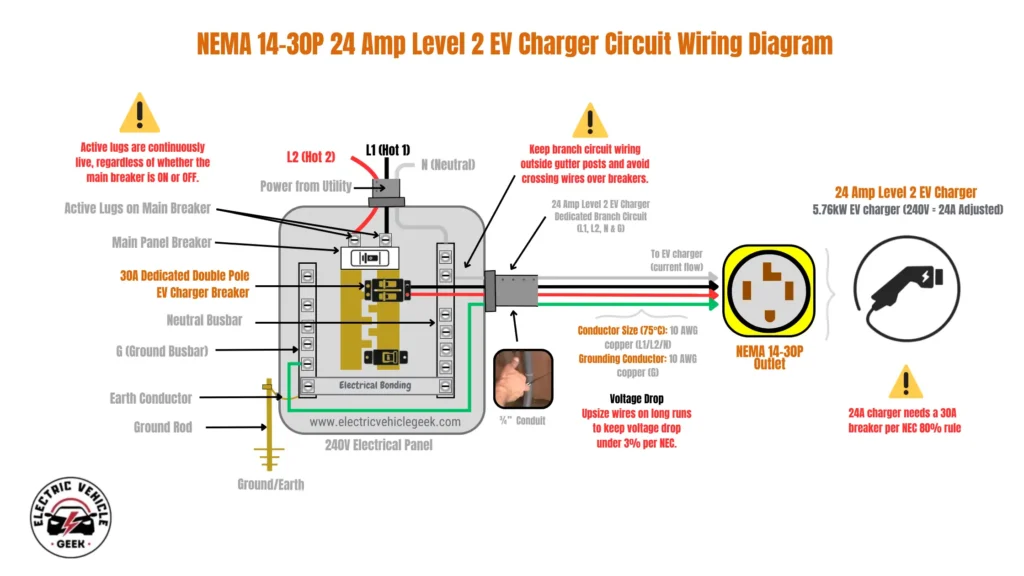
We test NEMA 14-30 chargers on a dedicated 240V, 30A two-pole circuit with 10 AWG copper wiring. Continuous current is measured at 24 amps during 8-hour cycles. We thermally image both the NEMA 14-30 plug body and the wall outlet face. For chargers using 14-50-to-14-30 adapter cables, we test the adapter junction for heat under sustained load. We verify that the charger’s internal current limiter remains at or below 24 amps during a voltage sag.
Our NEMA 14-30 EV Charger Reviews
Each charger below can deliver up to 24 amps via a standard NEMA 14-30 power plug, operating on a 240V circuit for reliable Level 2 charging. We evaluate every unit on a 10-point scale across performance, build quality, durability, design, value, and brand reputation. Click any title to read the full hands-on review. These chargers offer a practical balance of charging speed and convenience, making them well-suited for daily home charging, overnight replenishment, and households with existing NEMA 14-30 outlets.
Use the “Compare” button on each product to select multiple chargers, then click the ⚖️ scale icon to see a full side-by-side comparison.
How Fast Will an EV Charge on a NEMA 14-30 Charger?
A NEMA 14-30 charger delivers 5.76 kW of Level 2 power. That works out to 18 to 22 miles of range added per hour, about 4 to 5 times faster than a NEMA 5-15 outlet.
Over an 8-hour overnight charge, you get 144 to 176 miles of range. That covers most daily driving in the U.S. with margin for back-to-back long days.
A 75 kWh Tesla Model Y refills in about 14.5 hours at NEMA 14-30 speed. For a 40-mile daily commute that draws 12 kWh, the outlet fully recharges the battery in about 2.3 hours overnight. Daily driving is fast; a full-empty-to-full recovery takes longer than a single overnight cycle.
How to Identify a NEMA 14-30 Outlet in Your Home
A NEMA 14-30 outlet is in almost every modern American home, but most owners only know it as the dryer outlet. Identifying it for EV charging takes one minute.
What Is a NEMA 14-30 Outlet?
A NEMA 14-30 outlet is a 240V, 30-amp, 4-prong outlet used as the modern dryer outlet in U.S. homes built or rewired since 1996. It carries two hot conductors, one neutral, and one ground conductor. Under the NEC 80 percent rule, the maximum continuous load is 24 A, delivering 5.766 kW for EV charging. It is one of the cheapest paths to Level 2 because most homes already have one.
The 14-30 has 4-prong slots: two angled hot slots, one straight neutral slot, and one L-shaped ground slot. It is smaller than a NEMA 14-50 (about 2 inches across versus 2.5 inches for the 14-50). The slot pattern matches the 14-50 but with thinner blade sizes because the contacts only need to carry 30 amps.

If you don’t already have a NEMA 14-30 outlet for EV charging, or you’re looking to install a dedicated 240V, 30-amp circuit for convenient home EV charging, here are the best NEMA 14-30 solutions we recommend for reliable Level 2 charging performance.
A standard NEMA 14-30 outlet from a home costs $10 to $18. The internal contacts are rated for the load, and the dryer cycling is gentle enough that contractor-grade outlets typically last 10+ years in their original use.
Commercial-grade NEMA 14-30 outlets from Hubbell or Bryant run from $25 to $40. The premium is harder to justify here than at NEMA 14-50 because the thermal stress is lower. Still worth it for buyers who plan to charge their EVs nightly at the outlet for the next decade.
If your existing 14-30 dryer outlet has been in service for over 10 years and you want to add EV charging duty, replace the outlet before installation. The contacts have already cycled thousands of times, and adding a sustained EV load will accelerate the next failure. A 25 dollar outlet is much cheaper than a failed install.
Where You Will Find It
Behind your electric dryer in the laundry room or in the garage near where the dryer used to live. Some homes have a 14-30 outlet in a garage that was originally meant for a dryer install that never happened. Look for the 4-prong rectangular outlet on the wall about 12 to 18 inches above the floor.
How to Test If It Is Wired Correctly
Verify 240V across the two angled slots with a multimeter. Confirm the breaker for that outlet is a 30A two-pole (one breaker handle spanning two slots, rated 30A). Confirm the conductor feeding the outlet is 10 AWG copper (orange insulation on most modern installs). If any of these specs are wrong, do not connect an EV charger until an electrician corrects the wiring.
NEMA 14-30 EV Charger Buyer's Guide
Choosing a NEMA 14-30 charger is about confirming the unit ships with the right plug (or accepts an adapter) and that your dryer circuit is genuinely sized for continuous load.
The 14-30 vs 10-30 Difference
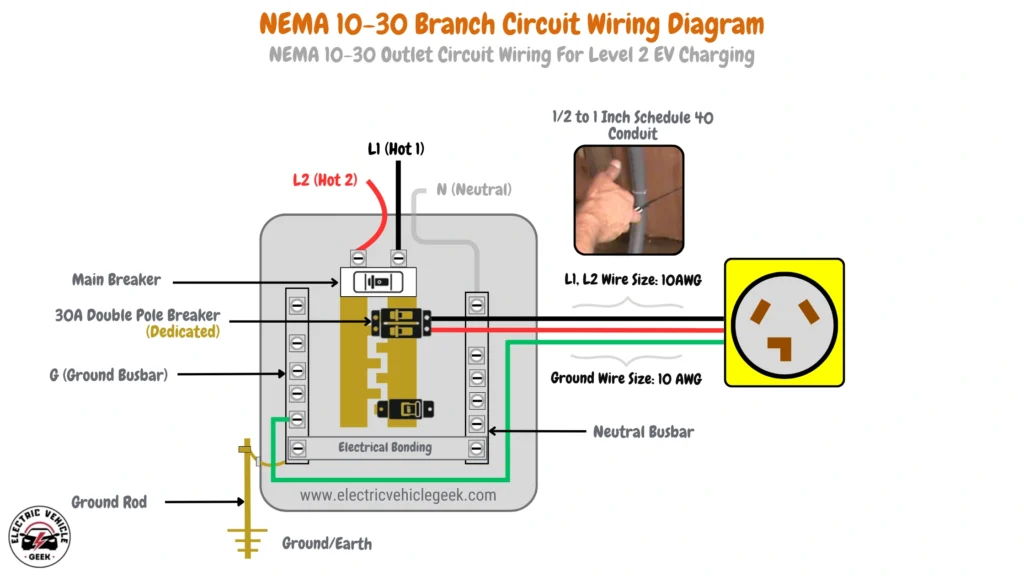
NEMA 14-30 is the modern 4-prong dryer outlet that includes a dedicated ground wire. NEMA 10-30 is the older 3-prong dryer outlet that lacks a separate ground and is commonly found in homes built before 1996. The two are not interchangeable. A NEMA 14-30 EV charger will not plug into a NEMA 10-30 outlet without an adapter, and upgrading a NEMA 10-30 circuit to a NEMA 14-30 receptacle typically requires running a new ground wire. If you live in an older home, verify which outlet type you have before purchasing an EV charger.
Sharing or Replacing Your Dryer Circuit
Keeping the dryer means installing a manual transfer switch or smart splitter (200 to 400 dollars) that allows only one device on the circuit at a time. Never use a generic Y splitter on a 240V circuit because both devices can draw current simultaneously and trip the breaker. The cleanest solution is converting from an electric to a gas dryer and dedicating the outlet to EV charging.
Adjustable Amperage Chargers Fit Best
Many EV chargers sold today are 32-amp or 48-amp units that can be dialed down to 24 amps for a 30A circuit. The amperage setting lives in the unit’s app or hardware switch. This is the most flexible choice because if you later upgrade to a 40A or 60A circuit, the same charger can handle it with a simple setting change. Fixed-24-amp chargers are slightly cheaper but cap you at 5.76 kW forever.
When to Convert 14-30 to 14-50
If you want faster charging than 5.76 kW and your panel has capacity for a 50A circuit, converting from 14-30 to 14-50 unlocks 7.68 to 9.6 kW. The conversion requires a new 50A two-pole breaker, 6 AWG copper conductor (larger than the existing 10 AWG), and a new outlet. The total cost is typically 400 to 700 dollars, depending on the conductor run length. The speed gain is roughly 40 percent.
EVs That Work With a NEMA 14-30 Charger
NEMA 14-30 works well for most modern EVs because the 24 amp continuous draw fits the onboard charger ratings of most BEVs sold from 2018 to 2024.
Best matches at NEMA 14-30 include the Tesla Model 3 Standard Range (full charge in about 11.6 hours), Chevy Bolt EV and EUV (12.7 hours), Nissan Leaf 40 kWh (7.7 hours), Hyundai Kona Electric (12.7 hours), Mini Cooper SE (6.3 hours), and Volkswagen ID.4 standard battery (11.7 hours). Heavier daily mileage drivers and owners of F-150 Lightning, Rivian R1T, or Tesla Model Y Long Range may want to upgrade the circuit to NEMA 14-50 for faster recovery.
Related Amp and kW Coverage
A NEMA 14-30 outlet supports the same circuit as our 24 Amp EV Charger archive, which covers breaker sizing, conductor gauge, and NEC code citations. For charging speed math and vehicle range per hour, see our EV Charger kW Ratings hub.
NEMA 14-30 EV Charger Frequently Asked Questions
You’ve Got NEMA 14-30 EV Charger Questions, We’ve Got Answers.
Can I Use My Dryer NEMA 14-30 Outlet for EV Charging?
Yes, if it is a NEMA 14-30 (4-prong) outlet on a properly sized 30A two-pole circuit. The same outlet works for both the dryer and an EV charger, though not simultaneously. To share, install a manual transfer switch or smart splitter. To dedicate, convert the electric dryer to gas, and use the outlet exclusively for EV charging.
What Is the Difference Between NEMA 14-30 and NEMA 10-30?
Ground wire. NEMA 14-30 has 4 prongs, including a separate ground conductor. NEMA 10-30 has 3 prongs with the ground bonded to the neutral, which is the legacy pre-1996 wiring method. The 14-30 is safer because the dedicated ground is isolated from the neutral. Modern EV chargers expect a 4-prong outlet for safety reasons.
Can I Use a NEMA 14-50 Plug Charger on a NEMA 14-30 Outlet?
Only with a properly rated adapter that limits the charger to 24 amps. A NEMA 14-50 plug expects a 50A circuit. Plugging it into a 30A circuit without amperage limiting will trip the breaker. Some chargers ship with NEMA 14-30 adapter cords specifically for this scenario, and many include an amperage setting in the app or on the unit. Confirm both the adapter and the amperage limit before plugging in.
How Much Does It Cost to Convert NEMA 14-30 to NEMA 14-50?
Typically, $400 to $700 in 2026 labor and parts. The work requires pulling a new 6 AWG copper conductor (versus the existing 10 AWG), installing a 50A two-pole breaker (versus a 30A breaker), and replacing the outlet. If your conduit run is short and your panel has spare capacity, the cost is on the lower end. Long runs or panel issues push up the cost.
Why Are Most EV Chargers Sold With NEMA 14-50 Plugs Instead of 14-30?
Because the U.S. EV charging market standardized on NEMA 14-50 early on, driven by Tesla's original Mobile Connector and the existing RV and electric range outlet base. NEMA 14-30 chargers exist but are less common. Many buyers use a 14-50 charger with a 14-30 adapter, which works fine with proper amperage limiting.
Will a 24 Amp Charger Trip My 30 Amp Dryer Breaker?
It should not, as long as the breaker is in good condition and not heat-fatigued from years of dryer cycling. 24 amps is exactly at the NEC 80% limit for a 30A breaker. If the breaker trips with a 24-amp charger, the breaker itself is the problem. Replace it with a quality unit from Square D, Eaton, or Siemens (about 25 dollars).
Is a NEMA 14-30 Outlet Considered Level 2 Charging?
Yes. Any AC charging at 240V is Level 2 under the SAE J1772 standard. A NEMA 14-30 at 5.76 kW qualifies, even though it is on the lower end of Level 2 power. The classification depends on voltage, not on charging speed.
Can I Install a NEMA 14-30 Outlet Where None Exists?
Yes, with a licensed electrician. Installing a new 14-30 outlet requires a 30A two-pole breaker, a 10 AWG copper conductor, and the outlet. The total installation cost typically ranges from NS 400 to 800 per panel, depending on available capacity. If you are paying for new circuit work anyway, consider going with NEMA 14-50 because the marginal cost is low and the speed gain is significant.
What Vehicles Need More Than NEMA 14-30 Speed?
Vehicles with large batteries are used for heavy daily driving. The Ford F-150 Lightning Extended Range (131 kWh), Tesla Cybertruck (123 kWh), Lucid Air Grand Touring (118 kWh), Rivian R1T Max Pack (135 kWh), and Tesla Model Y Long Range, when used for high mileage,e all benefit from NEMA 14-50 or higher. For PHEVs and smaller BEVs (under 75 kWh) with typical commute mileage, NEMA 14-30 is fast enough.