
Supported by you via insider access, and when you purchase through links on our site, we may earn an affiliate commission. See our Affiliate Disclosure.
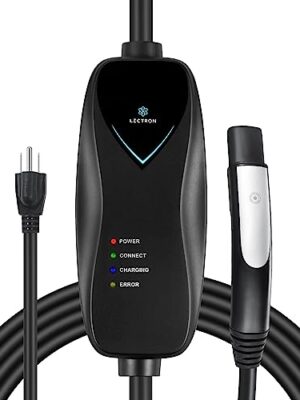
A 1.65 kW EV charger sits in the middle of the Level 1 power band. It runs on a 120V outlet, drawing 13.75 amps continuous, which means it cannot run on a standard 15A household circuit and instead requires a 20A branch circuit under the NEC 80 percent continuous-load rule. In exchange,e you get about 4 to 6 miles of range per hour, around 30 percent faster than entry-tier 1.44 kW units.
This tier is built for the gap between ‘I have a standard outlet’ and ‘I want Level 2.’ If your garage already has a 20A circuit, or you can have one added cheaply, 1.65 kW gives you noticeably faster overnight charging without the cost of going 240V.
We have tested every 1.65 kW charger under continuous 13.75A load to verify it stays below the 80 percent threshold without nuisance breaker trips, and confirmed cable temperature handling at this slightly higher current.
1.65 kW chargers are tested on a dedicated 120V/20A circuit with both NEMA 5-15 and NEMA 5-20 receptacle adapters. Continuous current is measured for 6-hour windows to confirm sustained 13.75A operation without thermal derating. We verify the charger respects the 80 percent rule and does not creep above 14A under voltage sag, which is a known failure mode at this tier. NEMA 5-15-to-5-20 adapter cable connections are stress-tested for heat at the adapter junction.
Before you scroll, here is what 1.65 kW means in real-world electrical terms. Use this snapshot to confirm a 1.65 kW charger matches both your vehicle and your home wiring.
Want to calculate the exact charging time for your specific EV battery? Use our EV Charging Calculator to plug in your battery size and get a precise estimate at 1.65 kW.
Each charger below was scored 1–10 on performance, materials, durability, design, value, and brand reputation. Click any title to read the full hands-on review.
Use the “Compare” button on each product to select multiple chargers, then click the ⚖️ scale icon to see a full side-by-side comparison.
A 1.65 kW EV charger delivers 1.65 kilowatts of AC power from a 120V outlet at 13.75 amps continuous draw. It requires a dedicated 20A branch circuit under the NEC, adds 4 to 6 miles of range per hour, and is the conservative middle tier of Level 1 charging. For the broader context on how Level 1 fits in the U.S. charging landscape, see our Level 1 EV charging guide.
At 1.65 kW, the engineering decision is whether the modest speed bump over 1.44 kW is worth the cost of upgrading your branch circuit from 15A to 20A.
1.65 kW is the result of a specific NEC math problem. A 20A circuit can deliver 16 amps continuous (20A × 80 percent). Still, many chargers in this band are factory-set to 13.75A to give themselves headroom and avoid edge-case breaker trips on circuits with voltage drop. The 13.75A setpoint at 120V works out to exactly 1.65 kW. It is the safe, conservative middle option between the 12A floor and the 16A ceiling of 120V Level 1 charging.
If your garage already has a 20A circuit, you are done – plug in and charge. If not, the upgrade from a 15A circuit to a dedicated 20A circuit typically costs $200 to $500. The work involves a new 20A single-pole breaker, 12 AWG copper conductors (not 14 AWG), and a NEMA 5-20 receptacle. The home value bump from a dedicated 20A garage circuit usually exceeds the install cost over the life of the home, so this is rarely wasted spend.
Both 1.65 kW and 1.92 kW chargers can run on the same 20A circuit, but the 1.65 kW unit leaves more margin. If your 20A circuit is shared with other loads (lighting, garage door opener), the 1.65 kW unit’s lower draw reduces the chance of nuisance trips. On a dedicated 20A circuit with no shared loads, 1.92 kW is the better pick. On a shared circuit, 1.65 kW is the safer pick.
1.65 kW best matches small-to-mid-battery PHEV,s where the extra speed over 1.44 kW shortens overnight charging meaningfully without requiring a 240V install.
Best matches at 1.65 kW include the BMW X5 xDrive50e (29.5 kWh battery), Volvo XC90 Recharge (18.8 kWh), Audi Q5 TFSI e (17.9 kWh), Range Rover P440e (38.2 kWh), Lexus NX 450h+ (18.1 kWh), and Mercedes GLE 450e (31.2 kWh). Larger-battery PHEVs see a real benefit from the 30 percent speed bump over 1.44 kW because their batteries are big enough that the extra hour or two matters. Battery EVs over 40 kWh see diminishing returns; if you are driving a BEV, look at Level 2 EV chargers.
Charging time depends on three things: battery size, charger output, and AC-to-DC conversion losses in your car’s onboard charger. Real-world efficiency runs roughly 90 percent because of heat losses during AC-to-DC conversion. The formula:
Charging Time (hours) = Battery Capacity (kWh) ÷ (1.65 kW × 0.90)
An 18.8 kWh Volvo XC90 Recharge battery: 18.8 ÷ (1.65 × 0.90) = 12.7 hours from empty to full, comfortably within an overnight window. A 29.5 kWh BMW X5 xDrive50e: 29.5 ÷ (1.65 × 0.90) = 19.9 hours, which means two overnight cycles. For a full BEV like a 75 kWh Tesla, the math is 50.5 hours, which is why this tier is wrong for full BEVs and right for medium-to-large PHEVs.
1.65 kW is the first tier where a real electrical upgrade may be needed. If your garage outlet is on a 15A circuit (very common in homes built before 2000), you cannot run a 1.65 kW charger safely on that circuit.
The required circuit is a dedicated 20A single-pole branch circuit with 12 AWG copper conductors, a 20A breaker (NEC 210.20(A)), a NEMA 5-20 receptacle, and GFCI protection per NEC 210.8(A)(2) in garages and outdoor locations. A 1.65 kW charger will physically plug into a NEMA 5-15 outlet if the cord ships with an adapter, but doing so on a 15A circuit violates NEC and will likely trip the breaker after a few hours of continuous load. Do not skip the circuit upgrade.
For the deeper breakdown of breaker sizing, conductor selection, and NEC compliance specifically for this current draw, see our 16 Amp EV Charger archive.
Because 13.75A continuous exceeds the NEC 80 percent limit on a 15A breaker, which is 1, running 13.75A continuously on a 15A circuit will eventually trip the breaker, and more importantly, it violates NEC 210.20(A). The breaker manufacturer's UL listing does not cover sustained loads above 80 percent of the breaker rating. This is a code violation, not a soft recommendation.
Adapters that convert a 5-15 plug (15A) to fit a 5-20 outlet (20A) exist, but going the other direction (plugging a 5-20 plug into a 5-15 outlet) is not permitted under NEC because it bypasses the amperage limit of the upstream circuit. If your charger has a NEMA 5-20 plug, install a 5-20 outlet on a proper 20A circuit. Do not adapt your way around it.
About 30 percent faster, which translates to roughly 4 to 6 miles of range per hour versus 3 to 5 for 1.44 kW. Over a 10-hour overnight charge, that is 40 to 60 miles added versus 30 to 50 miles. The real value is for drivers who do not have a full 10-hour overnight window - shift workers, multi-driver households, or anyone who plugs in at 11 PM and leaves at 6 AM.
Most 1.65 kW chargers are 120V-only. A few dual-voltage portable units can detect input voltage and switch modes, in which case they will deliver 3.3 kW on 240V rather than 1.65 kW. Read the product spec carefully - if it lists only 120V input, do not plug it into a 240V outlet even with an adapter, as the internal electronics may not survive.
Level 1. The SAE J1772 standard defines Level 1 as 120V AC charging up to about 1.92 kW (16A max). 1.65 kW sits comfortably inside that band. Level 2 begins at 240V regardless of amperage. Even a low-amperage 240V charger like a 16A unit (3.84 kW) qualifies as Level 2.
Manufacturers round 1.65 kW differently for marketing - 1.6 kW, 1.7 kW, even 'about 1.5 kW.' The actual current draw of 13.75A and the kW value of 1.65 are fixed by physics, not marketing. To verify what you are buying, look at the listed continuous amperage. 13.75A on 120V is always 1.65 kW.
Yes, on a 120V solar inverter rated above 2 kW continuous. The math is simple: 1.65 kW continuous draw, with 10 percent inverter losses, means you need at least 1.85 kW of available solar production. A typical 3 to 5 kW residential solar array easily covers this during peak sun hours. The catch is that EV charging usually happens overnight when there is no solar, so you need battery storage to make solar-direct charging practical at this tier.
Looking for chargers with different power outputs? Check out these common options, ranging from entry-level 1.44 kW Level 1 chargers to high-output 19.2 kW Level 2 EV chargers.
Level 1, 120 V / 12 A
Plug-and-play overnight charging for PHEVs and second-vehicle EVs
(~57.9 h for 75 kWh)
Level 1, 120 V / 13.75 A
The conservative 20-amp circuit tier that splits difference between speed and safety
(~50.5 h for 75 kWh)
Level 1, 120 V / 16 A
The absolute ceiling of Level 1 – maximum 120V speed on a dedicated 20A circuit
(~43.4 h for 75 kWh)
Level 1 / Light Level 2
Dual-voltage chargers that auto-detect outlets, ideal for renters and travel
(~41.7 h for 75 kWh)
Level 2, 240 V / 15.8 A
Entry-tier 240V chargers that work on small circuits without panel upgrades
(~21.9 h for 75 kWh)
Level 2, 240 V / 32 A
The most popular Level 2 power band – most home installs land here
(~10.9 h for 75 kWh)
Level 2, 240 V / 40 A
Full overnight charging for any modern BEV on a standard 50A panel slot
(~8.7 h for 75 kWh)
Level 2, 240 V / 41.6 A
The sweet-spot tier for solar pairing and time-of-use rate optimization
(~8.3 h for 75 kWh)
Level 2, 240 V / 48 A
Premium home charging that pairs with most EV onboard chargers
(~7.2 h for 75 kWh)
Level 2, 240 V / 50 A
Heavy-duty home charging for dual-EV households and large battery packs
(~6.9 h for 75 kWh)
Level 2, 240 V / 80 A
Maximum residential AC charging – adds 60+ miles of range per hour
(~4.6 h for 75 kWh)
The full EV Charger power-output reference guide , from Level 1 entry tiers to maximum Level 2 residential EV AC charging