Supported by you via insider access, and when you purchase through links on our site, we may earn an affiliate commission. See our Affiliate Disclosure.
NEMA 14-50 EV Charger Reviews
-
 Best Picks By
James Ndungu
Best Picks By
James Ndungu
- last updated September 6, 2026

We recommend NEMA 14-50 EV chargers for Level 2 charging, as they use a 240-volt outlet with a maximum of 50 amps, making them ideal for efficient plug-in EV charging. They typically deliver around 25–40 miles of range per hour depending on the vehicle, making them one of the most practical and widely used home charging solutions for convenient overnight charging.
A NEMA 14-50 outlet is the most common Level 2 EV charging outlet in the U.S. It is a 4-prong 240V outlet rated for 50 amps. The same outlet feeds electric ranges and RV hookups, which is why so many homes already have one.
If you already have a NEMA 14-50 (from an RV pad, an electric range circuit, or a previous EV install), you have the foundation for fast Level 2 charging. Plug in a 32-40 A charger, and you get 7.68-9.6 kW of power, enough to fully recharge most BEVs overnight.
Every charger reviewed below was tested at a sustained 32 to 40A continuous draw on real 50A circuits with 6 AWG copper conductors. We watched closely for thermal failures at the NEMA 14-50 plug, which is the known weak point at this outlet.
How We Tested This Amp Tier
We test NEMA 14-50 chargers on a dedicated 240V, 50A circuit with 6 AWG copper wiring. Continuous current is measured at the charger’s rated amperage during 12-hour stress cycles. The receptacle temperature is logged every 30 minutes to catch creeping thermal failures (the leading failure mode at NEMA 14-50). We stress-test the plug through 1000 plug cycles and verify that the plug control pilot signal remains stable as the contactor switches.
Our NEMA 14-50 EV Charger Reviews
Each charger below can deliver up to 50 amps via a standard NEMA 14-50 power plug, operating on a 240V circuit for high-performance Level 2 charging. We evaluate every unit on a 10-point scale across performance, build quality, durability, design, value, and brand reputation. Click any title to read the full hands-on review. These units offer a strong balance of speed and convenience, making them well-suited for daily home charging, long-distance drivers, and EVs with larger battery packs requiring reliable overnight replenishment.
Use the “Compare” button on each product to select multiple chargers, then click the ⚖️ scale icon to see a full side-by-side comparison.
How Fast Will an EV Charge on a NEMA 14-50 Charger?
A NEMA 14-50 charger delivers up to 9.6 kW of Level 2 power, with a 40-amp charger, that works out to 30 to 36 miles of range added per hour. With a 32-amp charger, the same outlet delivers 7.68 kW and 24 to 30 miles of range per hour.
Over an 8-hour overnight charge, a NEMA 14-50 with a 40-amp charger adds 240 to 288 miles of range. That covers any daily mileage in the U.S. with hours to spare.
A 75 kWh Tesla Model Y takes about 8.7 hours to recharge at 9.6 kW. For a 40-mile daily commute that draws 12 kWh, the outlet refills the battery in about 1.3 hours overnight. The NEMA 14-50 is the speed sweet spot for most U.S. EV households.
How to Identify a NEMA 14-50 Outlet in Your Home
Choosing a NEMA 14-50 charger is about feature selection and outlet quality more than amperage. Most chargers in this archive are 32- or 40-amp units, both of which fit cleanly on a 50A circuit.
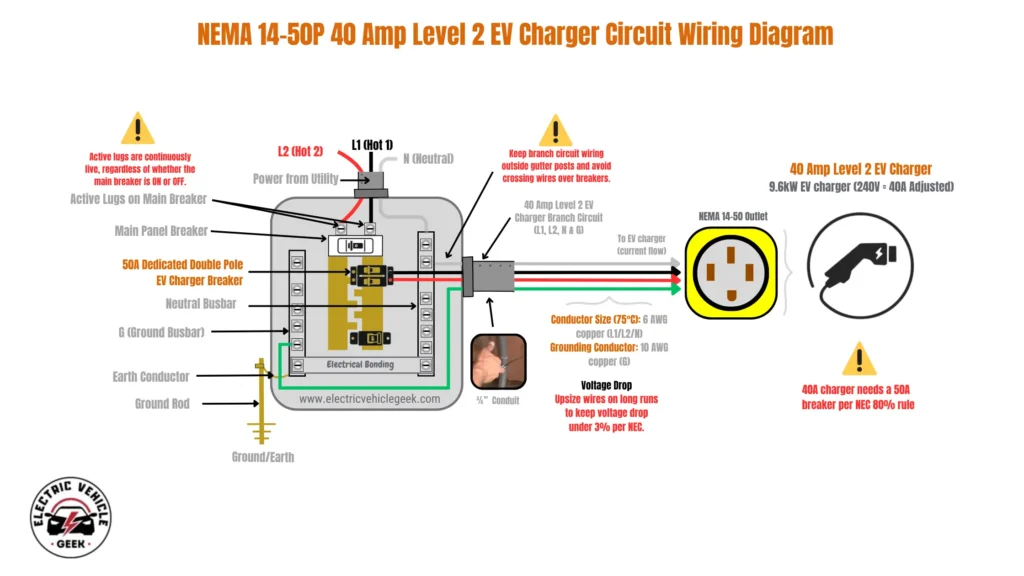
A NEMA 14-50 outlet is a 240V, 50-amp, 4-prong outlet used throughout the U.S. for electric ranges, RV hookups, and EV charging. Under the NEC 80 percent rule, the maximum continuous load is 40 amps, which delivers 9.6 kW for EV charging. It is the mainstream Level 2 charging outlet in U.S. homes.
A NEMA 14-50 has 4-prong slots arranged in an L-shape: two angled hot slots, one center neutral slot, and one ground slot. The outlet body is large, about 2.5 inches across. The slots are noticeably bigger than on smaller 240V outlets because the contacts must carry 50 amps.

If you don’t already have a NEMA 14-50 outlet for EV charging, or you’re looking to install a dedicated 240V, 50-amp circuit for convenient home EV charging, here are the best NEMA 14-50 solutions we recommend for reliable Level 2 charging performance.
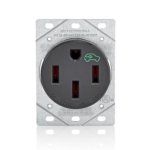
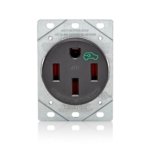
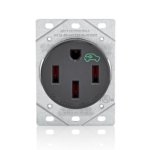
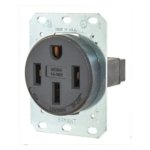
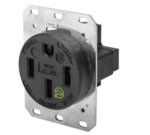
A NEMA 14-50 outlet from a home center costs $8+. It is rated for the load but not designed for continous loads of EV charging and thermal cycling. The blade contacts and the outlet body wear faster than with commercial-grade alternatives.
Commercial-grade outlets from Hubbell (the HBL9450A is the gold standard at this tier), Bryant (9450FR), and certain Leviton commercial line units cost $25 to $40. The internal contacts are heavier, the spring tension is calibrated for continuous high current, and the warranty covers EV charging duty cycles.
Replace any existing NEMA 14-50 outlet that shows discoloration around the blade slots, brown marks on the face, or loose plug fit before installing your EV charger. These signs indicate past overheating, and the outlet will not improve with sustained EV charging added to its workload.
Where You Will Find It
The most common locations are kitchens behind electric ranges, dedicated RV pads in driveways, and recently installed EV charging stations in garages. Some workshops have them for high-power equipment. If you bought a home built since 2000 with an electric range, the range outlet is likely a NEMA 14-50.
How to Test If It Is Wired Correctly
Verify three things with a licensed electrician or with a multimeter. First, confirm 240V across the two angled hot slots. Second, verify the breaker is a 50A two-pole (not a smaller breaker installed on the same outlet). Third, confirm the conductor feeding it is 6 AWG copper, not 8 AWG aluminum (which is undersized for a 50A continuous load).
NEMA 14-50 EV Charger Buyer's Guide
Choosing a NEMA 6-50 charger is about confirming the unit ships with the right plug (or accepts the adapter) and that your existing welder circuit is correctly sized for 40 amp continuous EV charging.
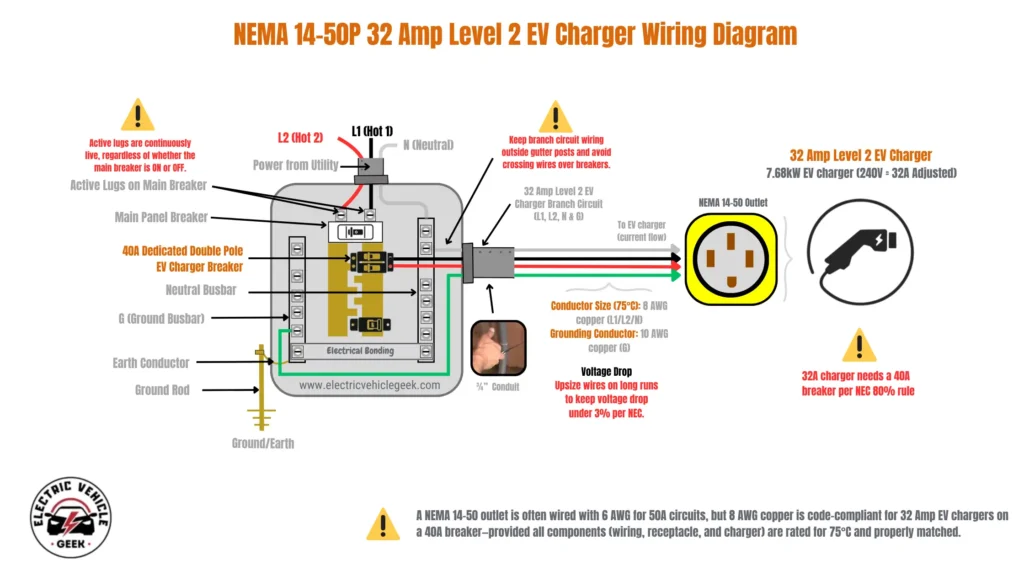
32 Amp vs 40 Amp on the Same NEMA 14-50
Both 32-amp (7.68 kW) and 40-amp (9.6 kW) chargers fit the same NEMA 14-50 outlet. The 40-amp version costs $50 to $150 more but delivers 25 percent faster charging if your car supports it. For Tesla Model 3 and Model Y with stock 32A onboard chargers, the speed is identical. For Rivian, Cybertruck, and EVs with 48A onboard chargers, the 40A wall unit is faster.
Why the Outlet Itself Matters at This Tier
The NEMA 14-50 receptacle is the single weakest point in a 32- to 40-amp install. A cheap home center outlet costs 8 to 15 dollars and fails under nightly EV charging duty cycles within 5 to 7 years. A commercial-grade Hubbell or Bryant outlet costs $25 to $40 and lasts 15+ years. The 20-dollar upgrade is the highest leverage reliability fix at this outlet.
Plug-In vs Hardwired at NEMA 14-50
Plug-in is the default at this outlet because that is what NEMA 14-50 was designed for. Hardwired versions of the same chargers exist for buyers who want to eliminate the plug as a failure point. The hardwired install costs 100 to 200 dollars more in labor but removes the leading 14-50 failure mode. For permanent installs in homes you will not sell soon, hardwired is the more reliable choice.
When Your Existing 14-50 Outlet Was Wired Wrong
Some existing NEMA 14-50 outlets in U.S. homes were installed on undersized breakers (40A instead of 50A) or undersized aluminum conductors (8 AWG aluminum instead of 6 AWG copper). These installs work for an RV but will trip or run hot under continuous EV charging. Have an electrician verify both the breaker rating and the conductor gauge before relying on an existing 14-50 outlet for EV charging.
EVs That Work With a NEMA 14-50 Charger
NEMA 14-50 supports any EV with up to 40 amp onboard charging capability. Most modern BEVs and all PHEVs work well at this outlet.
Best matches at NEMA 14-50 include the Tesla Model 3 and Model Y (32 amp onboard, full charge in about 10.9 hours), Hyundai Ioniq 5, Ford Mach-E, Chevy Bolt EUV, Kia EV6, Volkswagen ID.4, Rivian R1T and R1S with 48 amp onboard (capped at 40A by the wall unit), and every PHEV in the market. Larger BEVs like the F-150 Lightning and Lucid Air have 80A onboard chargers and benefit from going to NEMA 14-60 or hardwired 60A installs instead.
Related Amp and kW Coverage
A NEMA 14-50 outlet supports the same circuit as our 40 Amp EV Charger archive, which covers breaker sizing, conductor gauge, and NEC code citations. For charging speed, math, and vehicle range per hour, see our 9.6 kW EV Charger archive.
NEMA 14-50 EV Charger Frequently Asked Questions
You’ve Got NEMA 14-50 EV Charger Questions, We’ve Got Answers.
Is My Electric Range Outlet a NEMA 14-50?
Suppose the range has been installed since 2000. Modern electric range outlets are required by code to be NEMA 14-50 (4 prong) with a separate ground wire. Older homes may have NEMA 10-50 (3-prong, no separate ground), which is the legacy version. If your range outlet has 4 slots, it is a 14-50 and is compatible with EV charging.
Can I Share a NEMA 14-50 Outlet Between My Range and EV Charger?
Not with a generic Y splitter. The two devices can together exceed the 50A breaker rating if both run at once. The safe solution is an automatic transfer switch or smart splitter (200 to 500 dollars installed) that only allows one device at a time. The cleaner solution is to convert from an electric range to a gas range and dedicate the outlet to EV charging.
Will a NEMA 14-50 Outlet Charge My Tesla as Fast as a Tesla Wall Connector?
Not quite. A NEMA 14-50 with a 40-amp charger delivers 9.6 kW. A Tesla Wall Connector hardwired at 48 amps delivers 11.5 kW. For a Tesla Model 3 or Model Y with the stock 32A onboard charger, both wall units deliver 7.68 kW because the car caps the rate. For Tesla configurations with the 48A onboard upgrade, the Wall Connector is genuinely faster than a 14-50 outlet by about 20 percent.
Why Do Some Electricians Warn Against NEMA 14-50 for EV Charging?
Because cheap NEMA 14-50 outlets fail under nightly EV charging cycles, posing a fire risk. The outlet itself is fine for occasional RV use (a few hours per month), but the thermal stress of continuous EV charging at 40 amps for years overwhelms contractor-grade outlets. The fix is to use commercial-grade outlets and hire an installer who torques the terminal screws to spec. Done right, NEMA 14-50 is safe and reliable for EV charging.
Can I Install a NEMA 14-50 Outlet Myself?
Only if you hold a residential electrician license, installing a new 14-50 outlet requires pulling 6 AWG copper wire, installing a 50A two-pole breaker, and terminating the outlet correctly. Most U.S. jurisdictions require a licensed electrician and a permit for new high-amperage circuits. The total installation cost runs from 600 to 1200 dollars for a panel with available capacity.
What Is the Difference Between NEMA 14-50 and NEMA 14-50R?
NEMA 14-50 is the plug shape (what the cord cap looks like). NEMA 14-50R is the receptacle (what the wall outlet looks like) that accepts a 14-50 plug. The R stands for receptacle. The two work together: a 14-50 plug fits a 14-50R outlet. Product listings use NEMA 14-50 loosely to mean either side of the connection.
Should I Use Aluminum or Copper Wire for a NEMA 14-50 Install?
Solid Copper. Aluminum is permitted under the NEC but must be one size larger than the equivalent copper, and aluminum terminations require periodic retorquing due to aluminum's cold flow under thermal cycling. For EV charging at 40 amps continuous, copper is the cleaner and more reliable choice. Use 6 AWG copper with the typical NEMA 14-50 install.
Do I Need GFCI Protection on a NEMA 14-50 Outlet?
Yes, under NEC 625.41 for plug-in EVSE installations since the 2023 NEC cycle. The simplest path is a GFCI breaker (80 to 150 dollars). Most modern Level 2 chargers also include internal GFCI protection that may satisfy your AHJ. Confirm with the local code authority before assuming the charger's internal GFCI is enough.
Why Do Tesla Mobile Connectors Sometimes Damage NEMA 14-50 Outlets?
Why Do Tesla Mobile Connectors Sometimes Damage NEMA 14-50 Outlets?
Because the Tesla Mobile Connector draws 32 amps continuous through the 14-50 plug, which stresses cheap outlets to their breaking point. Combined with frequent plug-and-unplug cycles (which Tesla owners do more than RV owners), the outlet wears out quickly. The fix is the same as for any 14-50 install: use a commercial-grade Hubbell or Bryant outlet, and consider hardwiring the Tesla Wall Connector instead of using the Mobile Connector daily.