Max Output Amps & Power at 240V
Max Output (A)
Power (kW)
Supported by you via insider access, and when you purchase through links on our site, we may earn an affiliate commission. See our Affiliate Disclosure.
 Best Picks By
James Ndungu
Best Picks By
James Ndungu
A Level 2 EV charger uses 240V to deliver 3.8 to 19.2 kW of power, adding 20 to 60 miles of range per hour, depending on amperage. That is 5 to 10 times faster than a Level 1 charger and is fast enough to fully refill almost any EV overnight, even high-mileage daily drivers.
Over the past four years,s our team has hands-on tested 50+ Level 2 EV chargers across home garages, multi-family driveways, and small commercial sites, in temperatures from 14°F to 95°F. Below are the top Level 2 EV chargers we would actually buy today, a step-by-step buying guide that walks you through amperage and installation choice, and answers to the questions most homeowners ask before installing.
Every Level 2 charger on this page was hands-on tested by our team for at least 30 days, with several units in continuous use for over a year. We score each charger across 10 categories on a 1-10 scale: features, real-world usage, materials, durability, craftsmanship, design, monetary value, product value, brand reputation, and expert valuation.
Real charging sessions on Tesla, Ford, Hyundai, Chevy, Kia, Rivian, and Nissan EVs
Temperature endurance from 14°F winter cold to 95°F summer heat
Sustained high-amperage draw checking enclosure heat, cable warmth, and breaker stability
Wi-Fi reliability, app responsiveness, scheduling accuracy, and OTA update behavior
Cable durability, flex, kink resistance, weight, and cold-weather pliability
We confirm UL, ETL, CSA, and Energy Star claims against the actual certificate or listing
We test more EV chargers than anyone else. Here are the best Level 2 EV Chargers we have ever tested and reviewed.
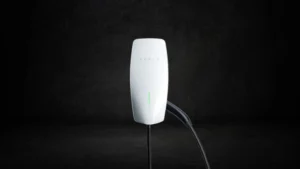
Up to 48A / 11.5 kW, dual NACS + J1772 connector, 24 ft cable, Wi-Fi enabled, hardwired or plug-in. Does not lock you into one connector standard.
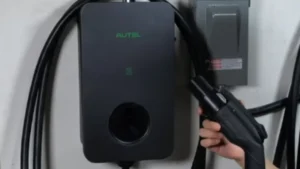
Up to 80A / 19.2 kW, OCPP compliant, 4G + Wi-Fi + Wi-SUN, AI-driven load management—Future-proof for buyers with high-mileage trucks and bidirectional EVs.
UL-listed, Energy Star-certified, all-metal enclosure rated for outdoor use, NEMA 14-50 plug-in, reliable smart charging at roughly half the price of premium wallboxes.
Compact hardwired form factor, 50A capable, indoor/outdoor rated, Wi-Fi + Bluetooth, 25 ft cable. Clean look for finished garages where a NEMA outlet would be ugly.
Use the “Compare” button on each product to select multiple chargers, then click the ⚖️ scale icon to see a full side-by-side comparison.
A Level 2 EV charger uses 240V at 16-80A, delivering 3.8-19.2 kW for 10-60 miles per hour. Ideal for home and public charging, it provides faster, more efficient charging for daily EV drivers needing quick power-ups.

A Level 2 EV charger operates on a 240V single-phase circuit, requiring either a 240V outlet for plug-in chargers or a junction box for hardwired chargers. A dedicated 15A to 80A breaker is used, with wiring sized between 14 AWG and 2 AWG, depending on the charger’s power rating (2.88kW to 19.20kW).
Comparison of Level 2 EV charging power (kW) based on circuit breaker size and maximum continuous amperage output at 240V.
📋 Per NEC standards, an EV charger can only pull 80% of the circuit breaker's rated amperage.
Source: electricvehiclegeek.com · Max output = 80% of breaker rating (NEC rule) · Power = Output A × 240V
A plug-in Level 2 EV charger connects to a 240V outlet, typically a NEMA 6-50 or NEMA 14-50 receptacle. It requires a dedicated 15A to 50A breaker, with 14 AWG to 6 AWG copper wire, depending on the charger’s power rating (2.88kW to 9.6kW).
A plug-in Level 2 EV charger connects to a 240V outlet, which can be either a three-prong or four-prong type. Common three-prong outlets include NEMA 6-30, NEMA 6-50, NEMA 10-30, and NEMA 10-50, which have two hot wires and a ground. Four-prong outlets, such as NEMA 14-30 and NEMA 14-50, include an additional neutral wire. The choice of outlet depends on the charger’s plug type and installation requirements.
The four-prong Level 2 EV charger outlet wiring diagram shown below highlights Level 2 EV charging circuits with NEMA outlets, featuring two hot wires (L1 and L2), a neutral wire (N), and a ground wire (G).
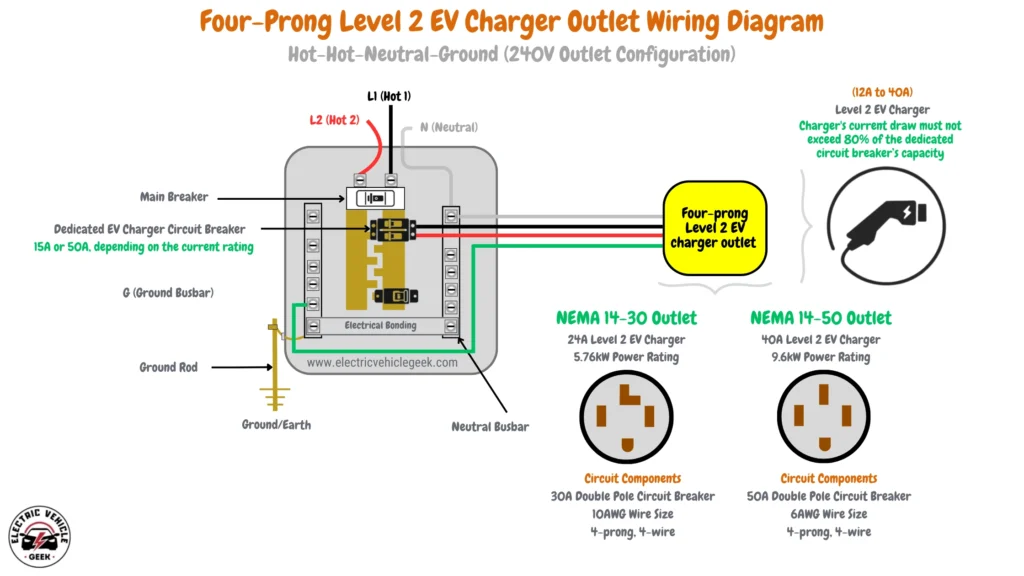
This configuration is commonly found in NEMA 14-30 (30A, 240V) outlets for 24A Level 2 EV chargers and NEMA 14-50 (50A, 240V) outlets for high-amperage 40A EV chargers, as per NEC rules. It ensures proper power delivery and grounding for the safe and efficient charging of EVs. The neutral wire plays a crucial role in managing the electrical load and balancing the circuit.
A Three-Prong Level 2 EV Charger Outlet Wiring Diagram illustrates the electrical connections of a 240V, three-prong outlet used for charging electric vehicles. There are two types of three-prong configurations: Hot-Hot-Ground (Modern 240V Three-Prong Outlets) and Hot-Hot-Neutral (Older 240V Three-Prong Outlets).
A Hot-Hot-Ground Level 2 EV Charger Wiring Diagram below illustrates the electrical connections of a 240V, three-prong outlet used for charging electric vehicles. This configuration consists of two hot wires (L1 and L2), each carrying 120V and combining to provide 240V power, along with a ground wire (G) that ensures electrical safety by providing a path for fault currents.
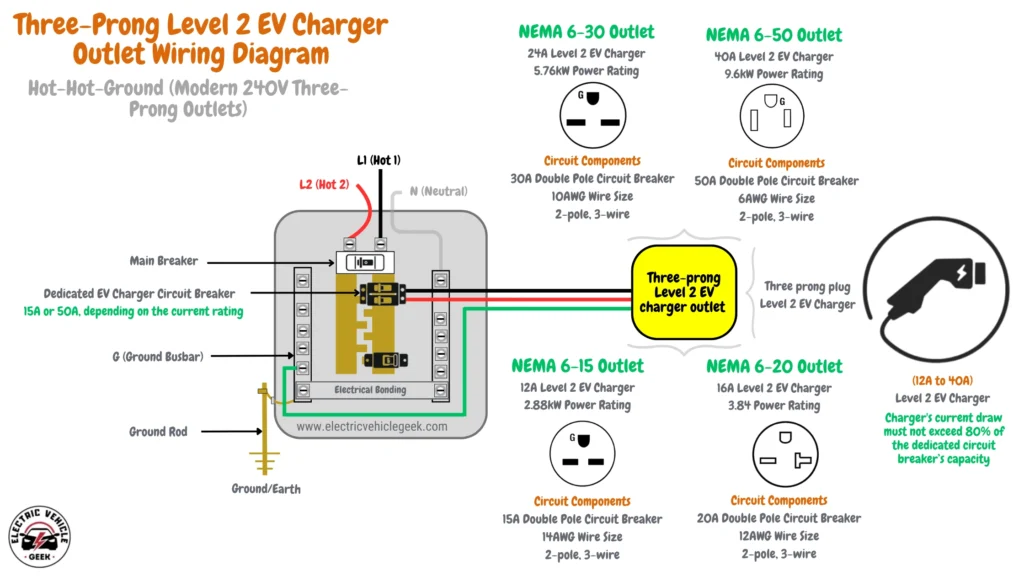
This setup is used in modern three-prong 240V outlets designed for pure 240V loads, such as Level 2 EV chargers. Since it lacks a neutral wire, it does not support 120V devices. Examples of Hot-Hot-Ground outlets for Level 2 EV charging include NEMA 6-30 (30A, 240V), NEMA 6-50 (50A, 240V), NEMA 6-15 (15A, 240V), and NEMA NEMA 6-20 (20A, 240V).
A Hot-Hot-Neutral Level 2 EV Charger Wiring Diagram below illustrates the electrical connections of a 240V, three-prong outlet used for charging electric vehicles. This configuration consists of two hot wires (L1 and L2), each carrying 120V and combining to provide 240V power, along with a neutral wire (N) that serves as the return path for the current.
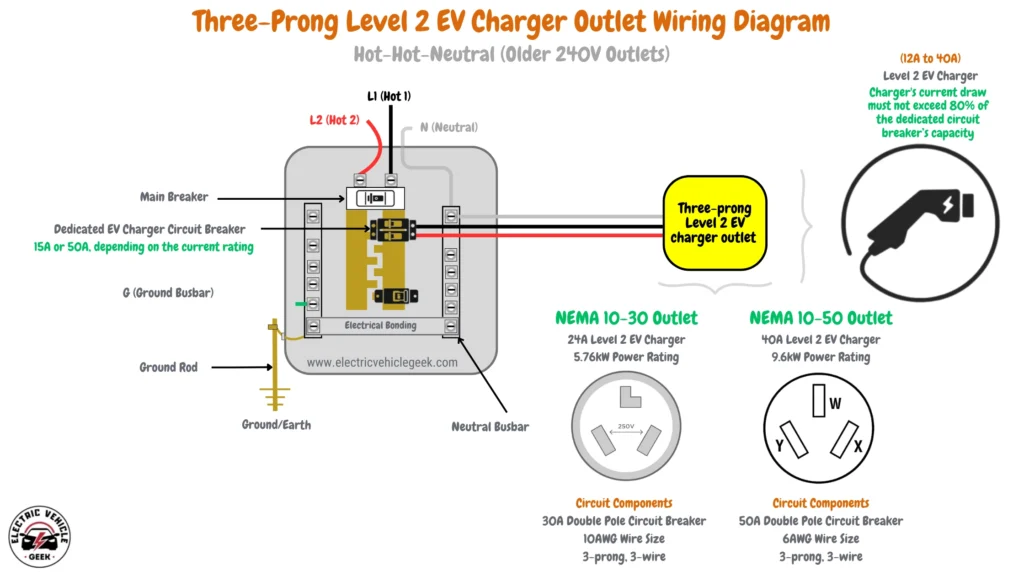
This setup is used in older three-prong 240V outlets designed for pure 240V loads, such as Level 2 EV chargers. Since it includes a neutral wire, it provides 240V power using two hot wires (L1 and L2), but it lacks a dedicated ground wire, which can be a safety concern. Hot-Hot-Neutral outlets for Level 2 EV charging include NEMA 10-30 (30A, 240V) and NEMA 10-50 (50A, 240V).
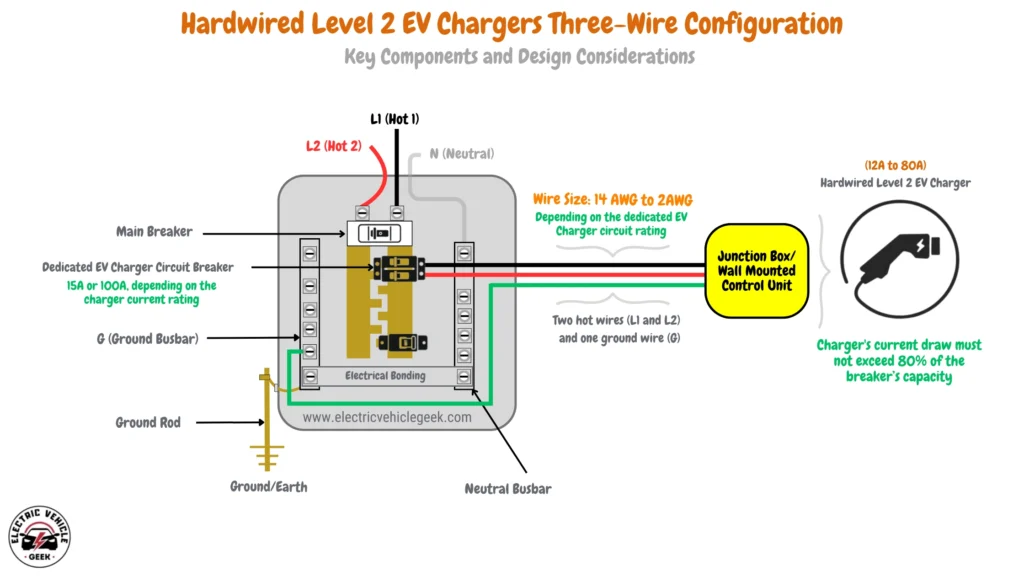
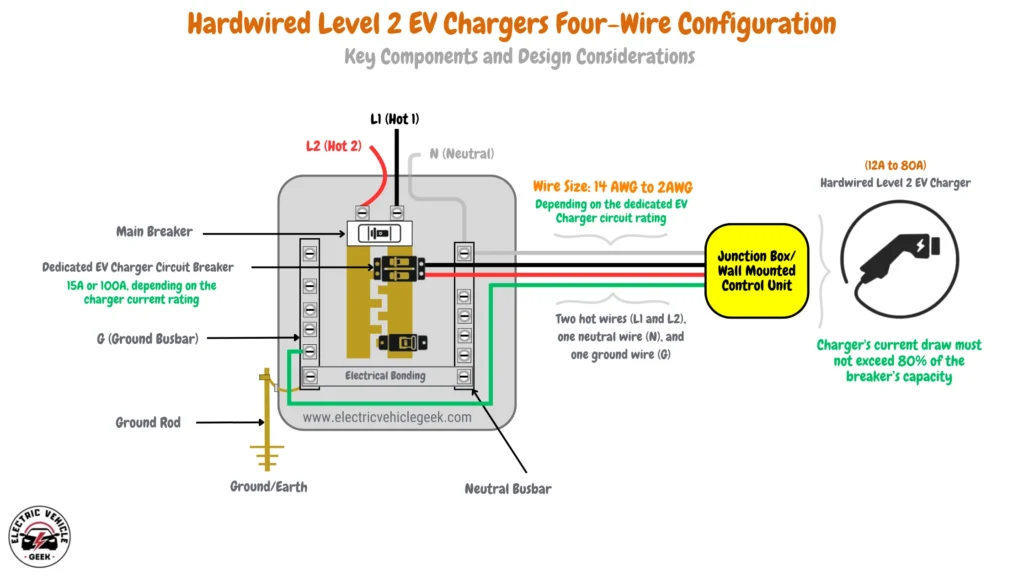
A hardwired Level 2 EV charger connects directly to the electrical circuit, with or without a junction box. It requires a dedicated 15A to 100A breaker, with 14 AWG to 2 AWG copper wire, depending on the charger’s power rating (2.88kW to 19.20kW). This setup is commonly used for permanent, high-power installations.
The three-wire EV charger configuration typically consists of two hot wires (L1 and L2) and one ground wire (G). The neutral wire is not present in this setup, and it is commonly used for 240V circuits in certain locations or older installations.
The four-wire hardwired EV charger configuration consists of two hot wires (L1 and L2), one neutral wire (N), and one ground wire (G) they are more common in modern installations, providing greater safety and flexibility, especially for high amperage Level 2 EV chargers.
This is the single biggest decision. Higher amperage charges faster but requires a heavier-gauge circuit and a bigger breaker. Most homeowners do not need 80A. Level 2 EV chargers come in eight standard ratings:
12A (1.44 kW, ~3 mi/hr) entry-level Level 2 for plug-in hybrids and small EVs. Runs on a standard 15A breaker.
16A (3.84 kW, ~12 mi/hr) doubles speed at modest panel cost. Works on a 20A breaker, fine for daily PHEV duty.
24A (5.76 kW, ~22 mi/hr) solid mid-range option for compact EVs on a 30A breaker, often a NEMA 14-30 outlet.
32A (7.68 kW, ~26 mi/hr) good fit for EVs with batteries under 60 kWh. Runs on a 40A breaker with NEMA 14-50.
40A (9.6 kW, ~30 mi/hr) is the sweet spot for most EV owners with 60-80 kWh batteries. Runs on a 50A breaker.
48A (11.5 kW, ~40 mi/hr) is better for two-EV households or trucks with 100+ kWh batteries. Requires hardwiring.
50A (12 kW, ~45 mi/hr) fast home charging for larger EVs. Needs a 70A breaker and a hardwired install.
80A (19.2 kW, ~75 mi/hr) overkill for most homes. Only worth it for 100+ kWh trucks driving 200+ miles daily.
Most homes have a 200A main panel. A 48A charger draws 60A continuously, which often requires a load calculation before installation. Higher amperage costs more in wire, breaker, and labor than in the charger itself.
Plug-in (NEMA 14-50 or 6-50 outlet) is faster to install, easier to swap out later, and lets you take the charger with you if you move. It is capped at 40A continuous draw per NEC rules. Best if you are renting, expect to upgrade, or want flexibility.
Hardwired connects directly into a junction box on the wall, with no outlet in between. It is required for 48A and above, looks cleaner in the long term, and is more reliable because there is no outlet to overheat. Best if the install is permanent.
If you are unsure, pick a charger that supports both (the Tesla Universal Wall Connector, Emporia Pro, ChargePoint Home Flex, and several others on this page do).
Choose hardwired if you want 48A or higher charging, you want the cleanest possible wall installation, your install is outdoors, and you want IP-rated weatherproofing, or you do not plan to move the charger for years. Hardwiring eliminates the single most common Level 2 failure point, overheated outlets.
NACS (Tesla) used by Tesla Model 3/Y/S/X/Cybertruck, plus 2025+ Ford, GM, Rivian, Hyundai, and Kia.
J1772 is used by every other EV sold in North America before the 2025 industry-wide NACS shift.
Buy an EV charger compatible with your current vehicle charging port. EV charger adapters work in both directions, and dual-connector chargers like the Tesla Universal Wall Connector future-proof you against the connector shift.
Expect $400 to $1,500 for a typical home installation by a licensed electrician, with two main cost drivers: distance from your main panel to the install location (wire and conduit), and whether your panel has capacity for a new 40A to 60A breaker. Houses with full 200A panels and short runs often come in under $700; older homes with sub-panels or long runs can exceed $2,000. Some utilities and local programs offer rebates of $250 to $1,000 toward installation.
It does not, but it should be UL or ETL listed at minimum (these confirm electrical safety testing). Energy Star offers a meaningful efficiency benefit and is required for most utility rebate programs, which is the main reason to prioritize it. CSA is the Canadian equivalent of UL and is fully accepted in the U.S.
Worth paying for if: you are on a time-of-use electricity plan (you save 30-50% by scheduling overnight charging), you share the charger across two or more vehicles, or you want detailed energy usage tracking and remote control via an app.
Skip if you’re on a flat-rate electricity plan and just want the car ready in the morning. Your EV’s onboard scheduling can already do most of what a smart charger does, with no Wi-Fi setup required.
At the U.S. average electricity rate of about 16 cents per kWh and a 9.6 kW draw (40A charger), a Level 2 session costs roughly $1.54 per hour. A full overnight charge of a 75 kWh battery from empty is about $12, or 4 to 5 cents per mile. Time-of-use plans drop this to 2 to 3 cents per mile, which is about a third of what gasoline costs at $3.50/gallon in a 30 mpg car.
About 4 to 10 hours for a typical 60 to 80 kWh battery from 10% to 100%, depending on the charger's amperage rating and the car's onboard charger limit. A 40A wallbox fills a Tesla Model Y in roughly 8 hours, while a 48A unit on a 60A circuit takes about 7 hours.
For nearly all daily-driver EV owners, yes. Level 2 pays for itself in convenience within months by eliminating the overnight-only constraint of Level 1, and the total cost (charger plus licensed install) is typically $800 to $2,000 spread across many years of reliable use.
Charging speed and circuit size. A 32A charger adds roughly 25 mi/hr on a 40A breaker, a 40A charger adds 30 mi/hr on a 50A breaker (most popular pick), and a 48A charger adds 40 mi/hr on a 60A breaker and must be hardwired. Choose based on daily mileage and panel capacity.
Yes, as long as the connector matches your car (J1772 or NACS) or you use the included adapter. The car's onboard charger automatically limits the rate to its maximum capacity, so a 48A wallbox plugged into a vehicle that only accepts 32A will charge safely at 32A.
Yes, in most U.S. jurisdictions. Electrical permits are required because you are adding a new dedicated 240V circuit, and most utility rebate programs require a licensed, permitted installation. Your electrician handles pulling the permit and scheduling the final inspection visit.
Sometimes, but it requires a load calculation. A 40A Level 2 charger draws 32A continuous, which is 32% of a 100A panel's capacity. If your home uses electric heating, an electric range, a dryer, and central AC, you may need a panel upgrade or a load-management smart charger.
Yes, if it carries an outdoor rating (typically NEMA 3R, NEMA 4, or IP54 and higher). Most chargers on this page are outdoor-rated, but always confirm before installing in a location directly exposed to rain, snow, or full sun, and mount it under cover where possible.
Hardwired. NEMA 14-50 outlets are the single most common failure point in Level 2 installations because consumer-grade outlets were never designed for continuous high-amperage draw over many years. If you plan to keep your charger in one place long-term, a hardwired one lasts longer.
The Tesla Universal Wall Connector is a hardwired unit with dual-connector NACS plus J1772 support, or the Tesla Mobile Connector for a portable NACS-native option. Both are reviewed on this page. Any J1772 charger also works with a Tesla using the included adapter.
Got Level 2 EV charger questions? We’ve got answers! From installation to compatibility, we make it easy to choose the right charger. Reach out to James via email at james[@]electricvehiclegeek.com for expert advice!