Supported by you via insider access, and when you purchase through links on our site, we may earn an affiliate commission. See our Affiliate Disclosure.
Best 240V EV Chargers
-
 Best Picks By
James Ndungu
Best Picks By
James Ndungu
- last updated September 6, 2026

A 240V EV charger is any Level 2 home charger that runs on a 240-volt circuit, and it is the tier where home charging transforms from a slow overnight trickle into a genuine daily energy system.
240V EV charger speed jump over 120V EV charger is not incremental: even the entry-level 240V option (a NEMA 6-20 outlet at 16 amps) delivers three times the power of a standard wall outlet, while a NEMA 14-50 at 40 amps delivers nearly seven times more. For the vast majority of U.S. BEV owners, a 240V circuit is the point at which home charging stops being a consideration and starts being a convenience.
The 240V home EV charger category is also broader than buyers expect, spanning from a NEMA 6-20 outlet on a 20-amp two-pole circuit to an 80-amp hardwired connection on a dedicated 100-amp circuit, with several intermediate outlet tiers in between. Each tier fits a different combination of electric vehicle onboard charger rating, panel capacity, and daily mileage, so the buying decision is really about choosing the right EV charger amperage tier for your specific situation rather than simply picking the most powerful unit available.
Use the EV Charging Calculator to work out which tier fully covers your daily mileage before choosing an outlet.
240V AC EV Chargers We Recommend
Every charger below operates on a 240V circuit. The grid includes plug-in units for NEMA 14-50 and other 240V outlets, hardwired units for 48 to 80 amp permanent installs, smart and basic units, J1772 and NACS chargers, and options across the full amperage range from 16 to 80 amps. Click any title for the full hands-on review.
Use the “Compare” button on each product to select multiple chargers, then click the ⚖️ scale icon to see a full side-by-side comparison.
240V Electric Vehicle Chargers Reviews
Our 240V EV chargers reviews are ranked by expert ratings, providing a clear look at the best chargers available. Each unit is evaluated on a 1–10 scale across ten essential criteria: Features, Real-World Performance, Build Quality, Durability, Craftsmanship, Design, Value for Money, Overall Product Worth, Brand Trust, and Professional Assessment.
For full details, click a charger image or title to read the complete review. Comparing multiple chargers? Use the “Compare” button below each charger, then click the ⚖️ scale icon to view a side-by-side comparison of specs and expert ratings, helping you make a confident, informed choice.
How Fast Is a 240V EV Charger?
The 240V EV charger branch circuit supported amperage determines speed at 240V, since power equals voltage times current, and the circuit breaker sets the current ceiling. At 240V, the range runs from 3.84 kW on a NEMA 6-20 circuit up to 19.2 kW on a hardwired 80-amp connection, covering every practical home charging scenario between the entry Level 2 tier and the maximum residential AC charging speed available in the U.S.
The mainstream 240V EV charger (NEMA 14-50 at 40 amps) delivers 9.6 kW and adds 30 to 36 miles of range per hour. Over a typical 8-hour overnight window that is 240 to 288 miles of added range, enough to fully recover any BEV sold in the U.S. under normal daily driving conditions. Stepping up to a hardwired 48-amp charger delivers 11.5 kW and adds 40 to 48 miles per hour, while an 80-amp hardwired unit delivers 19.2 kW and adds 60 to 70 miles per hour for large battery trucks like the Ford F-150 Lightning.
Plug-in vs. Hardwired 240V EV Chargers
There are two main types of 240V EV chargers: plug-in and hardwired. The right choice depends on your setup and needs. Plug-in models are great if you already have a 240V outlet and want portability or easy DIY installation. Hardwired chargers deliver more power and a clean, permanent setup – ideal for faster charging and outdoor use.
The 40-amp ceiling applies specifically to plug-in EV chargers because NEC 625.41 prohibits plug-in EVSE above 40 amps continuous. Above that level, hardwired EV charger installation is required, and the outlet pattern changes from a receptacle to a direct wire termination inside a junction box. The boundary between plug-in and hardwired 240V is the most important code distinction in this category, and it determines whether you can move the charger later or whether it becomes a permanent fixture of the property.
240V Plug-in EV Chargers
240V Plug-in chargers can deliver up to 9.6kW at 40 amps. They’re easy to install if you already have a 240V outlet, such as a NEMA 14-50 outlet, making them a convenient option for most homes.
240V Hardwired EV Chargers
240V hardwired EV chargers can deliver up to 19.2kW at 80 amps. They’re permanently connected to your home’s electrical system, offering a cleaner, more professional look—ideal for homeowners seeking faster charging and a more integrated setup.
Why Choose a 240V Electric Vehicle Charger?
A 240V electric vehicle charger, also known as a Level 2 EV charger, offers significantly faster charging than 120V EV Chargers. For battery electric vehicles (BEVs), a 240V charger can recharge the battery from empty to 80% in about 4 to 10 hours. Plug-in hybrid electric vehicles (PHEVs) can reach a full charge in just 1 to 2 hours.
Whether you’re driving a Tesla, Jeep, Ford Mustang Mach-E, Chevy Bolt, or any other EV model, a 240V home EV charger ensures faster charging speeds than a typical 120V EV charger.
What Are the Electrical Requirements for a 240V EV Charger?
Installing a 240V EV charger at home requires the following:
Dedicated 240V circuit
240v EV chargers require a 20 to 100-amp circuit depending on the charger's amperage.
Breaker panel capacity
Your electrical panel should have enough capacity to handle the added load and breaker.
NEMA outlet or hardwiring
Plug-in models use 240V outlets like NEMA 14-50, while hardwired chargers are connected directly
Professional installation
For safety and code compliance, a licensed electrician should handle the installation.
Wiring a 240V Plug-in EV Charger
A 240V plug-in Level 2 EV charger connects to a 240V outlet, which may have either a three-prong or four-prong configuration. Common three-prong 240V outlets include NEMA 6-30, 6-50, 10-30, and 10-50, using two hot wires and a ground. Four-prong 240V outlets—like NEMA 14-30 and 14-50 include a neutral wire. The right outlet depends on your 240V EV charger’s plug type and home electrical system.
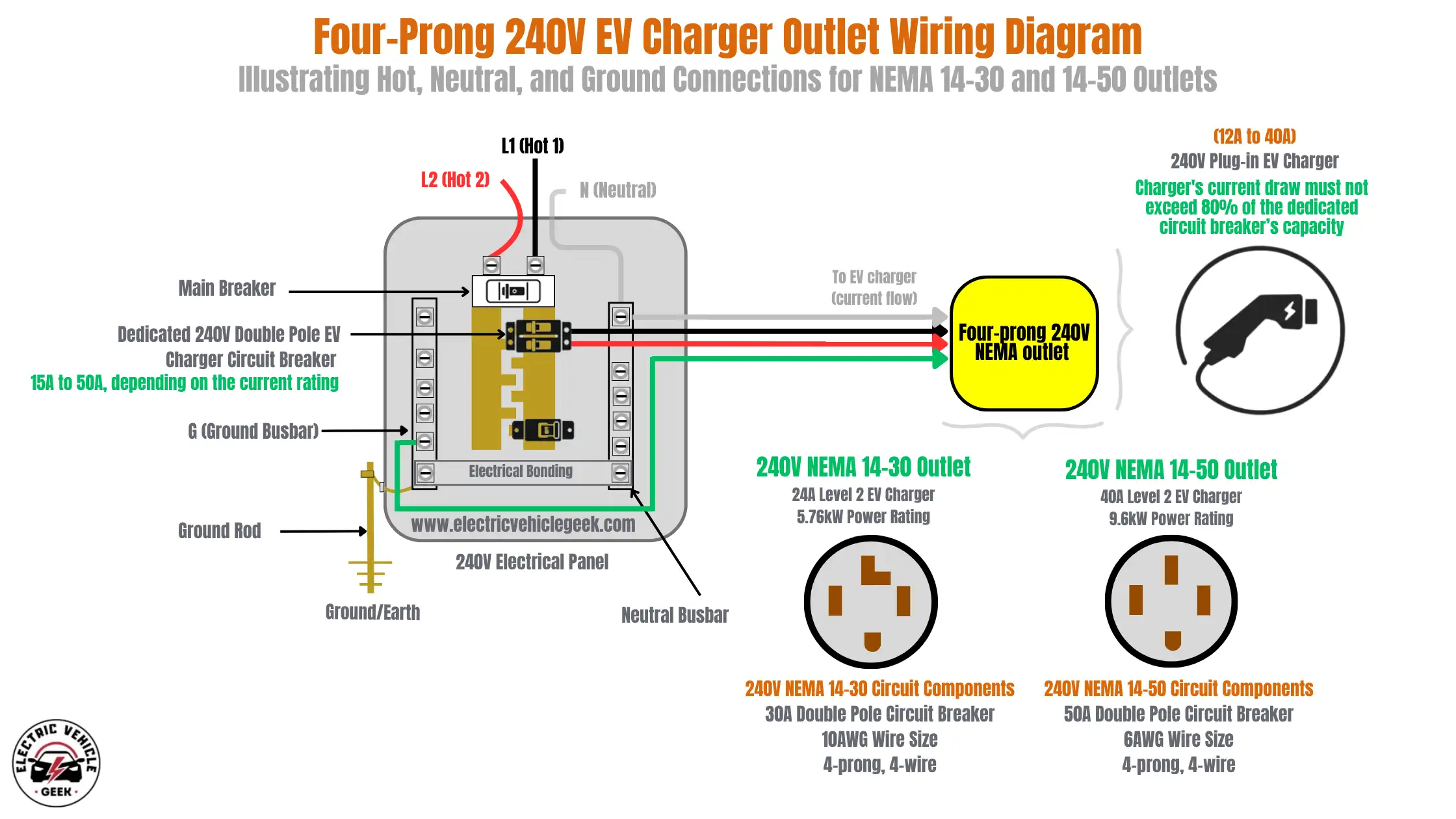
Four-Prong 240V EV Charger Outlet Wiring Diagram
The wiring diagram below shows a four-prong 240V outlet setup for plug-in EV chargers, including common outlets like NEMA 14-30 and NEMA 14-50. These outlets use two hot wires (L1 and L2), a neutral (N), and a ground (G).
NEMA 14-30: The Modern Dryer Outlet
The NEMA 14-30 is the four-prong dryer outlet in modern U.S. homes, 240V and 30 amps, found in laundry rooms and garages with dryer circuits since 1996.
The NEMA 14-30 supports 24 amps of continuous EV charging and delivers 5.76 kW without requiring a new circuit if you already have a dryer outlet to repurpose or share. See our NEMA 14-30 EV charger archive for compatible units.
NEMA 14-50: The Mainstream Level 2 Standard
The NEMA 14-50 is the most common Level 2 EV charging outlet in the U.S., a four-prong 240V 50-amp receptacle that also feeds electric ranges and RV hookups. It supports 40 amps of continuous charging and delivers 9.6 kW, adding 30-36 miles of range per hour. Most Level 2 plug-in chargers ship with a NEMA 14-50 plug; most licensed electricians have installed them dozens of times, and parts are stocked at every electrical supply house. See our NEMA 14-50 EV charger archive for outlet choices and matching chargers.
Three-Prong 240V EV Charger Outlet Wiring Diagram
Three-prong 240V outlets come in two configurations: modern electrical systems with two hot wires and ground (Hot-Hot-Ground) and older electrical systems with two hot wires and a neutral (Hot-Hot-Neutral), all of which support 240V plug-in EV charger installations.
Hot-Hot-Ground 240V EV Charger Outlet Wiring Diagram
The diagram below shows a hot-hot-ground 240V plug-in EV charger circuit that supports 240V outlets with hot-hot-ground configurations, including NEMA 6-15 (15A), NEMA 6-20 (20A), NEMA 6-30 (30A), and NEMA 6-50 (50A).
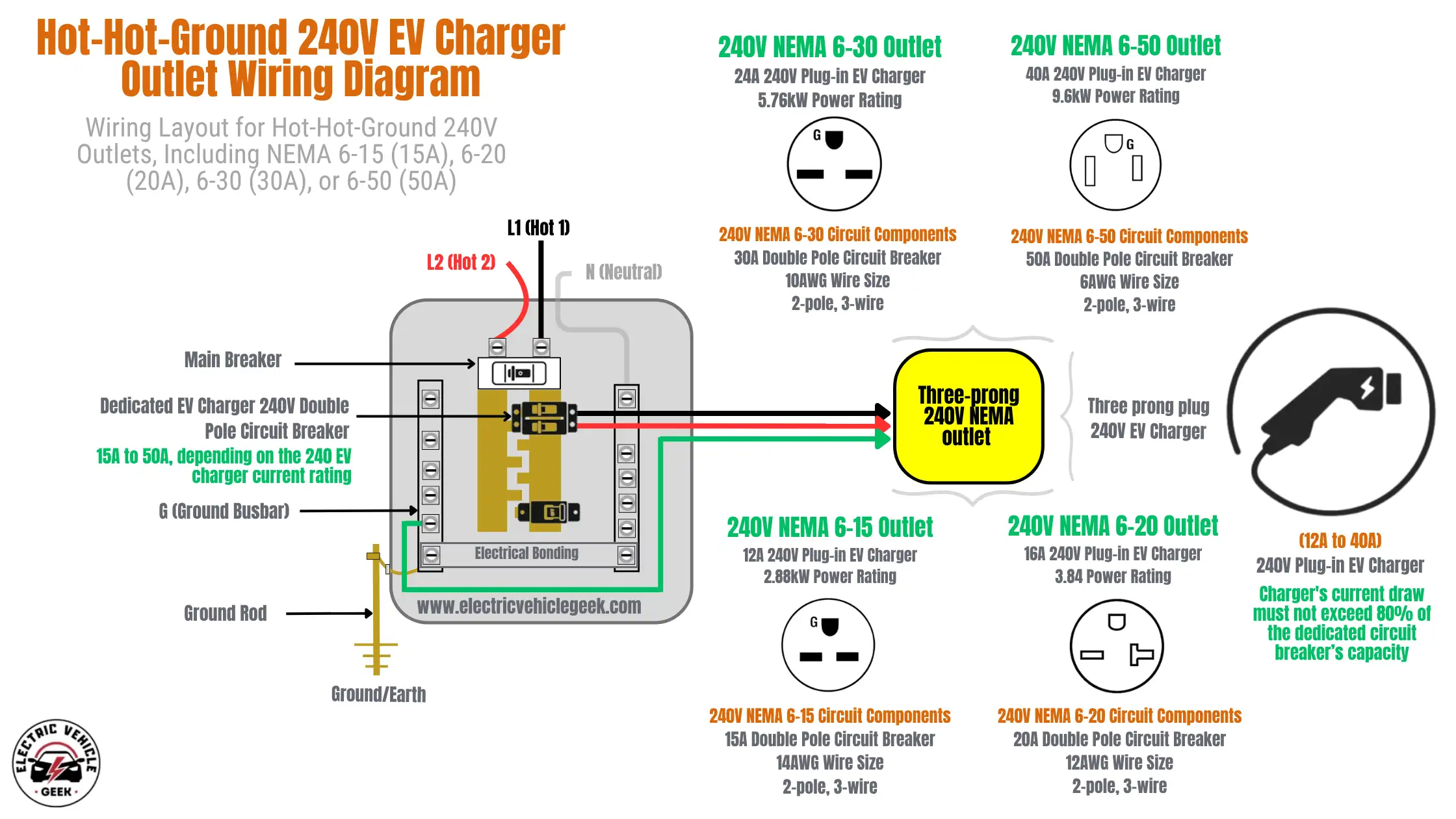
The NEMA 6-20 is a 240V 20-amp outlet with two horizontal-blade slots and a round ground hole; no neutral wire. Found in workshops, older window AC installs, and some garages. A new NEMA 6-20 circuit is the cheapest dedicated 240V install available, typically costing $200 to $400 for a licensed electrician, and it delivers 3.84 kW, about three times the power of a standard 120V outlet. See our NEMA 6-20 EV charger archive for matching chargers.
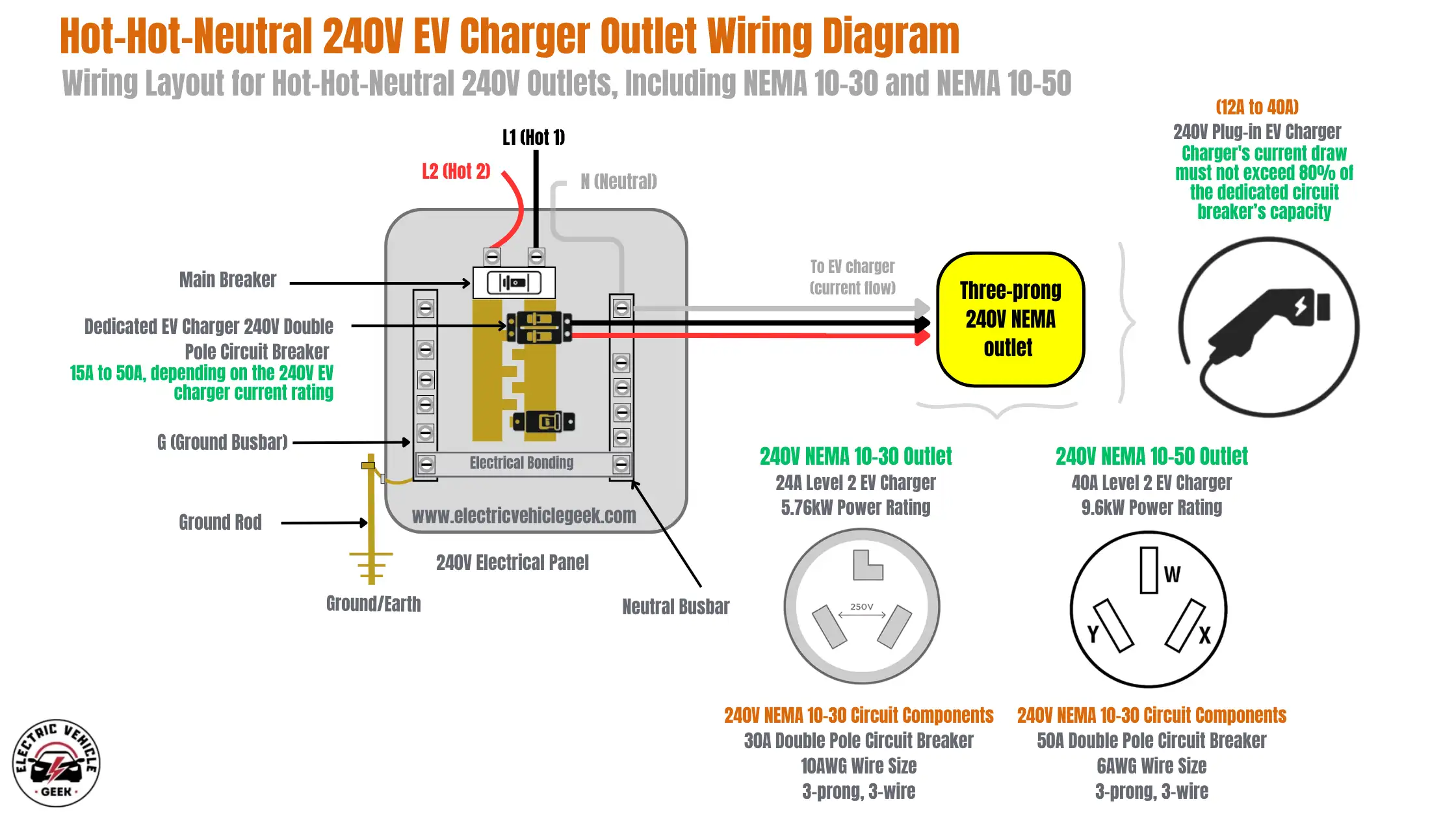
Hot-Hot-Neutral 240V EV Charger Outlet Wiring Diagram
The diagram below shows a hot-hot-neutral 240V plug-in EV charger circuit that supports outlets with hot-hot-neutral configurations, including NEMA 10-30 (30A, 240V) and NEMA 10-50 (50A, 240V).
Wiring a 240V Hardwired EV Charger
A 240V hardwired EV charger installation requires a dedicated 15A to 100A circuit breaker and copper wiring sized between 14 AWG and 2 AWG, depending on the charger’s power rating (2.88 kW to 19.20 kW). Wiring configurations typically follow either a three-wire or four-wire setup, based on the charger’s 240V terminal requirements
Above 40 amps, NEC 625.41 requires hardwired installation, and 48 amps on a 60-amp circuit is the most popular hardwired tier in the U.S. It matches the onboard charger in Tesla Cybertruck, Rivian R1T and R1S, and Tesla Model 3 and Model Y with the 48-amp upgrade, delivering 11.5 kW and 40 to 48 miles per hour. A licensed electrician and a permit are required. See our hardwired EV charger archive for the full hardwired tier.
The 80-amp hardwired EV charger on a 100-amp circuit delivers 19.2 kW and 60 to 70 miles per hour, the maximum AC charging speed available at a U.S. residence. This tier matches the Ford F-150 Lightning (80A onboard) and the Lucid Air (80A onboard), and it often requires a panel upgrade to a higher service amperage. The installation cost, including a panel upgrade, can reach 4,500 to 12,000 dollars. See our 80 Amp charger archive and hardwired EV charger archive for units and install guidance.
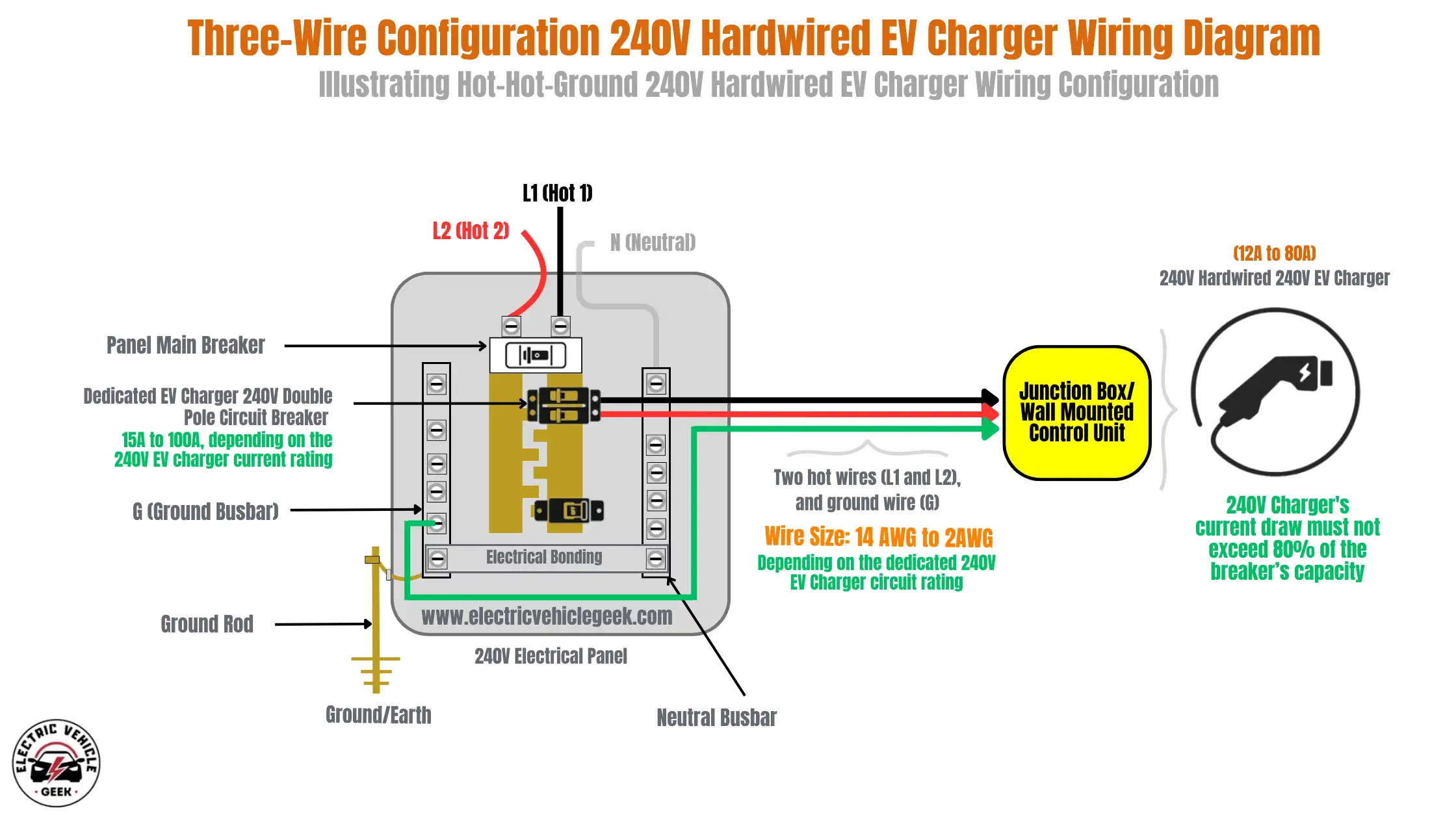
Three-Wire Configuration 240V Hardwired EV Charger Wiring Diagram
The diagram below shows a 240V three-wire hardwired EV charger circuit, which typically consists of two hot wires (L1 and L2) and one ground wire (G). This configuration does not include a neutral wire, as it is not required for most 240V EV chargers.
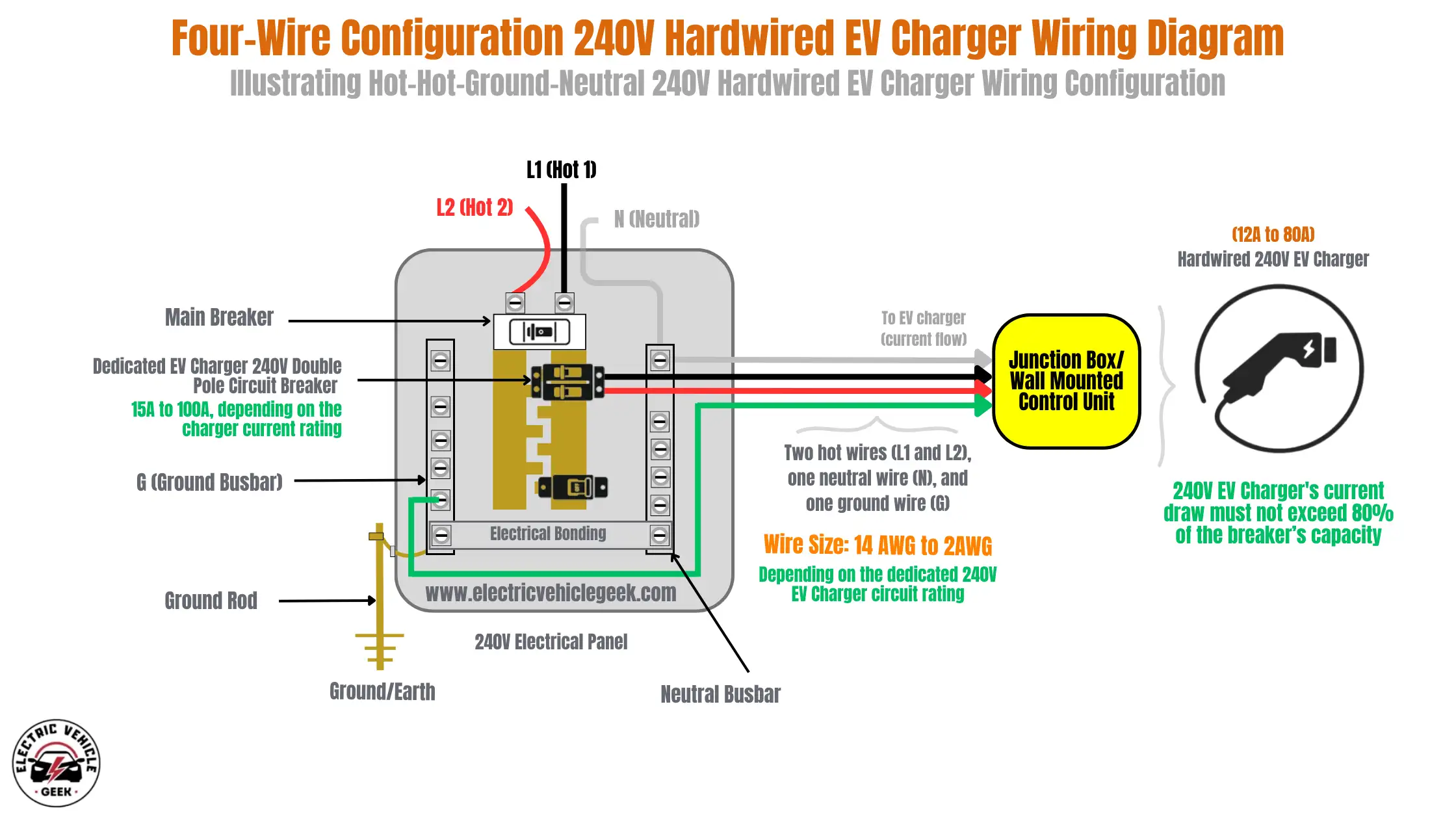
Four-Wire Configuration 240V Hardwired EV Charger Wiring Diagram
The diagram below shows a 240V four-wire hardwired EV charger circuit, which consists of two hot wires (L1 and L2), one neutral wire (N), and one ground wire (G). This configuration is more common in modern installations, offering greater safety and flexibility – especially for high-amperage hardwired 240V EV chargers.
The 80 Percent Rule: How It Shapes Every 240V EV Charger Circuit
The NEC 80 percent continuous load rule governs every breaker in a 240V EV charger circuit by limiting sustained charging current to 80 percent of the breaker’s rating. Because EV charging runs continuously for hours, it always qualifies as a continuous load, so a 40-amp breaker supports a maximum of 32 amps of EV charging, a 50-amp breaker supports 40 amps, a 60-amp breaker supports 48 amps, and a 100-amp breaker supports 80 amps. These four pairings define the four practical tiers of 240V home charging.
The 20 percent thermal headroom that the rule builds in is not dead capacity; it is the buffer that keeps the breaker, the conductors, and the outlet from overheating during a long overnight session. Running a charger at exactly the breaker’s rated current rather than at 80 percent shortens the breaker’s service life. It can cause nuisance trips after years of use, so the rule exists for real engineering reasons rather than being arbitrary conservatism.
The EV charger conductor sizing follows the same logic: the wire feeding the circuit must be rated for the breaker’s full ampacity, not just the charger’s continuous draw, because the conductor is protected by the breaker rather than by the charger. A 32-amp charger on a 40-amp breaker, therefore, needs conductors rated for 40 amps (8 AWG copper minimum), which means correctly sizing the wire requires knowing the breaker size rather than the charger’s continuous output.
Is 240V EV Charger Worth the Upgrade From 120V EV Charger?
The upgrade from 120V to a NEMA 14-50 at 240V delivers roughly 6.7 times more charging power. At a typical install cost of 600 to 1,200 dollars, the payback is most visible in two ways: daily driving reliability, because you stop arriving at work wondering whether the car charged enough overnight, and flexibility, because a 240V circuit also serves future higher-amperage chargers as vehicles and onboard charger ratings improve.
For any BEV owner driving more than 40 miles per day on average, the 240V upgrade pays back in daily peace of mind within the first few weeks of ownership. For PHEV owners and light BEV commuters under 35 miles daily, 120V is often genuinely adequate,e and the upgrade is optional.
Our 120V EV charger archive covers that side of the decision in detail if you are still deciding between the two voltage tiers.
240V EV Charger Buyer's Guide
Match Your EV Charger Amperage to Your Vehicle Onboard Charger
The EV charger’s amperage for full speed is whichever is lower: the wall unit’s output or the electric vehicle’s onboard charger rating. A Tesla Model 3 with a 32-amp onboard charger charges at 7.68 kW on a 32A, 40A, or 48A wall unit because the car caps the charging rate. A Rivian R1T with a 48-amp onboard charger uses the full 11.5 kW from a 48-amp wall unit. Buying higher amperage than your vehicle’s onboard charger can use adds installation cost without adding speed.
Our EV onboard charger guide lists the onboard charger rating for every major EV sold in the U.S.
Use Existing Dedicated Branch Circuit Circuits First
If your home already has a 240V circuit (dryer, electric range, welding outlet, old RV hookup), check whether repurposing or sharing it for EV charging is feasible before paying for a new dedicated circuit. A NEMA 14-30 dryer circuit supports 24 amps of EV charging. A NEMA 6-50 welding outlet supports 40 amps. Either can be shared with its original appliance using a manual transfer switch if both devices do not run simultaneously.
The Commercial Grade Outlet Matters as Much as the Charger
For any plug-in 240V EV charger installation, the receptacle carries the full charging current every night for years. A contractor-grade NEMA 14-50 outlet costs $8 to $15 and wears out under EV charging in 5 to 7 years. A commercial-grade Hubbell or Bryant outlet costs $25 to $40 and lasts over a decade under the same load. Replacing the outlet before installation is the single highest-leverage reliability upgrade available at this tier.
Utility Rebates Can Offset a Large Part of the Cost
ENERGY STAR-certified 240V EV chargers qualify for utility rebates from most major U.S. utilities, typically 200 to 1,500 dollars, which can offset a large part of the charger and installation cost when stacked with the federal Alternative Fuel Vehicle Refuelling Property Credit of up to 1,000 dollars. Check our EV charger rebates finder page before purchasing and confirming that the charger qualifies is among the most financially impactful steps in a 240V install.
Panel Capacity: Check Before You Buy
A new 240V EV charger circuit draws on your panel’s available capacity, and many homes with full panels cannot accommodate a 50-amp or 60-amp circuit without a load management device or a panel upgrade. Have a licensed electrician run a load calculation before committing to a high-amperage tier, since discovering the panel is full mid-install adds unexpected cost. Most 200-amp panels can accommodate a 50-amp EV circuit with typical household loads, but full panels and 100-amp services often cannot.
Which EVs Work Best With 240V Charging
Every BEV sold in the U.S. benefits from a 240V Level 2 charger for daily use, since 240V is the tier at which overnight full recovery becomes practical for any battery size. The question is which outlet tier within 240V matches your vehicle’s onboard charger rating.
Most pre-2024 BEVs have 32-amp onboard chargers, so they draw 7.68 kW regardless of whether the wall unit is 32 or 40 amps. A NEMA 14-50 charger at either amperage is the correct installation. Vehicles in this group include the Tesla Model 3 and Model Y with stock onboard chargers, the Hyundai Ioniq 5 with J1772, the Ford Mach-E, the Chevy Bolt EV and EUV, the Kia EV6 standard, and the Volkswagen ID.4.
Premium EVs with higher onboard charger ratings benefit from the hardwired tier: Rivian R1T and R1S (48A onboard), Tesla Cybertruck (50A), Tesla Model 3 and Model Y with the 48A upgrade, Ford F-150 Lightning (80A), and Lucid Air (80A) all reach their full AC charging speed only through hardwired 240V installation.
Our vehicle compatibility hub lists the best EV chargers for every major EV by model and trim.
Compare Other Charging Voltage and Installation Tiers
240V covers the widest range of home charging scenarios, from a 200-dollar NEMA 6-20 install to an 80-amp hardwired EV charger on a dedicated 100-amp circuit. For buyers who want no electrical work at all, our 120V EV charger archive includes Level 1 charging via existing household outlets. For buyers who want the portability to take the charger between properties, our plug-in EV charger archive and portable EV charger archive cover outlet-based EV charger installations across both voltages.
Save Up to 20% on Your 240V EV Charger Purchase and Installation
Get up to 20% off buying and installing your 240V home EV charger by making smart choices. We’ll help you find a dependable charger that fits your current needs and is built for the future. Click below for a personalized recommendation and installation consultation tailored to your EV and home setup.Why Choose Us?
Top-Rated Products
We offer only the most reliable and inhouse tested EV chargers just for you.
Charge Faster. Drive Farther.
Upgrade your EV experience today with a reliable, efficient 240V EV charger that suits your lifestyle. Browse our full collection and make your daily charging routine faster, safer, and smarter.
240V EV Charger Frequently Asked Questions
You’ve Got 240V EV Charger Questions, We’ve Got Answers.
What Is a 240V EV Charger?
A 240V EV charger is any Level 2 home charger that operates on a 240-volt circuit rather than the standard 120-volt household current. At 240V, an EV charger delivers between 3.84 kW on a small circuit and 19.2 kW on a large hardwired circuit, compared to a maximum of 1.92 kW on 120V. The higher voltage is what makes Level 2 dramatically faster than Level 1 at the same amperage.
Do I Need an Electrician to Install a 240V EV Charger?
Yes, in virtually every U.S. jurisdiction, because a 240V circuit requires a dedicated two-pole breaker, correct conductor sizing, and proper grounding, all of which are permitted electrical work. If you already have a 240V outlet, such as a NEMA 14-50 from a previous install (RV pad, electric range, prior EV charger), you can plug a new charger in without any new electrical work.
How Much Does It Cost to Install a 240V EV Charger?
A standard NEMA 14-50 circuit with a Level 2 charger costs $600 to $1,200 installed, including the charger, breaker, conductor, and labour, for a panel with available capacity. A NEMA 6-20 circuit costs $200 to $400. Hardwired 48-amp installs run $900 to $1,800. An 80-amp hardwired install that includes a panel upgrade can cost $4,500 to $12,000. Utility rebates and the federal tax credit can offset a significant portion of those costs.
What Is the Difference Between NEMA 14-50 and NEMA 6-50 for EV Charging?
Both supply 240V and support 40 amps of continuous EV charging at 9.6 kW, so they deliver identical charging speed. The difference is the connector: NEMA 14-50 has four prongs (two hot, one neutral, one ground) and is the consumer standard for EV charging, while NEMA 6-50 has three prongs (two hot, one ground, no neutral) and is the standard for welding shop outlets. Most EV chargers ship with a NEMA 14-50 plug; using a 6-50 outlet typically requires a compatible charger or a rated adapter.
What Amperage 240V Charger Do I Need?
Match or slightly exceed your vehicle's onboard charger rating. Most pre-2024 BEVs have 32-amp onboard chargers, so a 32 or 40-amp Level 2 charger on a NEMA 14-50 outlet is the right install. Vehicles with 48-amp onboard chargers (Rivian, upgraded Tesla, Hyundai Ioniq 6 Long Range) benefit from a hardwired 48-amp install. Buying higher amperage than your vehicle's onboard charger can use adds cost without adding speed.
Can I Use My Dryer Outlet for 240V EV Charging?
Yes, if it is a modern NEMA 14-30 (four-prong, 30 amps) or an older NEMA 10-30 (three-prong, 30 amps). A 30-amp dryer circuit supports 24 amps of continuous EV charging at 5.76 kW. If you want to keep using the dryer, a manual transfer switch allows only one device on the shared circuit at a time. The cleaner solution is to convert to a gas dryer and dedicate the circuit to EV charging.
Do I Need GFCI Protection on a 240V EV Charger?
Yes,s under NEC 625.41 for plug-in EVSE installations. The requirement can be met with a GFCI breaker, an outlet with built-in GFCI protection, or a charger with internal GFCI protection. Hardwired chargers may qualify for an exemption under NEC 210.8(F) in some jurisdictions. Confirm with your local Authority Having Jurisdiction before installation, since local code adoption varies.
What Is the Fastest 240V Home Charger I Can Install?
The fastest residential EV charger in the United States is an 80-amp hardwired charger, delivering up to 19.2 kW on a dedicated 100-amp circuit. For most homes, however, the fastest practical option is a 48-amp hardwired charger at 11.5 kW on a 60-amp circuit. If you prefer a plug-in installation, the fastest option is a 40-amp charger on a NEMA 14-50 or NEMA 6-50 EV charger, providing up to 9.6 kW of charging power.
Which 240V Chargers Qualify for Utility Rebates?
ENERGY STAR certified Level 2 chargers qualify for most major U.S. utility rebate programs, which offer 200 to 1,500 dollars, depending on the utility and program. The ChargePoint Home Flex, Emporia Pro EV Charger, and Wallbox Pulsar Plus are among the qualifying plug-in options. Verify your specific model in the ENERGY STAR Certified Products database at energystar.gov and check your utility's rebate page before purchasing, since programs change and some require pre-approval.