Supported by you via insider access, and when you purchase through links on our site, we may earn an affiliate commission. See our Affiliate Disclosure.
40 Amp EV Charger Reviews
-
 Best Picks By
James Ndungu
Best Picks By
James Ndungu
- last updated September 6, 2026

A 40-amp EV charger is the highest amperage you can plug into a NEMA 14-50 outlet without going hardwired. It runs on a dedicated 50-amp circuit and delivers 9.6 kW of power. Range added per hour runs 30 to 36 miles.
This is the tier where Level 2 stops feeling tight. Every part of the install sits below its NEC limit with real margin. The breaker, the conductor, the outlet, all sized with headroom you can feel under daily use.
Every 40-amp charger below was tested under a continuous 40-amp load on real 50-amp circuits with 6 AWG copper conductors. We tracked thermal performance during 12-hour stress cycles, since this is the current level at which weak NEMA 14-50 outlets begin to exhibit real failures.
How We Tested This Amp Tier
40-amp chargers run for at least 30 days on real EVs. We measure continuous current with a calibrated clamp meter across 12-hour stress windows. The NEMA 14-50 receptacle temperature is logged every 30 minutes to catch creeping thermal failures (a known weak point at 40 amps). We verify the connector control pilot signal stays stable as the contactor switches under load. The plug blades get 1000 plug cycles to test long-term integrity.
Best 40 AMP EV Chargers
No one tests more EV chargers than we do. Looking for a home charger with 40A support? Discover the top-rated 2025 models – offering up to 9.6 kW of power for faster daily charging without stepping into 50-amp territory. Includes both fixed 40 Amp and amperage-adjusted chargers, with options for Tesla/NACS and J1772 connectors.
Best Value Home Smart EV Charger
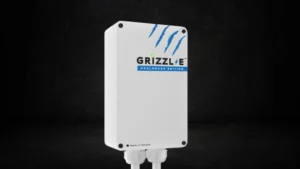
UL Tested and Certified. Energy Star Certified.
Best QualityJ1772 Home EV Charger
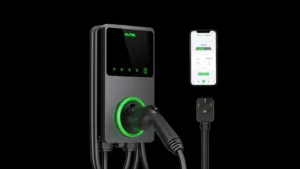
Integrate with home energy systems
Best Budget for NACs Alliance Electric Vehicles

Remotely opens Tesla charging port door
Best for Tesla Model S, Model 3, Model X and Model Y.

Power-share allows up to six Wall Connectors to be linked
Our 40 Amp EV Charger Reviews
Browse our curated selection of 40 Amp Level 2 EV chargers, including both dedicated 40-amp models and higher-capacity chargers that can be configured to operate at 40 amps. We include both hardwired and plug-in options, with most offering adjustable amperage settings and support for Tesla (NACS), J1772, or both charging standards. Each charger is independently evaluated and scored on a 10-point scale for performance, build quality, durability, design, value, and brand reputation. Click any title to read our full hands-on review.
Use the “Compare” button on each product to select multiple chargers, then click the ⚖️ scale icon to see a full side-by-side comparison.
What Is a 40 Amp EV Charger?
A 40 Amp EV charger delivers up to 9.6 kW of power at 240V, capable of adding approx 30 miles of range per hour, depending on your EV. It offers a performance sweet spot – powerful enough for most drivers’ daily needs while keeping electrical demands under the 50A threshold. Many units allow adjustable current settings down to 16A or 32A. Most 40A chargers require a 50A circuit and support hardwired or NEMA 14-50/6-50 plug-in installation.
Over a typical 8 to 10-hour overnight window, a 40-amp charger adds 240 to 360 miles of range. That covers any U.S. driver’s daily mileage, even after long highway days.
A 75 kWh Tesla Model Y refills in about 8.7 hours at 40 amps if the car has the optional 48 amp onboard charger. A 40-mile daily commute (12 kWh) takes about 1.3 hours to refill. The 40 amp tier gives you fast charging without the install complexity of higher tiers.
40 Amp EV Charger Circuit Requirements
A 40 Amp EV charger must be installed on a 240V circuit protected by a 50A double-pole breaker. The circuit should use 6 AWG solid copper conductors for hot wires and 10 AWG solid copper for the ground (G), all rated for 75°C insulation (e.g., THHN). These chargers typically plug into a NEMA 14-50 (4-wire) or NEMA 6-50 (3-wire) outlet or may be hardwired.
GFCI protection is typically required for plug-in installs under NEC 625.41, and may be integrated into the breaker, outlet, or charger per NEC and local code.
Want charging speed math instead of circuit specs? See our 9.6 kW EV charger archive for range per hour and how long it takes your specific EV to charge.
The 80 Percent Rule Explained: Why 40 Amps Matters
The NEC 80 percent rule limits continuous loads to 80 percent of the breaker rating. For a 50-amp breaker, the maximum continuous load is 40 amps. This is exactly why 40 amps became the upper limit for the Level 2 plug-in tier.
Above 40 amps, NEC 625.41 requires a hardwired installation. The 40-amp tier is the last amperage at which you can use a NEMA 14-50 plug and outlet. Push higher, and you cross into hardwired-only territory.
This makes 40 amps a sweet spot for buyers who want fast charging and flexibility. You can unplug the charger and take it to a vacation home, sell the house and leave the outlet for the next owner, or upgrade to a different unit later without having to rewire.
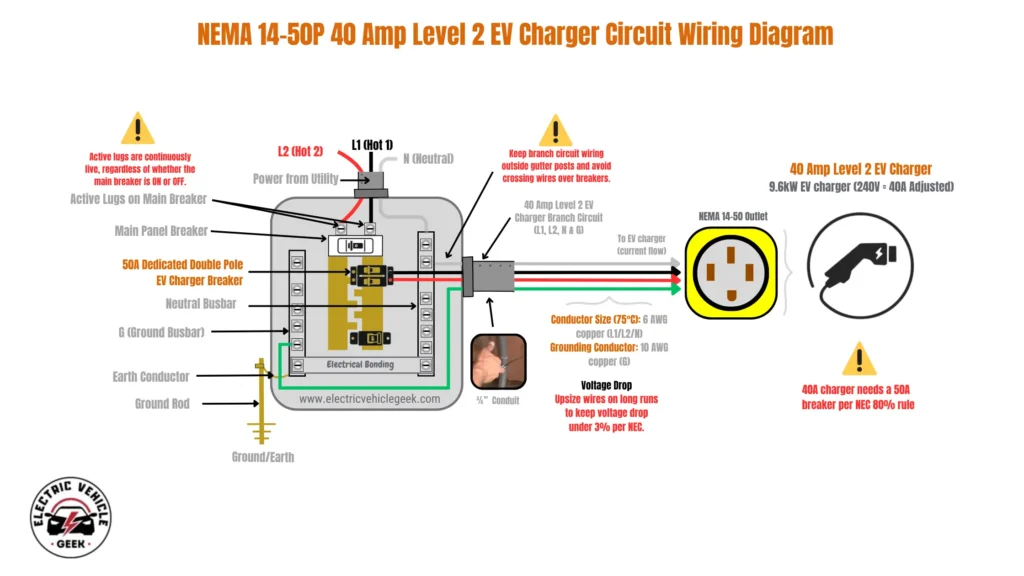
NEMA 14-50P 40 Amp Level 2 EV Charger Circuit Wiring Diagram
This setup uses a 240V NEMA 14-50R outlet. A 50A double-pole breaker feeds four wires- black (L1), red (L2), white (Neutral), and green (Ground) – from the panel to the outlet. Use 6 AWG solid copper for the hot and neutral conductors, and 10 AWG copper for the ground. The charger plugs into the outlet. Neutral may be required for standby or smart features.
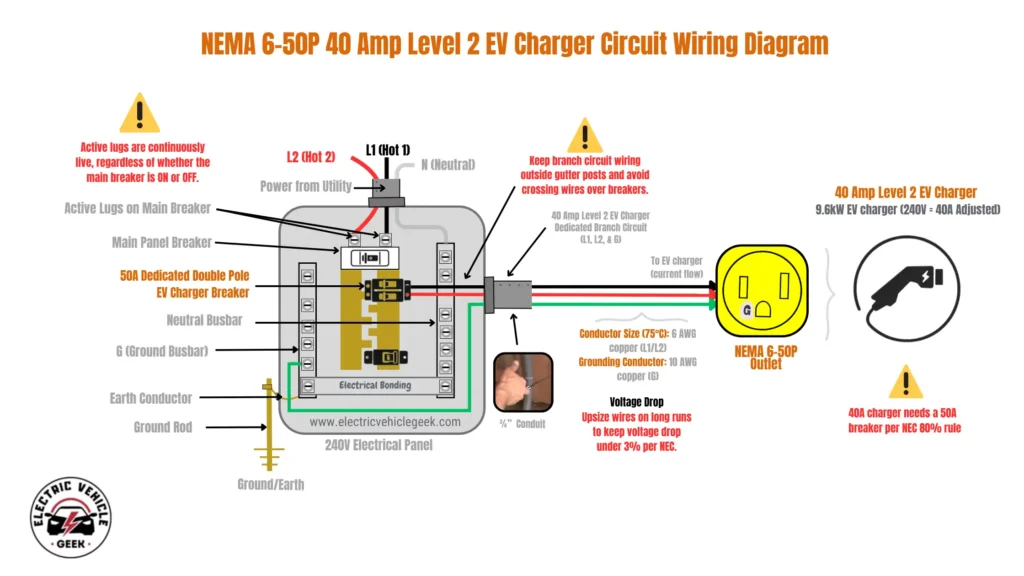
NEMA 6-50P 40 Amp Level 2 EV Charger Circuit Wiring Diagram
This 3-wire setup uses black (L1), red (L2), and green (Ground). A 50A double-pole breaker supplies 6 AWG solid copper for hots and 10 AWG copper for ground. Neutral is not used. The wires feed into a NEMA 6-50R outlet, where the charger plugs in.
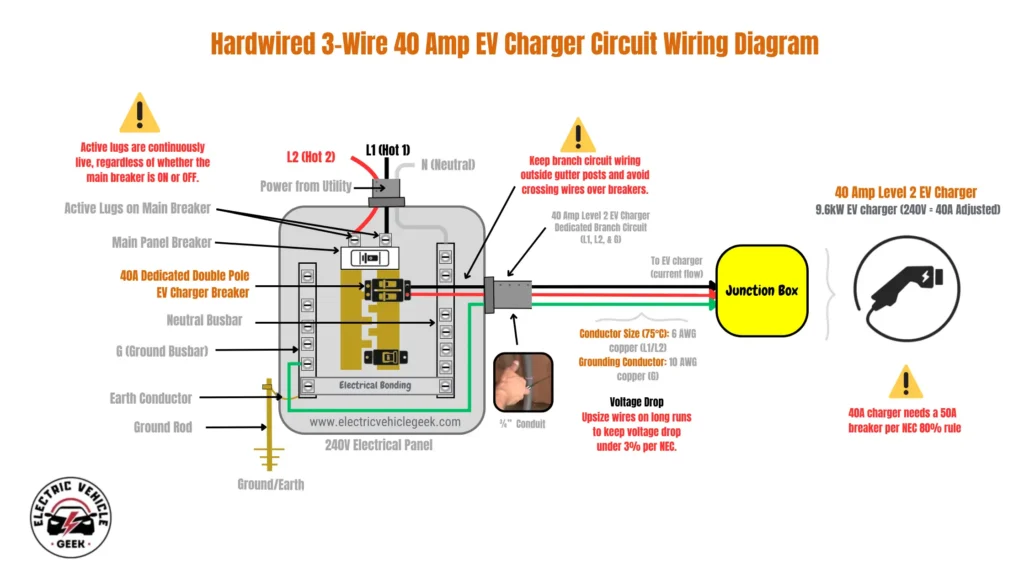
Hardwired 3-Wire 40 Amp EV Charger Circuit Wiring Diagram
This permanent 240V setup runs directly from a 50A double-pole breaker to a junction box. It uses three solid copper conductors – L1 (black), L2 (red), and Ground (green) – sized at 6 AWG for hots and 10 AWG for ground. The charger is directly wired in. No neutral is required.
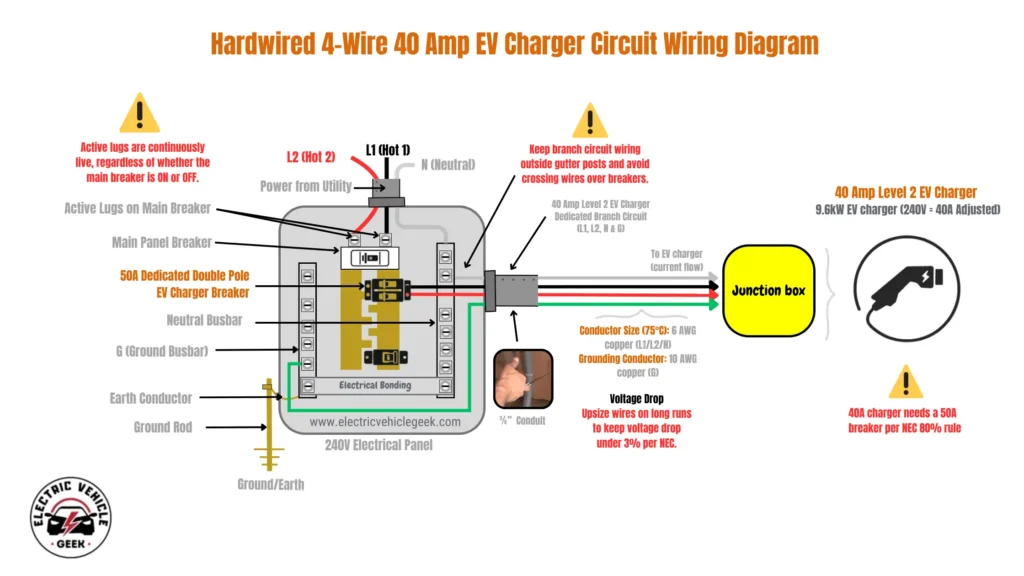
Hardwired 4-Wire 40 Amp EV Charger Circuit Wiring Diagram
Some hardwired chargers use a fourth conductor for internal features. A 50A breaker feeds four wires: black (L1), red (L2), white (Neutral from the neutral busbar), and green (Ground from the ground busbar). Use 6 AWG solid copper for hots and neutral, and 10 AWG for ground, all rated for 75°C. The wires terminate in a junction box where the charger is directly connected.
40 Amp EV Charger Buyer's Guide
Choosing a 40-amp charger is about deciding between plug-in flexibility and hardwired reliability. Both options use the same 50-amp circuit. The choice depends on whether you move the charger later.
Plug-In vs Hardwired at 40 Amps
A plug-in via a NEMA 14-50 outlet is still legal at 40 amps under NEC 625.41, provided a GFCI protects it. Hardwired is more reliable long term because the plug and outlet are eliminated as failure points, and GFCI is often exempted on hardwired installs per NEC 210.8(F). The labor cost difference is 100 to 200 dollars.
Why Commercial Grade Outlets Matter at 40 Amps
The standard NEMA 14-50 outlet from a home center costs $6 to $10. It is rated for the load but not for years of EV charging thermal cycling. Commercial-grade outlets from Hubbell or Bryant cost $25 to $40 and are the single biggest reliability upgrade you can make if you go plug-in. Cheap outlets are the leading cause of NEMA 14-50 plug failures at this amperage.
Headroom for Future EVs
A 40-amp charger plus its 50-amp circuit is over-spec for current 32-amp onboard EVs but right-spec for future 40-amp and 48-amp vehicles. If your next EV has a higher onboard charger rating (Rivian, Ioniq 6 Long Range, future Tesla configurations), the same wall unit and same circuit will charge them faster. Install at 40 amps now, and you have headroom for at least the next decade.
When to Go Hardwired 48 Amps Instead
Skip 40 amps and go to 48 amps if you own a Cybertruck, Lightning, Rivian, or other EV with a 48-amp or higher onboard charger and want every minute of charging speed. The hardware cost is similar, and the installation adds only $ 100 to $200 in labor. The trade-off is that hardwired chargers stay with the house.
EVs That Match a 40 Amp Charger
40 amps benefits vehicles with 40 amp or higher onboard chargers, which is a smaller but growing segment of the U.S. EV market.
Best matches at 40 amps include the Rivian R1T and R1S, the Hyundai Ioniq 6 Long Range with the optional 48 amp upgrade, the Porsche Taycan 4S Performance Plus, the Tesla Model 3 and Model Y with the 48 amp onboard upgrade, and Audi e-tron variants. Vehicles with 32 amp onboard chargers (most pre-2024 BEVs) cap at 7.68 kW regardless of wall unit capacity, so they see no benefit over a 32 amp wall unit.
Need a Little More or a Little Less? Compare Popular Home EV Charging Amperages
40A EV chargers offer approximately 30 miles of range per hour and are ideal for overnight charging. For smaller panels or moderate use, consider 12A to 32A EV chargers below. Need more power? Explore 40A to 80A EV chargers below.
120V, 12A, 1.44 kW
Adds approx. 3–8 miles of range per hour.
120V or 240V, 16A, 1.92–3.84 kW
Adds approx. 3–12 miles of range per hour
240V, 24A, 5.76 kW
Adds approx. 22 miles of range per hour
240V, 32A, 7.68 kW
Adds approx. 26 miles of range per hour

240V, 48A, 11.5 kW
Adds approx. 40 miles of range per hour
240V, 80A, 19.2 kW
Adds approx. 75 miles of range per hour
Need a charger with a different amperage? Our EV Charger Amperage hub covers every tier from 12 amps to 80 amps and links to each dedicated review archive.
40 Amp EV Charger Frequently Asked Questions
You’ve Got 40 Amp EV Charger Questions, We’ve Got Answers.
Is the Difference Between 32 Amps and 40 Amps Worth the Install Cost?
Only if your car can use 40 amps, going from 32 to 40 amps adds $ 50 to $ 150 to the charger price, and the install cost is nearly identical. If your EV has a 32-amp onboard charger (Tesla Model 3, Ford Mach-E, Chevy Bolt EUV), you get the same 7.68 kW from either tier. If your EV has a 40- or 48-amp onboard charger (Rivian, Ioniq 6 Long Range, Cybertruck), you see the full-speed bump.
Can I Run a 40 Amp Charger on a 40 Amp Breaker?
No. The NEC 80 percent rule requires a 50 amp breaker minimum for 40 amps continuous. Running 40 amps on a 40-amp breaker exceeds the continuous load limit and will trip the breaker after extended runtime. The breaker is also not rated for 100 percent continuous duty, so even if it does not trip immediately, it wears out faster.
Can I Plug a 40 Amp Charger Into My Existing NEMA 14-50 Outlet?
Yes, if the outlet was installed for 50 amp service with 6 AWG conductors on a 50-amp two-pole breaker. Check three things first: confirm the breaker is genuinely 50A two-pole (not 40A), confirm the conductors are 6 AWG copper (not 8 AWG aluminum), and confirm the outlet is commercial-grade (not a $ 6 contractor pack). Cheap 14-50 outlets fail under a 40-amp continuous load.
What Happens If I Plug a 40 Amp Charger Into a 30 Amp Circuit?
The breaker trips within minutes. The charger draws its rated 40 amps regardless of what circuit it is plugged into. A 30-amp breaker cannot carry 40 amps for any length of time before opening. If you only have a 30-amp circuit available, dial the charger down to 24 amps using its amperage setting, or buy a 24-amp charger instead.
Will a 40 Amp Charger Push My 200 Amp Panel Over Capacity?
Usually not, but it depends on your existing loads. A typical 200A panel running electric range, water heater, central AC, and dryer calculates around 140 to 175 amps of demand under NEC 220.83. Adding a 50-amp EV circuit usually fits within panel capacity. For 100A or 125A panels, the load calculation often fails, requiring a load management system or panel upgrade.
Does a 40 Amp Charger Charge My Tesla Faster Than a 32 Amp Charger?
Only if your Tesla has the 48-amp on-board charger upgrade, stock Model 3 and Model Y have 32-amp onboard chargers, which cap at 7.68 kW regardless of wall unit capacity. With the 48-amp onboard upgrade (a factory option on some configurations), the same Tesla draws 40 amps from a 40-amp wall unit and charges 25 percent faster.
Is OCPP Compatibility Worth It in a 40 Amp Charger?
If your utility offers managed charging programs, yes. OCPP lets your charger communicate with utility back-end systems and qualify for rebates. In California, New York, Massachusetts, and other states with managed charging programs, OCPP-capable units earn $100 to $400 per year in incentives. If your utility offers nothing, OCPP is a future capability rather than an immediate benefit.
How Long Does a 40 Amp Charger Last?
Well-built units from reputable brands typically last 10 to 15 years. The first failure point is the cable, which sees daily flexing and UV exposure. The second failure point on plug-in installs is the NEMA 14-50 outlet itself, which may need replacement at the 5 to 7-year mark. Brands with replaceable cables (Grizzl-E, Wallbox, Autel) extend practical lifespan.
Can I Take a 40 Amp Plug-In Charger With Me When I Move?
Yes, if you install a matching NEMA 14-50 outlet at the new property. The charger detaches from the outlet and travels with you. Hardwired 40-amp units stay with the house. The trade-off is that plug-in units have slightly higher failure rates because the plug and outlet wear out over time at this amperage.