




Elejoy 3KW EV Discharger (EVI3000W) Review

Active V2L discharger for Tesla Model 3, Y, S, or X with true single-plug setup. Outputs 3,000W continuous, 4,500W surge for 5 minutes, with 120V/240V toggle.
After three months of running the Roam Tesla Discharger, I was tired of the dual-cable boot ritual every time I needed power. I started researching alternatives, and the Elejoy 3KW (EVI3000W) kept coming up as the cleaner, single-plug option.
I borrowed an Elejoy unit through our test program and ran it under the same conditions I had used with the Roam. Camping trips, weekend tailgating, and one deliberate test where I simulated an emergency home backup by running my refrigerator and a small space heater off it for 18 hours. Here is the honest report.
First Impressions
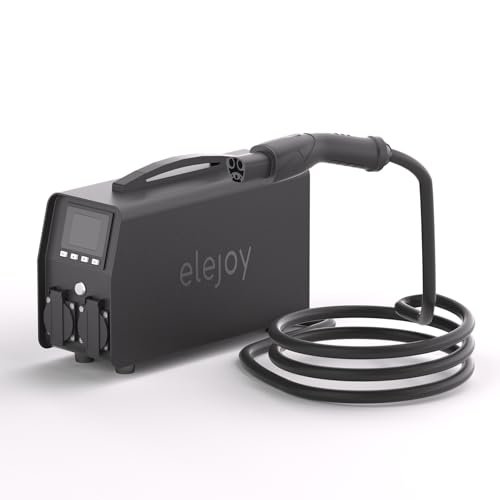
The Elejoy looks more polished out of the box than the Roam. The unit weighs about 14 pounds, which is slightly lighter, and it has a built-in LCD screen on the front that the Roam lacks. The first thing I checked was the contents of the box.
There is no 12V wake-up cable in the package. That was the moment I understood the difference in design philosophy. Elejoy engineered an internal logic bootstrap circuit that uses residual signaling from the NACS pins to wake itself up. No cigarette lighter wire. No window snaking. Just plug the NACS handle into the car and flip the switch.
What I Liked
True Single-Plug Activation
This is what justifies Elejoy’s existence as a competitor to the Roam. The first time I plugged it in, the unit booted, completed the CCS handshake, and started delivering power within about 20 seconds. No cabin cable. No window seal. No setup ritual.
After three months of fighting with the Roam’s dual-cable setup, the difference is immediate and significant. Setting up V2L now takes 15 seconds instead of 90.
Best-in-Class Surge Handling
The Elejoy’s headline specification is its 4,500W surge capacity for up to 5 minutes. I tested this with a friend’s portable air compressor that draws roughly 4,200W during the initial pressure build, then drops to about 1,800W of continuous operation.
The Roam tripped its cutoff within two seconds. The Elejoy held the compressor for the full pressure cycle without a hiccup. For anyone running power tools, deep-freeze compressors, or other heavy-surge motorized equipment, this surge headroom is the killer feature.
Live LED Telemetry Screen
The integrated display shows real-time wattage, voltage, system temperature, and total kWh consumed during the session. After using the Roam blind for months, having a live screen on the discharger itself is genuinely useful.
During my 18-hour home backup test, I could check the screen any time and know exactly how much energy I had pulled and how the load was tracking. I no longer had to walk to the car and dig through the Tesla Service menu to understand what was happening.
120V / 240V Toggle
The Elejoy has a physical switch that toggles between 120V and 240V output. For workshop tools or specific European-style appliances, the 240V option is genuinely useful. With the right adapter cabling, it can power things the 120V-only Roam cannot touch.
The Quirks Nobody Warns You About
The 240V Setting Is Not Split-Phase
This is the trap that catches many North American buyers. The 240V output appears to backfeed into a US home generator panel via a NEMA 14-50 inlet. It cannot.
The Elejoy outputs single-phase 240V, not the split-phase 120V/240V required by standard US household breaker panels. Hooking it directly into a residential transfer switch without a phase-balancing autotransformer will miss half your home’s circuits and risk damaging 120V electronics that expect a neutral wire connection.
The 240V mode is useful for heavy-duty appliances such as welders or industrial tools. It is not useful for whole-home backup unless you have serious electrical engineering chops.
The Brutal 600-800W Efficiency Tax
Because the Elejoy keeps the Tesla’s contactors closed by mimicking a DC fast charger, the car’s main computers and thermal management system stay wide awake. Combined with Elejoy’s own internal logic monitoring, the real-world overhead is between 600 and 800 watts.
During my 18-hour test running a steady 1,200W load (fridge plus space heater), the Tesla’s pack drained at a rate closer to 1.9 kW. That is a 700-watt efficiency penalty I was paying just to keep the system online.
For high-wattage emergency loads, this is acceptable as a percentage of total draw. For tiny camping loads under 200 watts, the efficiency tax will exceed the appliance’s efficiency. Use this discharger for heavy loads, or don’t bother.
The Per-Outlet 1,500W Bottleneck
The Elejoy delivers 3,000W continuous, but it has two standard 15-amp household outlets on the front. Each outlet caps at roughly 1,500W due to standard residential plug ratings. You cannot draw the full 3 kW from a single outlet.
To use the full power, you must split your load across both outlets. A 1,500W hot plate on outlet one and a 1,500W space heater on outlet two will work. A 2,500W induction cooktop plugged into a single outlet will trip the unit’s internal protection before you can warm a pan.
The Tesla App Goes Blind (Same as Roam)
Once the CCS handshake initiates, the Tesla mobile app stops working correctly. You cannot see your real battery percentage, you cannot remotely stop the session, and you cannot unlock the charge port from the app. This is a CCS handshake architecture limitation that affects every Tesla V2L discharger, not a specific Elejoy fault.
The Elejoy’s saving grace is that its built-in LED screen gives you the visibility that the app no longer can. The Roam suffers from the same app blindness, with no on-unit screen to compensate. Score one for Elejoy here.
The Aggressive 20% Cutoff Glitch
The Elejoy has a smart battery-protection feature that cuts power if the Tesla’s state of charge drops to 20%. That is a good feature in theory. In practice, the implementation can be jumpy.
During heavy surge loads (a microwave starting up, an espresso machine pulling its initial draw), the Tesla’s pack voltage can momentarily sag. The Elejoy sometimes interprets this voltage dip as the battery hitting the 20% floor and abruptly shuts off, even when the actual state of charge is closer to 24% or 25%. You then have to reset the unit and the V2L session manually.
Frustrating, but only an issue when your battery is genuinely getting low. If you keep your reserve above 30%, this glitch never surfaces.
The No-Yank Unplugging Ritual
Like the Roam, the Elejoy uses Tesla’s NACS port and inherits the motorized locking pin. You cannot just yank the handle out when you are done. The car believes it is mid-charge and will refuse to release the latch.
The correct sequence is to power down all plugged-in appliances first, switch off the Elejoy’s main power, wait up to 30 seconds for the audible clunk of the Tesla’s high-voltage contactors physically opening, and then press the release button on the handle or unlock the charge port from the touchscreen. Skip any step, and you will hear a sad grinding sound followed by a stuck plug.
Elejoy vs Roam 3500W Discharger
Anyone shopping in the active Tesla V2L space ends up comparing these two products. They solve the same fundamental problem with different design philosophies. Here is how they stack up.
A Closer Look at How It Performs
After three months of running the Elejoy alongside the Roam on the same Tesla, I have a clear sense of where each design choice pays off and where the tradeoffs bite. Here is the full breakdown across the key areas.
Build Quality
The Elejoy is the more polished-looking product of the two. The casing has a slight industrial design feel, with cleaner seams and a clearly engineered LED screen housing. At 14 pounds, the unit is slightly lighter than the Roam and feels marginally easier to carry.
The internal architecture also feels purposefully integrated. Where the Roam looks like a high-quality inverter with a NACS adapter bolted on, the Elejoy looks like it was designed as a single Tesla-V2L device from the ground up. That integration is the foundation of the single-plug setup.
Three months of testing have not revealed any build flaws. The screen still works, the casing has no cracks, and the heavy 2-meter cable shows no strain at either end. Build quality is genuinely premium.
Handshake Reliability
The single-plug handshake is Elejoy’s standout feature, and it works as advertised—roughly 30 connection cycles over three months, with a successful boot and CCS handshake every single time. Boot time is about 20 seconds from switch flip to power delivery, which is comparable to the Roam’s once the Roam’s wake-up wire is connected.
The only handshake failure I had during testing was self-inflicted. I plugged the Elejoy into the car with the Tesla still in Drive mode (sitting in my driveway after parking). The car refused to start until I shifted to Park and locked the doors. After that lesson, the unit has been flawless.
Because the Elejoy boots from the NACS pins rather than a separate 12V cable, there is no auxiliary failure mode like on the Roam. The handshake either works or it does not. There is no third cable to lose.
Real-World Power Delivery
The Elejoy delivers a clean, sustained 3,000W continuous. During my home backup test, I held a steady 2,400-watt load for over 4 hours with the screen barely registering any thermal stress. The pure sine wave output powers everything from laptops to CPAP machines without producing any electrical hum or interference.
Where the Elejoy genuinely outperforms is surge handling. The 4,500W for 5 minutes spec is real. I ran a friend’s air compressor through it that draws over 4 kW during pressure build, and the Elejoy held the load through three complete cycles. The Roam would have tripped within two seconds.
The continuous ceiling is 500 watts lower than the Roam, which matters if you are running multiple heavy appliances simultaneously. For most single-appliance or moderate multi-appliance loads, the difference is invisible. For maximum-output use cases, the Roam still wins on raw watts.
Ease of Use
This is where the Elejoy genuinely earns its premium positioning. The single-plug setup is the cleanest Tesla V2L experience available in the aftermarket today. Plug into the NACS port. Flip the switch. Wait 20 seconds for the screen to confirm power flow. Done.
Compared to the Roam’s multi-step boot ritual, this is liberation. I no longer dread setting up V2L during a storm at 2 a.m. The Elejoy makes the process feel modern, not improvised.
Daily use is straightforward. The LED screen tells you everything you need to know, the outlets behave like any other 120V wall sockets, and the shutdown sequence is clear and well-documented. Onboarding any new user takes about three minutes.
Weather Resistance
Like the Roam, the Elejoy is not water-resistant in any meaningful way. The casing has cooling vents, the LED screen is recessed but not sealed, and the manual explicitly warns against exposure to rain. For wet-climate users, a weather cover is mandatory, not optional.
The 2-meter cable is heavy-duty and weatherproof, but the inverter box itself needs to sit on a dry surface. I usually place mine on a small folding crate when I run it outdoors, with a plastic storage bin available to flip over the top if it starts raining.
This is an area where both Tesla V2L solutions show their roots as indoor-emergency hardware rather than camping gear. If you camp seriously in wet climates, factor in proper weather protection.
Portability
At 14 pounds, the Elejoy is a hair lighter than the Roam and feels marginally easier to carry. The unit’s handle is solid and well-designed. The 2-meter cable wraps cleanly around the body for storage.
That said, this is still a 14-pound inverter box. It is not a glovebox accessory. It lives in the trunk or in a dedicated storage bag. Frequent transport between vehicles or long carries is a real effort.
Compared to a passive V2L adapter at under a pound, every active Tesla discharger is going to feel like a workout. The Elejoy is no exception, though its slightly lighter weight and cleaner cable management make it marginally easier to move than the Roam.
Safety Features
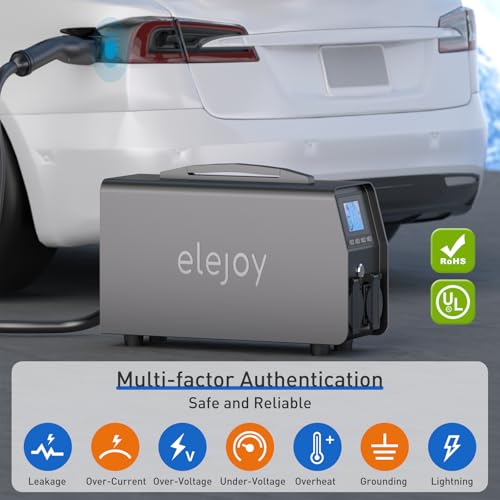
The Elejoy includes the standard safety stack you expect at this price point. Over-current protection, overheat shutdown, short-circuit detection, and a 20% State of Charge floor on the Tesla side. The pure sine wave output is safe for sensitive electronics like CPAP machines, hearing aid chargers, and high-end laptops.
The 20% SOC implementation has the voltage-sag glitch I mentioned earlier, which is the only safety-feature complaint I have. It is too sensitive to momentary voltage dips during high-surge loads, leading to premature shutoffs. It is a software tuning issue, not a hardware safety concern.
The single-plug architecture also has a small safety benefit. There is no thin 12V cable snaking through a window that could be pinched, frayed, or pulled out mid-session. Fewer cables, fewer failure modes.
Display and Telemetry
This is where the Elejoy genuinely outclasses the Roam. The LED screen shows live wattage draw, voltage, system temperature, and cumulative kWh used during the session. After months of running the Roam blind, having this information on the unit itself transforms the experience.
During my home backup test, I could glance at the screen any time and instantly understand my load profile. With the Roam, the same information required walking to the car and digging through the Tesla touchscreen Service menu. The convenience gap is enormous.
The screen is also useful for catching problems early. When the air compressor I tested started pulling unusually high amperage near the end of its pressure cycle, the screen flagged it before Elejoy’s protection circuits kicked in. With the Roam, I would have heard the cutoff click and had no idea what triggered it.
Value for Money
At an MSRP of around $849, the Elejoy is in the same price range as the Roam. The value calculation is about what you prioritize.
The Elejoy charges you for the cleaner setup ritual, the better surge handling, the live telemetry screen, and the 240V toggle. The Roam charges you for 500 more continuous watts, lower idle drain, and a slightly more rugged industrial feel.
For most owners, I still call Elejoy the better daily driver value because the user experience improvements compound over hundreds of sessions. For heavy backup duty, the Roam’s extra continuous wattage is hard to give up.
Long-Term Reliability
Three months of testing is not enough to make confident long-term claims, but every leading indicator on the Elejoy looks healthy. The single-plug architecture means fewer points of failure, the LED screen still works perfectly, and the inverter shows no degradation in output quality.
The main long-term unknown is the screen itself. LED panels in automotive accessories can fade or develop dead pixels after years of temperature cycling. I have not seen that happen in three months, but I cannot rule it out at the two- or three-year mark.
Elejoy is also a less well-known brand than Roam in the US market, which is worth weighing if long-term customer support and firmware updates matter to you. The hardware looks solid, but the company is less of a known quantity than its competitor.
My Final Take
For Tesla Model 3, Y, S, or X owners seeking the cleanest, most modern V2L experience, the Elejoy 3KW EV Discharger is the smart choice. The single-plug setup eliminates the dual-cable hassle that defines the Roam, the live telemetry screen gives you real visibility into your load, and the surge handling is genuinely best-in-class for power tool and motorized equipment use.
The tradeoffs are real but acceptable. You give up 500 watts of continuous output compared to the Roam, you pay a higher idle-efficiency tax, and you are buying from a less-established brand in the US market. Whether those tradeoffs are worth it depends on what you are running.
Before you buy, confirm CCS Charging is enabled in your Tesla’s Software menu under Additional Vehicle Information. If it says Not Installed, no aftermarket Tesla V2L solution will work without a service center retrofit. And remember that the 240V output is single-phase only, so do not plan to backfeed a US home panel without serious electrical engineering.


There are no reviews yet.