Supported by you via insider access, and when you purchase through links on our site, we may earn an affiliate commission. See our Affiliate Disclosure.
Best J1772 EV Chargers Reviewed: 56+ Tested and Ranked
-
 Best Picks By
James Ndungu
Best Picks By
James Ndungu
- last updated September 6, 2026

The SAE J1772 connector is the AC charging port on every non-Tesla EV sold in North America.
A good J1772 home charger should charge faster than a wall outlet, work outdoors through winter, and last 8 to 12 years. These 56+ chargers below are the ones that actually do.
Every charger was tested for at least 30 days on real EVs. Scores reflect installation difficulty, charge speed under load, cold-weather cable handling, and reliability over six-month windows. Not EV charger manufacturer claims.
How We Tested J1772 EV Chargers
Each charger ran 30+ days on real EVs (Chevy Bolt EUV, Nissan Leaf, Hyundai Ioniq 5, Ford Mach-E). We measured current under load, verified GFCI trips, stress-tested connector latches at 500 plug cycles, and tracked firmware updates.
Our Top Picks
Four awards, four buyer scenarios. Every other charger on this page is scored on the same 1 to 10 scale and ranked underneath these picks.
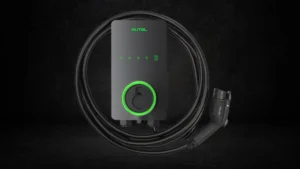
Best Overall J1772 Charger
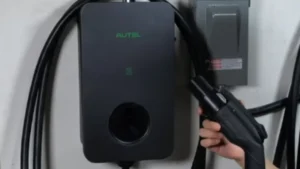
80 amps of headroom for any current or future EV, OCPP 2.0.1 for utility programs, a 5-year warranty, and an operating range down to minus 40 degrees Fahrenheit. Over-spec for most homes today and exactly right in five years
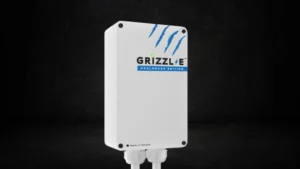
The cheapest charger on this page that still includes OCPP, dynamic load management, and solar integration. Rugged aluminum case, IP67 enclosure, and a price that undercuts every smart competitor at 40 amps.
Best for Dual EV Households
Two J1772 connectors on one unit, two 24-foot cables, and 40 amps split or dedicated depending on which car is plugged in. The right answer when you have two EVs and one panel slot to spare
Best for Solar and Time-of-Use Tariffs
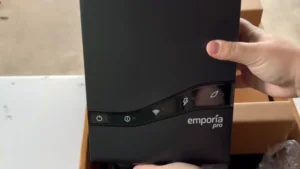
PowerSmart load management with real solar integration, time-of-use scheduling, and a Vue 3 energy monitor that tells you what your home is drawing in real time. The right pick when your power bill matters more than your charge speed.
Not sure if J1772 is the right plug for your EV?
Read our complete J1772 charger guide first. Learn how the plug works, which vehicles use it, charging speeds you can expect at home, and whether you need an adapter for a newer NACS car before you spend on hardware.
Read the J1772 Charger Guide →All Our J1772 EV Chargers Reviews
Explore reliable SAE J1772 chargers for home and public use. Each charger is rated and sorted on a comprehensive 1–10 scale for performance, build quality, safety, durability, design, brand reputation, and overall value, making it simple to compare and choose the best fit for your J1772-compatible electric vehicle.
Use the “Compare” button on each product to select multiple chargers, then click the ⚖️ scale icon to see a full side-by-side comparison.
Is J1772 the right plug for your car?
If your EV is any non-Tesla model from 2023 or earlier, you have J1772, and you are on the right page. If your car is a Tesla, or a 2024-or-newer Ford, GM, Rivian, Hyundai, Honda, Polestar, Volvo, or Mercedes EV, you have a NACS port and should head to the NACS chargers archive instead.
For the full breakdown of how the J1772 standard works, pin layouts, and the difference between AC Level 1 and Level 2 charging, read our complete SAE J1772 charger guide.
Choose a J1772 Charger by Use Case
Fifty-six + EV chargers in a lot. Use the scenarios below to narrow the field before clicking into individual reviews.
If you want the fastest possible home charging
An 80-amp hardwired unit delivers 19.2 kW, adding roughly 60 miles of range per hour. The Autel MaxiCharger 80A and Grizzl-E Ultimate 80A are the two options. Your panel needs a 100-amp dedicated circuit, so confirm with an electrician before buying.
If you want solid everyday charging on a typical home panel
A 40-amp continuous unit on a 50-amp breaker delivers about 9.6 kW and adds roughly 30 miles of range per hour. This is the sweet spot for most homes. The Grizzl-E Smart leads on budget, the Emporia Pro 48A leads on solar and time-of-use.
If you have two EVs
The Grizzl-E Duo is the simplest answer because it does not require a second breaker or panel slot. Two separate units sharing one circuit through load balancing is the alternative if you want each car on its own connector at full 40 amps, which the Autel MaxiCharger 80A supports natively through Group Power Management.
If you rent or move often
Look for plug-in models with NEMA 14-50 plugs rather than hardwired units. The ApexCharger MACH 3, Battery Tender eCharge 40A, and Lectron Level 1 and Level 2 portable let you take the charger with you. Hardwired units cost more to install and stay with the property.
If your garage gets below- 20 degrees Fahrenheit
Operating temperature matters. The three Autel models in this archive (the MaxiCharger 80A, the AC Lite, and the AC Elite In-Body Holster) all rate to minus 40 degrees Fahrenheit, which is the widest range in the category. Most other chargers stop at minus 22.
If you charge from solar
You want a charger that can throttle dynamically to match solar production. The Emporia Pro 48A and the Wallbox Pulsar Plus 40A both do this natively. The Autel MaxiCharger 80A does it through OCPP-compatible third-party software, which is more flexible but requires more setup.
J1772 EV Charger Specs at a Glance
The numbers below summarise key specifications across all 56 J1772 chargers reviewed on this page. Use them as a benchmark when comparing individual models.
Note: Specification updates for J1772 chargers listed on this page are tracked on our EV Charger Data Updates page.
J1772 charging power across the archive ranges from a low of 1.44 kW on Level 1 portable units up to a high of 19.2 kW on hardwired 80 amp units, with an average of 9.6 kW. If you are optimizing for raw speed and your panel supports a 100-amp dedicated circuit, the Autel MaxiCharger 80A and the Grizzl-E Ultimate 80A both deliver 19.2 kW. The MaxiCharger scores higher (9.1 versus 8.8) because its smart feature set is more complete, while the Grizzl-E Ultimate is the cheaper of the two and the better pick if you do not need OCPP.
Cable lengths run from 16 feet on portable units to 30 feet on the longest wall-mounted models, averaging 24.4 feet. The longest cables in the archive are on the ApexCharger MACH 1 and MACH 2, both at 30 feet, which matters if your panel is in a basement and your car parks at the far end of the driveway. The MACH 2 carries load management features that the MACH 1 does not, so it wins the longer-cable category if you also want smart features.
Warranties range from 1 year on the cheapest portable units up to 5 years on three premium models, with a 2.9-year average. The 5-year coverage belongs to the Autel MaxiCharger 80A, ApexCharger MACH 2, and MACH 3. Of those three, the MaxiCharger is the highest-scoring and the right pick if warranty length is a deciding factor.
Operating temperatures span from minus 40 to 167 degrees Fahrenheit. For cold-climate installs, the three Autel models (the MaxiCharger 80A, the Home Smart EV Charger, and the AC Elite In-Body Holster) all reach the -40 °C floor.
Weights range from 4.4 lbs on the Wallbox Pulsar Plus 40A up to 39.68 lbs on the Grizzl-E Duo, averaging 15 lbs. The Pulsar Plus is the easiest charger in the archive to install solo, and currently, it’s the highest-scoring lightweight unit. The Grizzl-E Duo is heavy because it houses two separate connectors and cables, and benefits from a two-person mount.
J1772 EV Charger Specs Chart
The chart below shows the lowest, average, and highest values for some key J1772 EV charger specifications across all the J1772 chargers we’ve reviewed. These include charging power, weight, operating temperature range, cable length, and warranty length. Use it as a quick benchmark when comparing individual models.
Using a J1772 Charger at a Public Station or a Friend's House With a Tesla
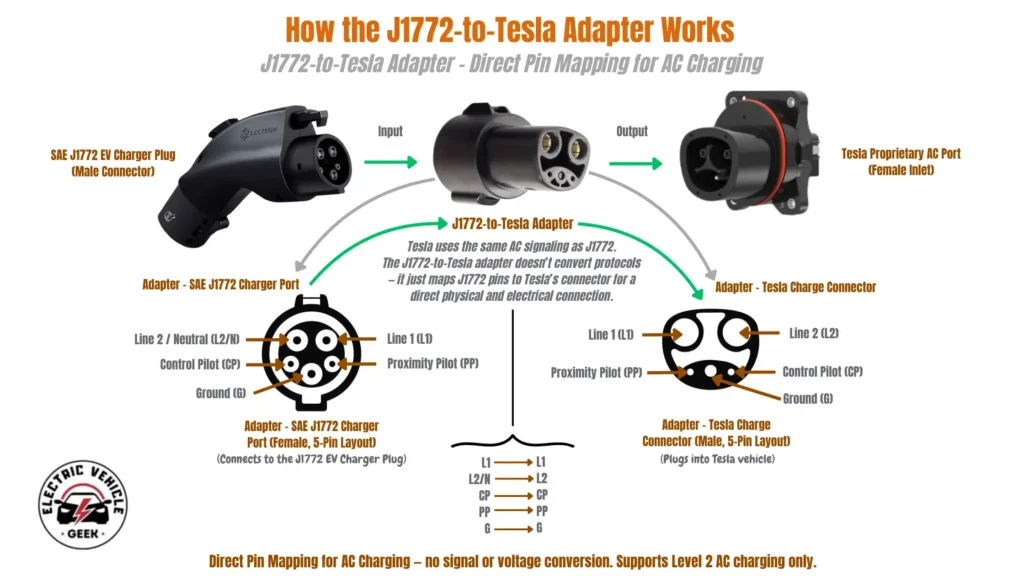
If you own a Tesla and your home charger is a NACS unit, you may still encounter J1772 plugs at public Level 2 stations, workplaces, or when visiting friends with older EVs. A J1772-to-Tesla adapter handles those situations
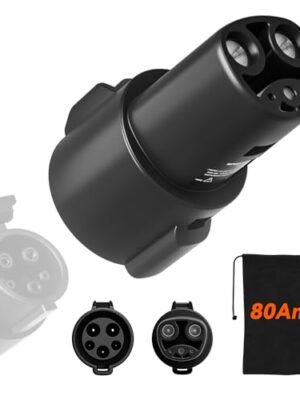
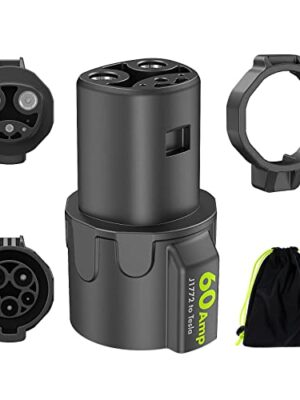
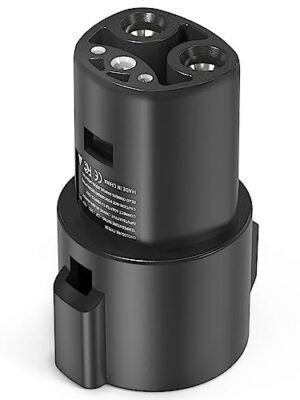
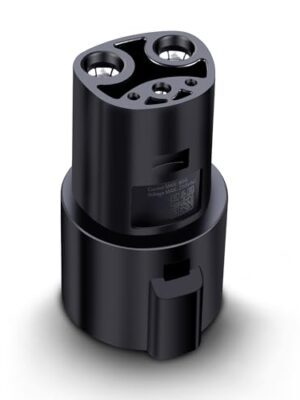
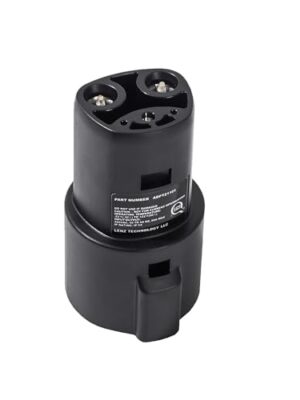
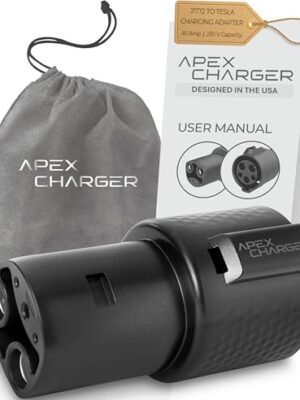
The J1772-to-Tesla adapter is essential because the J1772 connector doesn’t fit directly into a Tesla’s charging port. It simply plugs into the J1772 charger handle on one end and the Tesla port on the other, allowing safe and convenient charging.
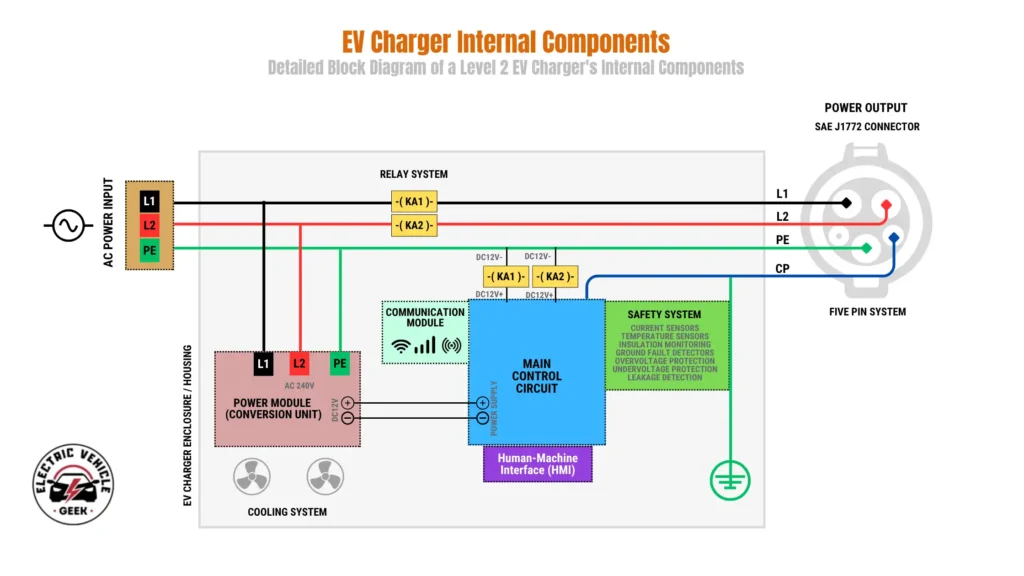
A J1772 charger is a Level 1 or Level 2 EV charger that follows the North American J1772 AC charging standard and is compatible with most non-Tesla electric vehicles. It delivers safe, single-phase AC power through a five-pin SAE J1772 plug, also called a J-plug or Type 1 connector.
Level 1 J1772 chargers run on 120V household outlets and deliver up to about 1.92 kW. Level 2 J1772 chargers operate on 240V circuits and deliver up to 19.2 kW, depending on the circuit size. For the complete technical breakdown, including pin layout, signaling protocol, and charging level specs, read our SAE J1772 charger guide.
What is a SAE J1772 Connector?
The five-pin SAE J1772 connector, commonly called the J-plug or Type 1, is the standard AC charging interface for most North American and Japanese EVs equipped with an SAE J1772 inlet. It supports single-phase AC charging up to 19.2 kW and is the most widely used plug type for Level 1 (120 V) and Level 2 (240 V) home and public charging.

As shown in the SAE J1772 plug above, the J1772 plug features five pins (viewed from the outside) that integrate protective grounding, communication, and interlock functions to ensure safe and reliable charging.
L1 – AC Line 1
Carries the main AC power used for Level 1 and Level 2 charging. Provides one phase of supply voltage directly to the vehicle safely and reliably.
N – Neutral / Line 2
Serves as a neutral for 120 V Level 1 charging. In 208–240 V Level 2 operation, it functions as the second AC line to supply a higher charging voltage.
PE – Protective Earth
Acts as the grounding path for safety and fault protection. Ensures proper earthing to protect the vehicle and user during all charging conditions.
PP – Proximity Pilot
Detects plug insertion and signals the latch button. Prevents vehicle movement while plugged in and confirms connector presence to the system.
CP – Control Pilot
Provides communication between EV and charger. Negotiates charging limits, manages start/stop, and uses a 1 kHz signal for coordination and safety.
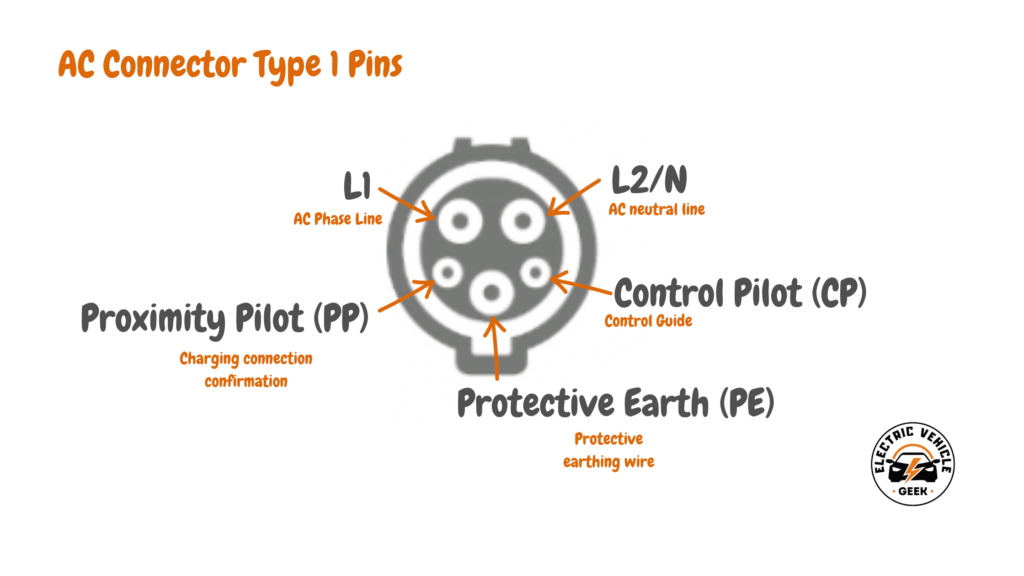
Every charger we review in this section follows this pin layout and SAE J1772 signaling/ communication protocol, ensuring reliable operation with compatible EVs. Physically, the connection pins are isolated on the interior of the connector when mated, ensuring no physical access to those pins. When not mated, J1772 connectors have no power at the pins; they are not energized until commanded by the vehicle.
SAE J1772 Charging Levels and Power Specs
The SAE J1772 standard defines two primary AC charging levels. These determine how quickly an EV can charge based on voltage, circuit size, and maximum current. Both levels use the same J1772 five-pin connector, but the power source and capacity differ.
AC Level 1 – 120 V Single-Phase Charging
Level 1 J1772 chargers are the most common entry point for home EV owners. It uses a standard 120-volt household circuit and is ideal for overnight charging. Portable J1772 chargers typically plug into common NEMA 5-15 outlets (delivering up to 12 A continuous, about 1.44 kW, on a 15 A breaker) or NEMA 5-20 outlets (up to 16 A continuous, roughly 1.92 kW, on a 20 A breaker). While slower than Level 2, Level 1 charging requires no special installation and works well for drivers with modest daily mileage.
AC Level 2 – 208–240 V Single-Phase Charging
Level 2 J1772 chargers uses 208–240-volt power and provides much faster charging speeds. Many units plug into 240 V outlets such as NEMA 6-20 (up to 16 A), NEMA 14-30 (around 24 A), or the popular NEMA 14-50 (40 A continuous, about 9.6 kW). Higher-capacity Level 2 equipment can also be hardwired, supporting 24–80 A continuous current with breaker ratings from 30–100 A, delivering up to approximately 19.2 kW. This flexibility allows you to select the right outlet and charger capacity for your vehicle and electrical system.
Popular Electric Vehicles Compatible with SAE J1772 Chargers
The SAE J1772 connector is the standard Level 1/2 AC charging plug used across North America, making it compatible with nearly all electric vehicles (EVs) and plug-in hybrid electric vehicles (PHEVs) sold in the U.S., except Tesla, which uses its own connector but supports J1772 charging through an adapter.
The table below highlights popular EVs and PHEVs in the U.S. that support J1772 chargers, helping you quickly identify which models work seamlessly with home and public Level 1/2 charging stations. Whether you’re shopping for your first home EV charger or upgrading your setup, choosing a J1772-compatible charger ensures universal compatibility, reliable performance, and future-ready convenience.
| Vehicle Manufacturer | Popular EV / PHEV Models (USA) |
|---|---|
| Alfa Romeo | Tonale Plug-in Hybrid |
| Audi | Q4 e-tron, Q8 e-tron, e-tron GT |
| Bentley | Bentayga Hybrid, Flying Spur Hybrid |
| BMW | i4, i5, i7, iX |
| Chevrolet | Bolt EV, Bolt EUV, Blazer EV, Equinox EV, Silverado EV |
| Fiat | 500e |
| Ford | Mustang Mach-E, F-150 Lightning, E-Transit |
| Genesis | GV60, Electrified G80, Electrified GV70 |
| Honda | Prologue |
| Hyundai | Ioniq 5, Ioniq 6, Kona Electric |
| Jaguar | I-PACE |
| Jeep | Grand Cherokee 4xe (PHEV), Wrangler 4xe (PHEV) |
| Kia | EV6, EV9, Niro EV |
| Land Rover | Range Rover PHEV, Range Rover Sport PHEV |
| Lexus | RZ 450e |
| Lucid Motors | Air |
| Maserati | Grecale Folgore, GranTurismo Folgore, GranCabrio Folgore |
| Mazda | MX-30 |
| Mercedes-Benz | EQB, EQE, EQS (Sedan/SUV), Maybach EQS SUV |
| MINI | Cooper Electric, Countryman Electric |
| Mitsubishi | Outlander PHEV |
| Nissan | Leaf, Ariya |
| Polestar | Polestar 2, Polestar 3 |
| Porsche | Taycan, Panamera S E-Hybrid |
| Rolls-Royce | Spectre |
| Subaru | Solterra |
| Toyota | bZ4X, Prius Prime (PHEV), RAV4 Prime (PHEV) |
| Volkswagen | ID.4 |
| Volvo | XC40 Recharge, C40 Recharge, EX30, EX90 |
Get a Personalized SAE J1772 Charger Recommendation
Save up to 20% on your home EV charger, and even more on total project costs, by sourcing smarter. Click the button below to find the best charger for your EV and home setup now!Frequently Asked Questions
You’ve Got J1772 Charger Questions, We’ve Got Answers.
Are all J1772 chargers compatible with all non-Tesla EVs?
Yes. The J1772 standard is universal across every non-Tesla EV sold in North America from roughly 2010 through 2023, and every charger in this archive will physically plug into and electrically communicate with any of those vehicles. The charge speed you actually get is capped by your car's onboard charger, not the wall unit. A 48-amp charger paired with a car limited to 32 amps will only deliver 32 amps.
Do I need a smart J1772 charger?
Only if you plan to charge on a time-of-use electricity tariff, charge from rooftop solar, or want to track energy use in detail. For everyone else, a non-smart J1772 charger like the Grizzl-E Classic costs less, has fewer parts to fail, and charges your car just as fast. The Grizzl-E Classic is the highest-rated non-smart charger in this archive.
How much does it cost to install a J1772 charger at home?
Plug-in models with a NEMA 14-50 cost between 200 and 600 US dollars to install if you already have a 240V outlet, or 600 to 1500 if you need a new outlet and breaker run from the panel. Hardwired chargers add 200 to 400 to the labor because the electrician has to terminate the wires inside the unit and pull a permit in most jurisdictions. Panel upgrades, if required, can push the total install cost above 3000.
How long does a J1772 charger last?
A well-installed J1772 unit from a reputable brand should last 8 to 12 years on the hardware side. Cables and connectors are the typical failure points before the electronics fail. Brands with replaceable cables (Grizzl-E, Wallbox, Autel) extend the practical lifespan by allowing you to swap the cable rather than replace the whole unit.
Can I install a J1772 charger outdoors?
Yes, provided the unit carries a NEMA 4 or higher enclosure rating, which all the chargers in this archive do. NEMA 4 covers wind-driven rain and splashing water, NEMA 4X adds corrosion resistance for coastal installs, and IP67 covers temporary submersion. For installs exposed to direct sun, look for chargers rated above 122 degrees Fahrenheit to avoid throttling in summer.
Will J1772 still work when all new cars use NACS?
Yes, for at least the next 15 years. There are roughly 3 million J1772-equipped EVs already on US and Canadian roads, every public Level 2 charger built before 2024 uses J1772, and SAE has confirmed continued support for the standard. The J1772 home charger you install today will reliably serve your current EV throughout its lifetime.
What is the difference between a J1772 charger and a J1772 connector?
The connector is the five-pin plug at the end of the cable that physically inserts into your car. The charger, technically called an EVSE (Electric Vehicle Supply Equipment), is the entire wall-mounted or portable unit, including the connector, cable, control electronics, safety circuits, and case. We use the term J1772 charger throughout this archive. For a pin-by-pin breakdown of how the connector works, read our J1772 guide.