CHAdeMO charger guide for Nissan Leaf owners and legacy EV drivers. Find working chargers, understand the fade-out timeline, get adapters, and avoid being stranded.
CHAdeMO is the boxy DC fast charging plug you used to see at every public charging station in the early 2010s. If you drive a Nissan Leaf from 2011 through 2024 or a Mitsubishi Outlander PHEV, you know the plug well. If you drive almost anything else, you have probably never used it. This guide is for the people who depend on CHAdeMO every day and are watching it slowly disappear from the public charging landscape.
We cover where working CHAdeMO stations still exist, how to plan a road trip without getting stranded, and what your options are when the network finally goes dark. The transition is real, but it is also more gradual than the panic on Reddit suggests.
CHAdeMO Physical and Electrical Specifications
- Connector Standard: CHAdeMO
- Primary Region: Japan and legacy global deployments
- Physical Port Strategy: Dedicated DC charging port requiring a separate AC charging inlet on the vehicle
- Max AC Delivery: Not supported
- Max DC Delivery: Typically 50–100 kW, with a 400 kW specification available
- Communication Protocol: CAN Bus communication
What CHAdeMO Was and Why It Lost
CHAdeMO is a Japanese DC fast charging standard developed in 2010 by a consortium that included Tokyo Electric Power Company, Nissan, Mitsubishi, Toyota, and Subaru. The name is a clever play on words. It comes from the phrase Cha demo ikaga desu ka, which means “s how about a cup of tea?” and suggests that you have time to drink a cup of tea while your car charges. The acronym stands for Charge de Move.
The standard was first to market with practical DC fast charging at scale.
Throughout the early 2010s, CHAdeMO was the only game in town for road-trip charging electric vehicles. Nissan deployed CHAdeMO ports on every Leaf sold worldwide, and early American charging networks built out around the standard.
Then CCS arrived in 2012, backed by every major German and American automaker who refused to license a Japanese standard. By 2017, CCS had won the volume war in Europe and North America. By 2020, almost every new EV launch outside Asia used CCS rather than CHAdeMO. By 2023, Nissan itself announced it would switch to NACS for its 2025 models.
CHAdeMO did not lose because it was bad. It lost because the geopolitics of automotive standards rarely favor them over others. The standard’s continued existence today serves the millions of older Leafs and other legacy EVs still on the road.
How CHAdeMO Works Technically
CHAdeMO is DC only. Unlike CCS and NACS, it cannot charge via AC at the same port. Every CHAdeMO-equipped vehicle has a separate AC port, almost always a J1772 in North American spec or a Type 2 in European spec, for home and slow public charging. The CHAdeMO port is solely for on-road fast charging.
Power levels range from 50 kilowatts on first-generation stations to 400 kilowatts on the latest CHAdeMO 3.0 specification, also known internationally as ChaoJi. In practice, almost every CHAdeMO station you will encounter in the wild is rated 50 kilowatts. A few newer stations hit 100 to 150 kilowatts, but cars from before 2020 cannot accept those higher rates anyway.
The standard uses CAN bus communication rather than the PLCs used by CCS and NACS. This is the same protocol your car uses for its internal computer network. The choice was practical at the time CHAdeMO was designed since every Japanese automaker already had robust CAN bus expertise. The choice became a problem later because it is fundamentally incompatible with the global direction of CCS and NACS.
Pin Configuration
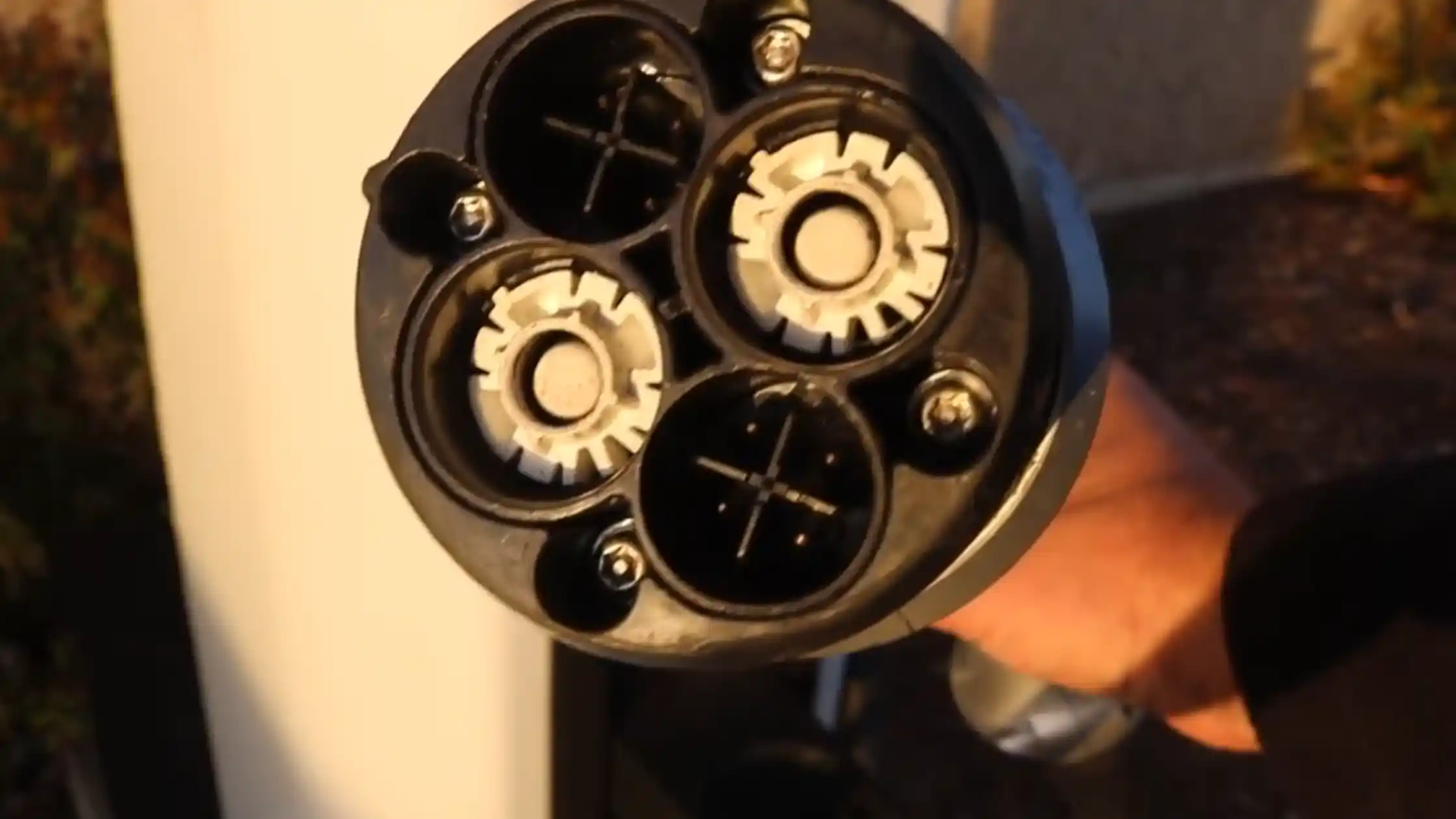
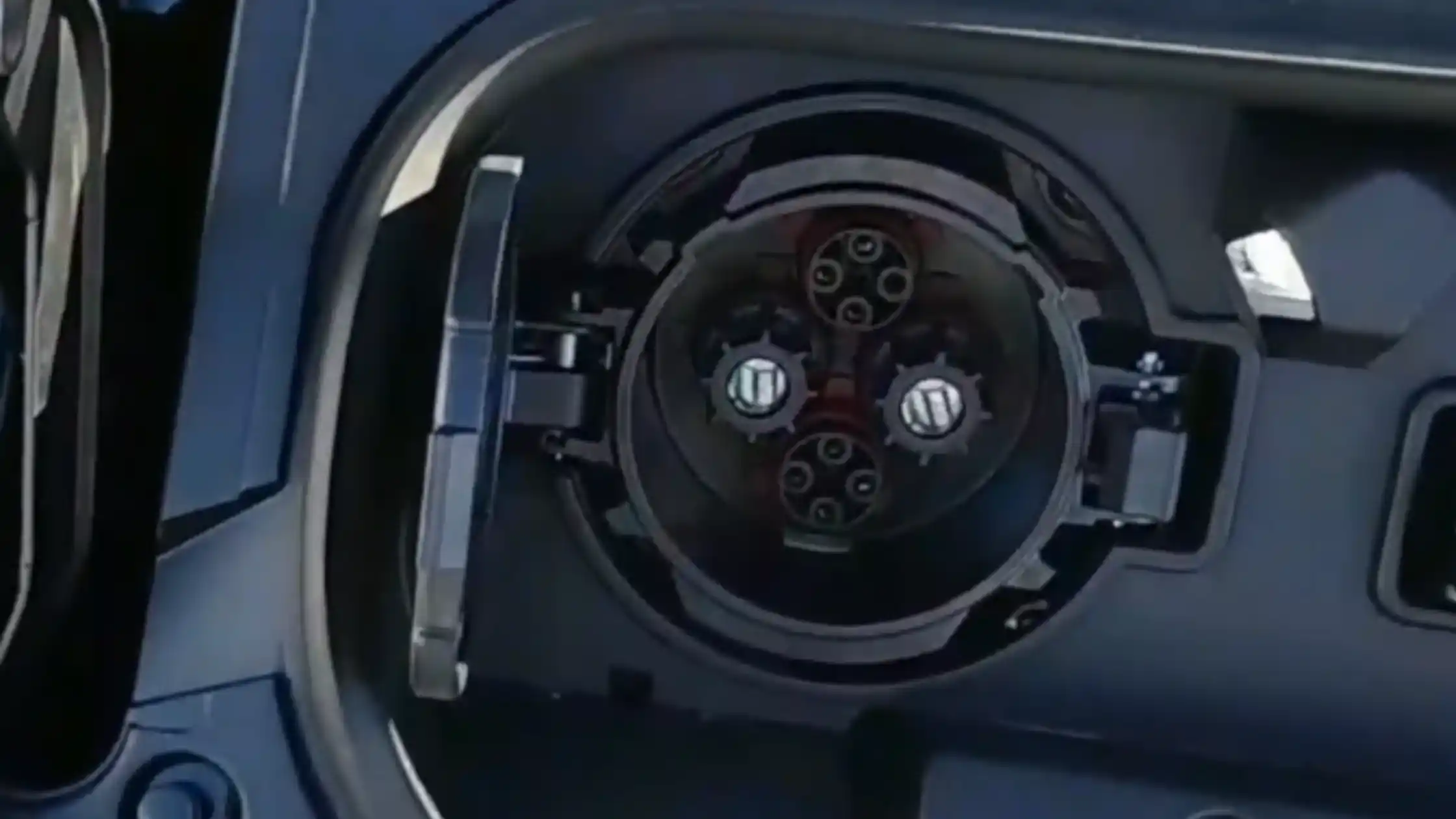
The CHAdeMO connector has ten pins in a unique layout that differs significantly from that of any other charging standard. The plug is also physically the largest connector you will find on any EV charger, which is the main reason drivers find it bulky and awkward to handle.
The Two DC Power Pins
Two large round pins carry the main DC current. One positive, one negative. Up to 400 amps in the latest revision, though most stations stay closer to 125 amps in practice.
The Signal Pins
CHAdeMO uses eight distinct signaling and grounding pins, which is more than any other standard. Two pins handle the CAN bus high and low data lines. Two more provide low-voltage power to wake the vehicle’s battery management system before the high-power session starts. The remaining pins handle confirmation signals that verify the cable is properly seated and grounded, as well as charge start and stop signaling.
All this complexity is the historical reason CHAdeMO can do something no other standard can. It supports true bidirectional charging out of the box. A CHAdeMO-equipped Nissan Leaf can power your house during a blackout, send energy back to the grid for utility credits, or charge another EV. This capability, called V2G or V2H, is the one area where CHAdeMO is still genuinely ahead of the competition.
Which Vehicles Use CHAdeMO
The list is much shorter than for the other standards. Almost everyone with a CHAdeMO port is driving a Nissan or a Mitsubishi.
| Brand | Models With CHAdeMO Port | Years |
| Nissan | Leaf (all generations) | 2011 to 2024 |
| Nissan | Ariya (very early Japan spec only) | Switched to CCS2 globally |
| Mitsubishi | i-MiEV | 2010 to 2017 |
| Mitsubishi | Outlander PHEV | 2014 to 2022 |
| Mitsubishi | Eclipse Cross PHEV | 2021 onward (Japan spec) |
| Kia | Soul EV (early generation only) | 2014 to 2019 |
| Toyota | Prius PHV (very early Japan spec only) | Limited |
| Subaru | Crosstrek Hybrid (Japan spec only) | Limited |
| Honda | Clarity Electric (Japan spec only) | Limited |
Where Working CHAdeMO Stations Still Exist
This is the question that matters most to current CHAdeMO drivers. The answer depends heavily on where you live and drive.
In urban California and the Pacific Northwest, CHAdeMO coverage is still surprisingly good. EVgo runs the largest CHAdeMO network in the country and has committed to keeping its existing stations operational through at least 2030. Most EVgo stations are dual-standard, with one CHAdeMO and one CCS1 cable on the same unit, so even as more drivers switch to CCS- or NACS-equipped cars, the CHAdeMO cable stays available.
In the Midwest and rural areas, CHAdeMO is fading faster. Many ChargePoint sites have removed CHAdeMO cables during equipment refreshes. Newer Electrify America stations were never built with CHAdeMO. The Tesla Supercharger network does not support CHAdeMO.
Always check PlugShare or A Better Route Planner before you depend on a station. Both apps let you filter by connector type, so you can see exactly which CHAdeMO stations are nearby and their recent uptime. User comments on PlugShare often catch broken stations before the network operators do.
Safety, Certifications, and Locking
CHAdeMO hardware sold worldwide meets the IEEE 2030.1.1 standard and is tested to handle the high voltages and currents involved. The connectors themselves carry IP54 or IP55 ratings for ingress protection. The thermal protection is built into the station, not the plug, because the standard predates the integrated sensors you find in modern NACS and CCS1 hardware.
The locking mechanism uses a manual mechanical slider on the connector handle. You press a button while plugging in, slide the lever forward, and the cable physically locks into the port. To unplug, you slide the lever back. There is no electronic actuator, and there is no failure mode in which the cable gets stuck due to a dead motor.
The downside is that the manual slider is exposed to dirt, snow, and ice. In winter, the slider can freeze and stop moving. The typical fix is to pour warm water over the lever or wait for ambient warmth to take effect. We have heard from drivers in cold climates that this is a real and recurring annoyance.
CHAdeMO Adapters and What Actually Works
The CHAdeMO-to-anything-else adapter story is messy because the protocol incompatibility runs deep. A passive mechanical adapter cannot translate between the CAN bus and PLC. You need a smart adapter with active electronics.
Tesla used to sell a CHAdeMO-to-NACS adapter for the early Model S and Model X. It is no longer in production, but it still appears on the used market for around 400 dollars. If you find one and need it, buy it, but verify your specific Tesla firmware version still supports the adapter.
Going the other direction, CHAdeMO-to-CCS1 adapters do not exist as practical products. The protocol translation is too complex, and the engineering costs are too high for the shrinking market. If you have a CHAdeMO car and pull up to a CCS1-only station, you cannot charge there. There is no consumer fix.
This is the real fade-out problem for CHAdeMO owners. As CCS1-only stations multiply and CHAdeMO stations age out, route planning gets harder every year.
Should You Buy a Used CHAdeMO EV in 2025?
With caveats, yes. A used Nissan Leaf from 2018 to 2022 with a healthy battery is one of the best value EVs on the market today. You can find them for under fifteen thousand dollars, they drive well, and the J1772 home charging works with any standard charger. The CHAdeMO port becomes a road trip limitation, not a daily one.
The math works if your daily commute fits within the Leaf’s range, you charge at home overnight, and you only need DC fast charging occasionally. For longer trips, plan around EVgo and ChargePoint CHAdeMO stations using PlugShare.
If you regularly need to fast-charge on routes with limited CHAdeMO coverage, consider a different used EV. A used Chevy Bolt with CCS1 is similarly cheap and has access to far more fast chargers.
Common CHAdeMO Problems and Practical Workarounds
Slider Lever Frozen Shut
Pour warm water over the slider mechanism on the plug. Wait two minutes. Try again. If you charge regularly in subfreezing weather, a small bottle of lock thaw fluid in your trunk solves this permanently.
Battery Will Not Accept Charge
Older Leafs have a known issue where the battery management system turns off fast charging if the internal temperature rises too high. After three sequential CHAdeMO sessions on a road trip, the third one may slow to a crawl or refuse to start. The fix is to wait 30 minutes or drive for an hour to let the battery cool before fast charging again.
CAN Bus Communication Error
Almost always a station problem, not a car problem. Try a different station. If it persists, your car’s onboard charge controller may need service.
How CHAdeMO Compares to Other EV Charger Plugs and Connectors
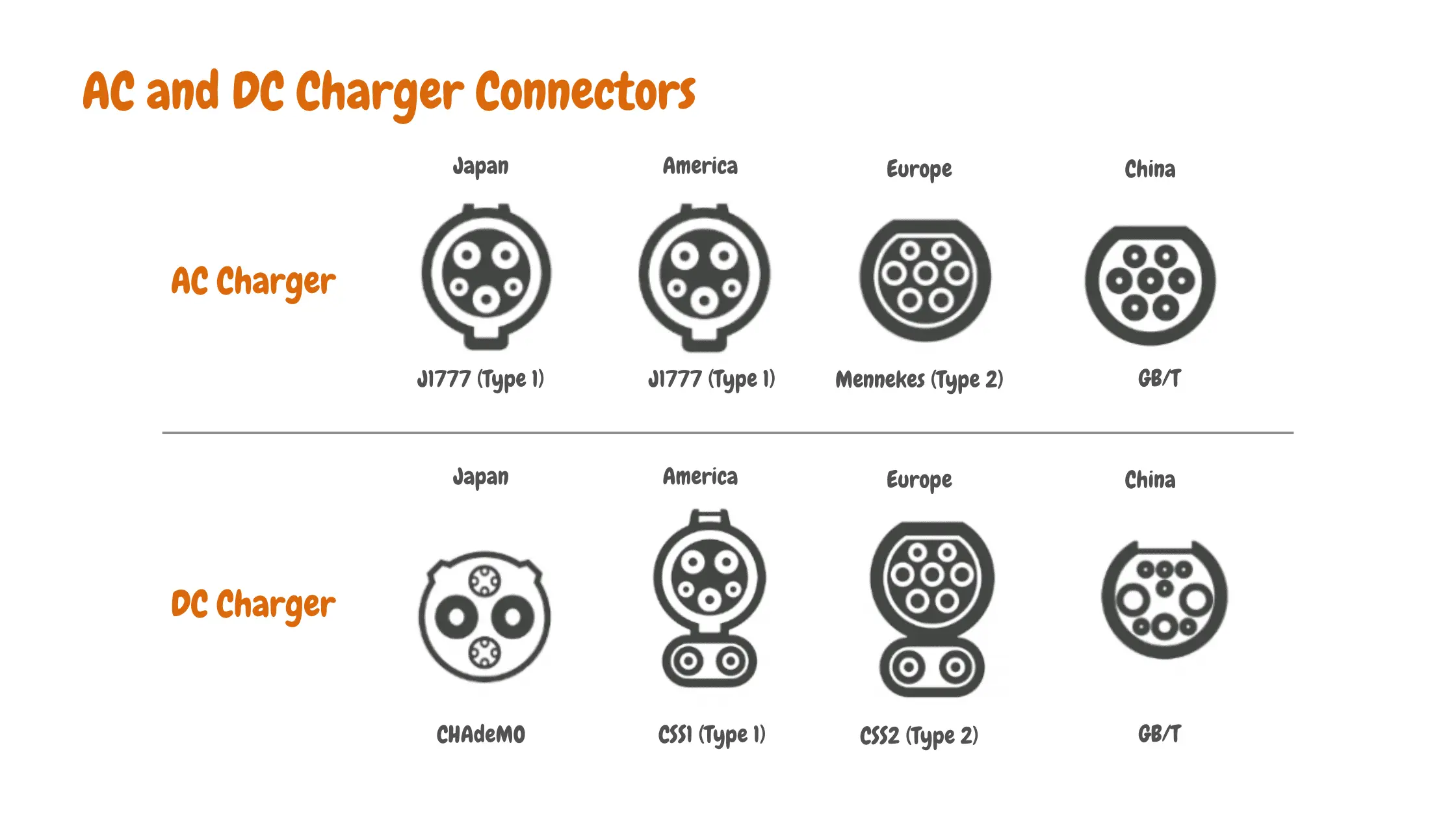
Here is how every major EV connector stacks up in terms of power, region, and use case. Use this table to see at a glance where this standard fits in the wider charging world.
| Connector | Region | Max AC Power | Max DC Power | Pin Count |
| NACS (J3400) | North America | 19.2 kW | 1,000 kW (theoretical) | 5 |
| CCS Combo 1 | North America | 19.2 kW | 360 kW | 7 |
| J1772 (Type 1) | North America, Japan | 19.2 kW | Not supported | 5 |
| Type 2 / CCS2 | Europe, Oceania | 43 kW (3 phase) | 360+ kW | 9 |
| CHAdeMO | Japan, legacy global | Not supported | 400 kW | 10 |
| GB/T | China | 27.7 kW | 237.5 kW (900 kW ChaoJi) | Dual port |
The Bottom Line on CHAdeMO
CHAdeMO is in slow decline, but it is not dead. If you own a CHAdeMO-equipped vehicle and you live in an area with EVgo coverage, you can keep driving the car for years without major changes to your habits. If you do not have good CHAdeMO coverage near you, plan your replacement vehicle carefully and start considering a CCS1 or NACS upgrade.
The V2H bidirectional capability is genuinely cool, and it’s the one feature CHAdeMO drivers shouldn’t give up easily. If grid resilience or backup power matters to you, a CHAdeMO Leaf with a Wallbox Quasar bidirectional charger remains the easiest way to power your house from your car today.

James Ndungu is a certified EV charger installer with over five years of experience in EVSE selection, permitting, and installation. He holds advanced credentials, including certification from the Electric Vehicle Infrastructure Training Program (EVITP) and specialized training in EV charging equipment and installation, as well as diplomas in EV Technology and Engineering Fundamentals of EVs. Since 2021, James has tested dozens of EV chargers and accessories, sharing expert insights into the latest EV charging technologies.